
Marine Outboard Engines: Complete Buyer’s Guide, Specs & Where to Buy

The phrase marine outboard engines covers a lot of ground. It includes everything from a 2.5 HP single-cylinder unit on a fishing dinghy to a pair of 300 HP V8s hanging off an offshore sportfisher. What they share is a self-contained design — powerhead, midsection, and lower unit built into one unit that clamps or bolts to the transom and can be removed without shipyard work.
That versatility is the core reason marine outboard engines dominate recreational and light commercial boating worldwide. You can swap them, upgrade them, tilt them out of the water when anchored, and service them without pulling the boat apart. For most boaters, an outboard is simply the practical choice.
At SH Continental Marine, we sell new marine outboard engines to customers across the globe. This guide covers how outboard technology works, what specs matter, which brands lead the market, and how to choose the right engine for your specific application.
How Marine Outboard Engines Work
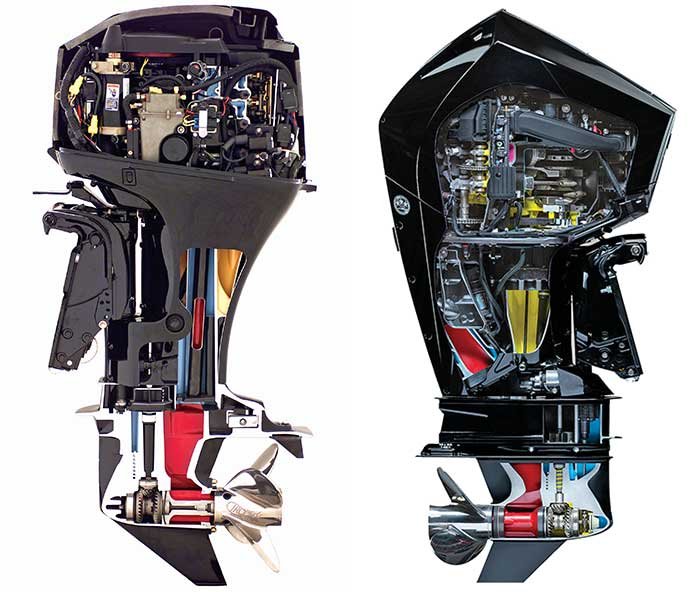
An outboard motor is a self-contained propulsion unit. The powerhead (engine) sits above the water line in a protective cowling. The driveshaft runs vertically through the midsection, turning 90 degrees at the gearcase (lower unit) to drive the horizontal propeller shaft.
Modern marine outboard engines are almost universally 4-stroke designs. The 4-stroke cycle draws in fuel and air, compresses it, ignites it, and expels exhaust — same as a car engine, just oriented vertically and cooled by water rather than air or a closed-loop radiator system. Water is drawn in through ports in the lower unit, circulates through the engine to manage heat, and exits through the exhaust system.
This water-cooling system is one reason outboard maintenance includes flushing with fresh water after saltwater use — salt buildup in the cooling passages causes long-term damage that can be largely prevented with proper flushing habits.
4-Stroke vs. 2-Stroke Marine Outboard Engines
The industry shifted from 2-stroke to 4-stroke dominance through the 2000s and 2010s, driven by emissions regulations and advances in 4-stroke engine technology. Here’s the honest comparison:
4-Stroke Marine Outboard Engines
- Better fuel economy across most operating conditions
- Quieter operation, especially at cruise
- Cleaner exhaust — no oil mixing required
- Standard engine oil like any car engine
- Generally heavier than equivalent 2-stroke
- More complex internally, requires proper service
2-Stroke Marine Outboard Engines
- Lighter weight for equivalent horsepower
- Simpler mechanical design
- Can be less expensive to purchase
- Higher power-to-weight ratio in older designs
- Higher emissions, banned in some waterways
- Requires oil mixing (unless direct injection)
For most buyers today, 4-stroke marine outboard engines are the right choice. If you have a specific need for 2-stroke — weight-critical applications, certain commercial uses, or markets where 2-stroke is still standard — contact us to discuss options.
Marine Outboard Engine Horsepower Guide
Choosing the right horsepower for your marine outboard engine comes down to your boat’s specifications and your intended use. Here’s a practical breakdown:
Under 10 HP
Portable marine outboard engines in this class cover tenders, inflatables, small aluminum boats, and kicker motors. The priority is weight and portability. Examples from our inventory include the Yamaha 8 HP F8LMHB and Yamaha 9.9 HP F9.9SMHB.
10 HP to 40 HP
This range covers small to medium fishing boats, utility craft, and pontoons in the 14-18 foot class. Strong fuel economy, good low-speed maneuverability. Popular marine outboard engines here include Tohatsu’s MFS20B through MFS40B and Yamaha’s portable-to-mid range.
40 HP to 90 HP
The workhorse range for center consoles, bay boats, and family runabouts in the 17-22 foot class. These marine outboard engines offer real performance without moving into the cost tier of large offshore motors. The Yamaha 60 HP T60LB, Yamaha 70 HP F70LA, and Yamaha 90 HP F90JB are strong options in this class.
90 HP to 150 HP
Serious fishing boats, twin-console boats, and larger center consoles in the 20-24 foot range. At this power level, you’re getting genuine offshore capability as a single engine and solid performance as part of a twin setup. The Yamaha 90 HP VF90LA V MAX SHO is a standout performer in this bracket.
150 HP to 300 HP+
Offshore-capable center consoles, express cruisers, and serious sportfishing boats. Twin and triple engine setups are common. These marine outboard engines are major purchases — contact us directly for availability, pricing, and shipping logistics on high-HP engines.
Key Specifications to Understand When Buying Marine Outboard Engines
When you’re shopping for marine outboard engines, specs matter. But some specs matter more than others. Here’s a guide to reading the numbers correctly:
Displacement
Measured in cc or liters, displacement is the total volume swept by the pistons. Larger displacement generally means more torque and better pulling power at lower RPM. It doesn’t always mean more horsepower — that depends on how the engine is tuned.
Bore x Stroke
The bore is the cylinder diameter; the stroke is how far the piston travels. A longer stroke generally favors low-end torque (better for pulling heavy loads). A shorter, wider bore tends to favor high-RPM power (better for speed).
Compression Ratio
Higher compression ratios generally produce more power and efficiency but require higher-octane fuel. Most modern 4-stroke marine outboard engines run on regular unleaded, though some high-performance models recommend premium.
RPM Range
This is the operating RPM band — minimum to maximum. Most 4-stroke outboards have a WOT (wide open throttle) range of 5000–6300 RPM. Cruising efficiently typically happens at 60-80% throttle.
Gear Ratio
The gearcase steps down the engine’s RPM to a practical propeller speed. A 2.33:1 ratio means the engine turns 2.33 times for every propeller rotation. Lower gear ratios suit high-pitch props and speed; higher ratios suit pulling and heavily-loaded boats.
Weight
Weight affects both performance and handling. Heavier engines at the transom affect boat trim and performance, particularly on smaller hulls. Always check that the combined weight of the engine and boat is within safe operational limits.
Popular Marine Outboard Engine Brands We Carry
Yamaha Marine Outboard Engines
Yamaha is the global market leader in outboard motors and has been for decades. Their engines are built to tight tolerances, backed by a worldwide parts and service network, and carry strong resale value. For buyers who prioritize having a well-supported engine anywhere in the world, Yamaha is hard to argue with.
We carry Yamaha marine outboard engines from 8 HP to 90+ HP in our standard inventory. Our popular Yamaha models include:
- Yamaha 8 HP F8SMHB
- Yamaha 9.9 HP T9.9XPB
- Yamaha 60 HP F60JB
- Yamaha 75 HP F75LB
- Yamaha 90 HP F90LB
- Yamaha 90 HP VF90LA V MAX SHO — our bestselling performance option
Tohatsu Marine Outboard Engines
Tohatsu has been manufacturing marine outboard engines since 1922. They’re the brand behind some Mercury and Nissan portable models, which tells you something about their engineering credibility. Tohatsu offers some of the lightest engines in their HP class, with a full range from 2.5 HP to 250 HP.
For buyers who want Japanese-engineered quality without the premium brand pricing, Tohatsu marine outboard engines are consistently the right answer. Their 5-year warranty on recreational models is one of the best in the industry.
Saltwater vs. Freshwater Use of Marine Outboard Engines
All modern marine outboard engines from reputable manufacturers are designed to handle both freshwater and saltwater. But saltwater is harder on equipment — period. Here’s what you need to know if you’re running in salt:
- Flush after every use — Run fresh water through the cooling system. Most larger outboards have a built-in flush port. Smaller ones have a hose adapter for the water pump intake. This removes salt before it can crystallize in cooling passages.
- Rinse the exterior — Salt spray sits on engine cowlings, clamps, and hardware. A rinse with fresh water and occasional protective spray goes a long way.
- Inspect anodes regularly — Sacrificial zinc anodes protect the aluminum gearcase and other components from galvanic corrosion. They need to be replaced when they’re 50% consumed — don’t let them wear away completely.
- Use corrosion-inhibiting sprays — Electrical connections, battery terminals, and exposed metal benefit from corrosion inhibitor sprays, especially in high-salt environments.
- Check impeller annually — The water pump impeller is a rubber part that can fail. Replacing it annually in saltwater use is cheap insurance against overheating.
Buying Marine Outboard Engines: New vs. Remanufactured vs. Used
This question comes up for anyone shopping marine outboard engines on a budget. Here’s the breakdown:
New engines are the cleanest option. You get a manufacturer warranty, zero hours, and no unknown history. That peace of mind has real value, especially if you’re planning to use the engine hard or in remote locations where service is difficult to access.
Remanufactured engines (rebuilt to manufacturer specs with replacement of worn parts) can offer good value if the reman is done properly by a reputable shop. Warranty coverage varies. Not all rebuilds are equal.
Used engines require due diligence. A compression test, gear oil check (milky oil = water intrusion = serious problem), visual inspection of the lower unit for impact damage, and a full water test are the minimum. Always ask for service records. Low hours with no documentation is a yellow flag, not a green one.
At SH Continental Marine, we sell new marine outboard engines only. No used inventory, no uncertainty.
Marine Outboard Engine Storage and Winterization
If you’re in a seasonal climate, proper storage keeps your marine outboard engine in shape for the next season. Key steps include:
- Fog the cylinders with fogging oil to prevent corrosion on internal surfaces
- Change the gear case oil before storage (not after — any water intrusion gets stored and causes damage)
- Stabilize the fuel or run the carb dry (EFI engines are less sensitive to fuel degradation but stabilizer is still recommended)
- Flush the cooling system thoroughly
- Remove and charge the battery separately
- Store upright or per manufacturer instructions — never stored on its side
These steps take a couple of hours but prevent the kind of damage that turns a $50 problem into a $500 service bill.
Marine Outboard Engine Maintenance Schedule
Sticking to a maintenance schedule is the single most effective thing you can do to extend the life of any marine outboard engine. Here’s a general framework:
Every use: Check engine oil, check for fuel or oil leaks, inspect propeller for damage, flush after saltwater use.
Every 100 hours or annually: Change engine oil and filter, inspect and replace spark plugs as needed, check fuel filters, inspect fuel lines, check battery terminals and connections, inspect zincs/anodes.
Every 200 hours or every 2 years: Change gear case oil, replace water pump impeller, inspect throttle and shift cables, full inspection of all fasteners and mounts.
Follow the manufacturer-specific service schedule in your owner’s manual for the most accurate guidance. Most marine outboard engine issues that show up in service are the result of deferred maintenance rather than inherent defects.
Ordering Marine Outboard Engines From SH Continental Marine
We supply marine outboard engines to customers in North America, Europe, Asia, Africa, South America, the Middle East, and island nations worldwide. Whether you’re a private buyer replacing a motor on a fishing boat or a commercial operator outfitting a fleet, we can help.
Our process is simple: contact us with your engine requirements (brand, model, HP, shaft length, quantity), and we’ll confirm availability, pricing, and shipping options to your location. We work with experienced freight forwarders for oversized and hazardous goods shipping, so we can reach most destinations in the world.
Browse our current marine outboard engine inventory, or read our guide on boat engines for sale if you want more help with selection. You can also explore our specific Tohatsu outboard motors guide for the full breakdown on that brand.
For global marine industry standards and specifications, the International Council of Marine Industry Associations is the reference body, and the National Marine Manufacturers Association sets the benchmark for the North American market. Both are useful resources for understanding engine certification and compliance requirements in different regions.
Ready to buy? Let’s find the right engine for you.
Posts Widget
- 1
- 2

- 3

- 4


S.H Continental Marine
USA HERALD MAGAZINE INC
Our team is dedicated to providing exceptional customer service.
Email: info@shcontinentalmarine.com
Choose S.H Continental Marine
for your outboard engine needs and enjoy superior quality, exceptional customer service, and unbeatable prices.
