
Evinrude ETEC Outboard: Full Specs and Buying Guide

If you’ve spent any time shopping for an Evinrude ETEC outboard, you’ve probably noticed the conversation around these engines is different from the usual four-stroke sales pitch. People who want an Evinrude ETEC outboard tend to already know why they want one — the direct injection, the light weight, the punch off the line. We keep a rotating stock of E-TEC engines across the horsepower range and ship them out to customers on pretty much every continent, so this guide covers what the platform actually is, what to expect spec-wise, and how to pick the right one for your boat.
What “E-TEC” Actually Means
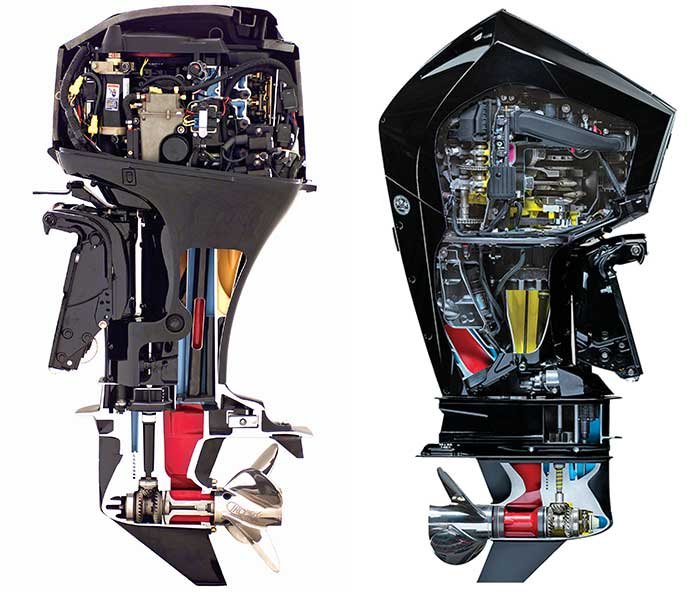
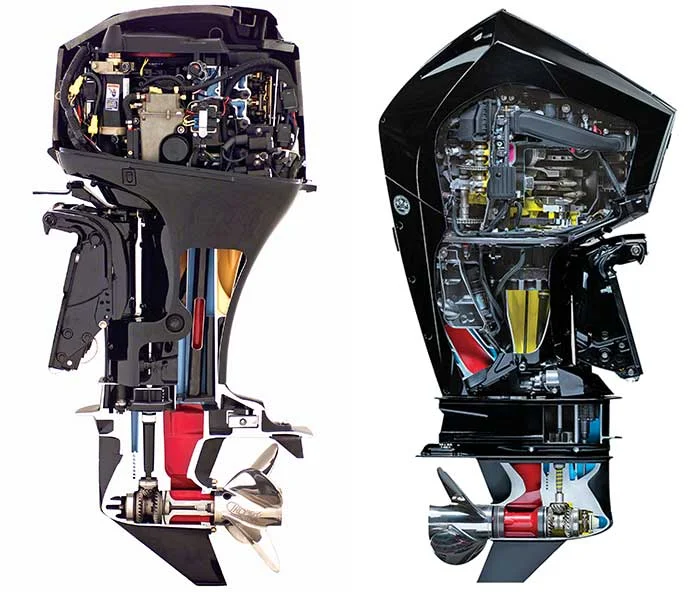
E-TEC stands for Evinrude’s direct-injection two-stroke system, and it’s the reason an Evinrude ETEC outboard doesn’t behave like the smoky, oil-mixing two-strokes a lot of older boaters remember. Instead of pre-mixing fuel and oil in a carburetor, E-TEC injects fuel straight into the combustion chamber at high pressure, with oil delivered separately through an automatic injection system. You fill a reservoir, the engine meters what it needs based on load and RPM, and you never touch a mixing can.
That single change fixes most of what people dislike about two-strokes. Fuel consumption drops because there’s no fuel escaping unburned during the scavenging cycle. Smoke and smell mostly disappear. And because combustion is cleaner and more controlled, an Evinrude ETEC outboard can go far longer between scheduled dealer visits than a typical four-stroke — some models are rated for three years or 300 hours before their first major service.
Evinrude ETEC Outboard Specifications Across the Range
The E-TEC lineup covers a wide horsepower spread, and specs shift quite a bit depending on where you land in that range. Here’s a general breakdown of what to expect:
| Spec | Typical Value |
|---|---|
| Horsepower range | 15 HP to 300 HP (G2 platform on the largest models) |
| Engine configuration | 1, 2, 3, 4, or 6-cylinder depending on horsepower |
| Fuel system | E-TEC direct injection |
| Oil system | Automatic oil injection, no premixing |
| Starting | Electric or manual depending on model |
| Shaft lengths | 15″, 20″, and 25″ |
| Service interval | Up to 300 hours / 3 years on many models |
| Emissions | CARB 3-Star rated |
| Recommended fuel | 87 to 91 octane unleaded (never above 91 on most models) |
At the smaller end, a 30 HP Evinrude ETEC outboard runs a single-cylinder or twin-cylinder powerhead around 432cc and weighs roughly 61 kg (134 lb), light enough that two people can move it without a hoist. Step up to the 90 HP range and you’re looking at a 1,298cc V4 pushing around 148 kg (327 lb), with a 60-amp alternator that handles a boat loaded with electronics without breaking a sweat. At the top of the range, the E-TEC G2 platform covers 150 HP up to 300 HP with V6 configurations and integrated steering and throttle-by-wire options that weren’t available on the earlier G1 engines.
Why Buyers Choose an Evinrude ETEC Outboard Over a Four-Stroke
The honest pitch here isn’t that E-TEC beats every four-stroke on every metric — it doesn’t. What it does is win decisively on a few things that matter a lot to a specific type of buyer.
- Weight. Two-strokes have always been lighter than four-strokes of equivalent horsepower, and E-TEC keeps that advantage while cleaning up everything else. On a pontoon or an aluminum jon boat, 20 to 30 kg less on the transom changes how the boat trailers, how it sits at rest, and how quickly it comes up on plane.
- Hole shot. Two-stroke torque delivery is more immediate than a four-stroke’s, and testers consistently clock faster times to plane on an Evinrude ETEC outboard compared to four-stroke competitors at the same horsepower.
- Simpler maintenance routine. No oil and filter changes, no valve adjustments. Just oil reservoir top-offs, spark plugs, and the usual water pump and gearcase checks.
- Price relative to performance. Since Evinrude stopped building new engines in 2020, used and reconditioned E-TEC units often sell for meaningfully less than a comparable four-stroke, without giving up much in the way of actual capability.
Where a four-stroke still wins is idle smoothness, long-term factory backing from an active manufacturer, and (for the biggest engines) outright fuel economy at cruise. If those matter more to you than weight and acceleration, a four-stroke is probably the better call. If they don’t, an Evinrude ETEC outboard is genuinely hard to beat for the money.
The Discontinuation, and What It Means for You
BRP stopped producing new Evinrude engines in May 2020. That’s not a secret and we’re not going to pretend otherwise — but it also doesn’t make an Evinrude ETEC outboard a bad purchase. It means you’re buying the final, most refined version of a platform that had two decades of development behind it, rather than a model that’s still being iterated on.
Parts support continues through BRP’s licensed aftermarket channels, and common wear items — impellers, spark plugs, fuel filters, gaskets — remain easy to source. Less common electronic components can take longer to track down, which is worth knowing before you buy, especially if you’re in a remote market. We can tell you honestly what parts availability looks like for the specific model and region you’re buying into, rather than just taking your money and letting you find out later.
Direct Injection in Practice: What You’ll Actually Notice
If your last experience with a two-stroke was a carbureted engine from the 1990s, an Evinrude ETEC outboard is going to surprise you. Idle is smoother thanks to a stratified low-RPM combustion mode that changes fuel delivery specifically for trolling and idle conditions. Cold starts are reliable because the injection system meters fuel precisely regardless of temperature. And because the engine management runs off an under-flywheel alternator rather than needing a big external battery the way some competing direct-injection systems do, most E-TEC models can be rope-started if your battery dies out on the water.
Fuel economy at cruise holds up better than people expect from a two-stroke. On a 90 HP E-TEC running around 3,500 RPM, owners routinely report fuel burn numbers that are competitive with four-stroke equivalents, not just “acceptable for a two-stroke.”
Choosing the Right Evinrude ETEC Outboard for Your Boat
Matching horsepower and configuration to your hull matters more than people think. A few starting points:
- Pontoons and tritoons generally do best in the 60 to 150 HP range, where the weight savings over a four-stroke has the biggest practical impact on how the boat handles.
- Aluminum fishing boats and jon boats often pair with the 30 to 90 HP range, depending on hull size and how much gear you typically carry.
- Bass boats and performance hulls tend to land in the 150 to 300 HP G2 range, where throttle-by-wire and integrated steering options come into play.
- Repower projects on a hull originally rigged for a lighter two-stroke are usually better served staying with an Evinrude ETEC outboard rather than switching to a heavier four-stroke, since the extra weight can throw off the boat’s balance and trim characteristics.
Shaft length is the other detail people get wrong most often. Measure your transom height before ordering — a 20″ engine on a boat that needs 25″ (or vice versa) is a much bigger headache to fix after delivery than it is to get right up front. If you’re not sure, send us your boat’s make, model, and transom height and we’ll confirm the correct configuration before you order.
Fuel, Oil, and Basic Care
Run 87 to 91 octane unleaded fuel through your Evinrude ETEC outboard. On most models, avoid anything above 91 octane — higher-octane fuel can strip lubricating oil from the cylinder walls on a direct-injection two-stroke, which defeats the purpose of the automatic oil injection system. On the oil side, use Evinrude’s XD100 synthetic for most use, or XD50 if you’re doing a lot of extended trolling. The oil injection ratio varies automatically from a rich mix at wide-open throttle to a much leaner mix at trolling speed, so there’s no guesswork on your end — just keep the reservoir filled with the right oil.
Beyond that, routine care on an Evinrude ETEC outboard is genuinely light: spark plug replacement on schedule, water pump impeller inspection roughly annually or every 100 hours, gear oil service in the lower unit, and a flush with fresh water after any saltwater use. Compared to a four-stroke’s oil-change schedule and valve maintenance, it’s a lot less to think about over a season.
Evinrude ETEC Outboard vs. Yamaha and Suzuki Four-Strokes
People shopping for an Evinrude ETEC outboard almost always cross-shop it against a Yamaha or Suzuki four-stroke in the same horsepower bracket, so it’s worth laying out the honest comparison rather than dodging it.
Yamaha and Suzuki four-strokes generally win on idle smoothness, quietness, and long-term factory parts support from an active manufacturer that’s still building new engines every year. If you’re running a boat where passengers sit close to the transom, or you spend a lot of time idling around no-wake zones, the refinement of a modern four-stroke is noticeable.
Where the Evinrude ETEC outboard pulls ahead is weight and acceleration. A four-stroke 90 HP engine from either brand typically weighs 15 to 30 kg more than the equivalent E-TEC, and that difference shows up directly in hole shot and how the boat sits on the water. It also tends to show up in your wallet — a well-reconditioned E-TEC usually costs less upfront than a comparable new four-stroke, sometimes by a wide margin, since production ended and used units are priced accordingly.
Neither answer is universally “right.” Buyers who prioritize acquisition cost, weight, and torque tend to pick E-TEC. Buyers who prioritize long-term dealer support and idle refinement tend to pick a current four-stroke. We sell both categories of engine and we’ll tell you honestly which one fits your situation instead of steering you toward whichever one we happen to have more of in stock that week.
Storage and Off-Season Care
An Evinrude ETEC outboard is genuinely easier to winterize than most engines on the market, mainly because the fuel system doesn’t need the same fogging and stabilizer routine a carbureted two-stroke requires. Run the engine on muffs or in a test tank until it reaches operating temperature, drain the fuel-water separator if equipped, and top off the oil reservoir before storage. E-TEC’s self-winterizing feature on many models automatically primes the cylinders with oil during shutdown when the engine detects it’s being stored, which is one less manual step compared to older two-strokes or most four-strokes.
If you’re storing the engine for an extended period in a cold climate, tilt it down fully to let any residual water drain from the water pump housing, and disconnect the battery if the boat won’t be run for several months. None of this is unusual outboard care, but the E-TEC platform makes a few of these steps simpler than the alternative.
What Owners Actually Say
The feedback we hear most consistently from customers who’ve run an Evinrude ETEC outboard for a full season falls into a few recurring themes. Pontoon owners talk about how much lighter the boat feels at rest and how much quicker it comes up on plane compared to the four-stroke it replaced. Aluminum boat owners mention trailering balance — less weight on the transom changes how the trailer tracks, which matters more than people expect until they experience it. And almost everyone who switched from an older carbureted two-stroke comments on how little smoke and smell there is compared to what they remember.
The complaints we hear are almost always about parts lead time on less common electronic components, which circles back to something we’re upfront about from the start: confirm parts availability for your specific model before you buy, and buy from someone who will tell you the truth about it rather than promising you it’s a non-issue.
What We Stock
Our current Evinrude ETEC outboard inventory spans small tiller engines up through the larger V4 and V6 configurations, both new-old-stock units that were never activated and reconditioned used engines that have been through compression testing, gearcase inspection, and a live tank run before listing. Every used unit we sell gets tested, not just wiped down and photographed. We can point you toward the Evinrude 90 HP E90SNL if you need a straight-shaft mid-range engine, or the Evinrude 30 HP E-TEC long shaft if you’re repowering something smaller.
Financing, Fleets, and Bulk Orders
We work with dealers, rental fleets, and charter operators who need multiple units of the same Evinrude ETEC outboard configuration. If you’re outfitting a fleet of similar hulls, tell us the quantity and timeline and we’ll work out volume pricing along with a consolidated shipping plan so freight costs stay reasonable per unit rather than getting charged out individually.
Worldwide Shipping
Every Evinrude ETEC outboard we sell ships internationally, crated and insured, with export documentation handled on our end. Most orders move by sea freight for cost efficiency, with air freight available if you’re on a tighter timeline. We’ve shipped these engines to customers across North America, Europe, the Middle East, Southeast Asia, and beyond, and we handle the paperwork so you don’t have to figure out customs classifications yourself.
Common Questions About the Evinrude ETEC Outboard
Is E-TEC still supported with parts?
Yes. Common service parts remain available through BRP’s licensed aftermarket network even though production ended in 2020. Less common electronic parts can take longer to source depending on your region.
Do I need to mix oil and fuel?
No. Automatic oil injection handles this for you — just keep the reservoir topped up with the correct oil grade.
How does fuel economy compare to a four-stroke?
Competitive at cruise speed thanks to direct injection, though a well-tuned four-stroke can edge it out at idle and low-RPM trolling.
What’s the difference between the standard E-TEC and E-TEC G2?
G2 is the newer platform used on 150 HP and up, with integrated steering, throttle-by-wire options, and some additional refinements over the original G1 design used on smaller horsepower models.
Do you ship internationally?
Yes, we export worldwide with both sea and air freight options depending on your timeline.
Can an Evinrude ETEC outboard run on 87 octane fuel?
Yes, on most models 87 octane is the minimum recommendation, with up to 91 octane acceptable. Avoid running fuel above the recommended range, since it can strip lubrication from the cylinder walls on this direct-injection design.
How long does a well-maintained E-TEC last?
Properly maintained units regularly reach several thousand hours of service life. The platform was engineered specifically for longevity, and the long factory service intervals reflected genuinely reduced wear compared to older two-stroke and even some four-stroke designs.
Is a used Evinrude ETEC outboard a safe purchase?
It can be, provided the unit has been properly tested before sale. Ask for a compression test result, confirm the gearcase has been serviced, and check when the water pump impeller was last replaced — that’s the most common failure point on an engine that’s sat unused for a while.
Ready to Order Your Evinrude ETEC Outboard
If light weight, strong low-end torque, and proven two-stroke reliability matter more to you than the extra smoothness of a four-stroke, an Evinrude ETEC outboard remains one of the smartest buys in the outboard market, especially at current pricing relative to comparable four-stroke engines. Get in touch and tell us your boat’s horsepower rating, transom height, and typical use, and we’ll help you land on the right configuration rather than just pointing you at whatever’s easiest to ship. You can also browse our broader outboard motor buying guides if you’re still weighing E-TEC against other brands.
For background on the underlying E-TEC engineering and BRP’s current parts and service network, BRP’s official site maintains documentation on the platform.
Posts Widget
- 1

- 2

- 3

- 4


S.H Continental Marine
USA HERALD MAGAZINE INC
Our team is dedicated to providing exceptional customer service.
Email: info@shcontinentalmarine.com
Choose S.H Continental Marine
for your outboard engine needs and enjoy superior quality, exceptional customer service, and unbeatable prices.
