
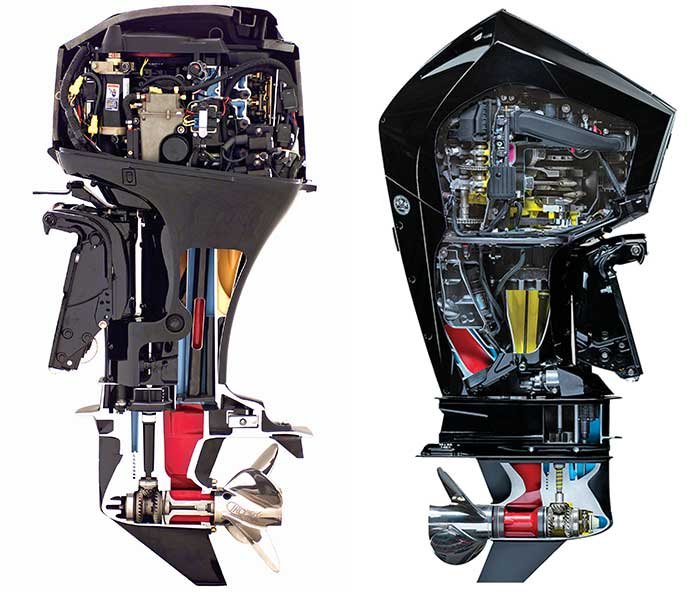
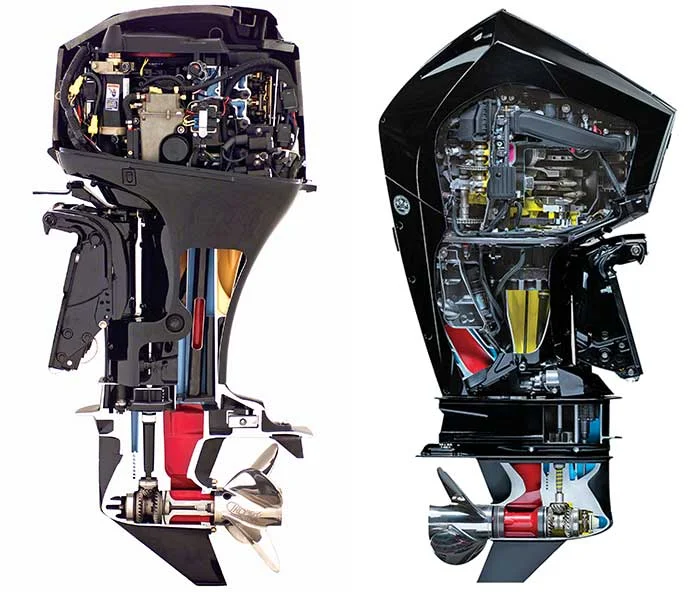
4-Stroke vs 2-Stroke Suzuki Outboards – Suzuki 4 stroke outboard

4-Stroke vs 2-Stroke Suzuki Outboards – Why Suzuki 4-Stroke?
The choice of what to power your boat with is an important one. We’re proud to be an official re-seller of authentic Suzuki outboard motors to the worldwide market, and in this article here we’re going to outline the principal differences between Suzuki’s 2-stroke and 4-stroke outboard ranges — so you’ll know why a Suzuki 4-stroke could be the optimal decision for long-term dependability, economy and power. Suzuki 4 stroke outboard
Why Suzuki Outboard Engines
Suzuki has gained international recognition for innovation, efficiency, reliability and international back-up service support for marine outboards. Its 4-stroke line includes state-of-the-art fuel-injection, lean-burn technology, anti-corrosion treatment and design for recreational or commercial use. It offers an international dealer and service station, spares stock and after-sale customer service all over the world.
By selling them to you directly, we offer you the convenience of Suzuki’s finest power, backed by our shipping, service brokering and inventory — so you can buy with confidence wherever you are.
2-Stroke vs 4-Stroke in Outboards: The Basics
We’re proud of what we make at Suzuki, but let’s step back to the basics of what “2-stroke” and “4-stroke” in outboards actually is, and why we care.
What is a 2-Stroke Outboard?
A 2-stroke (two-stroke) outboard engine operates using two piston strokes (one revolution of the crankshaft). Generally:
- Intake and exhaust in overlapping phases.
- Lighter mechanical construction overall – no valves, conventionally carburettor-powered in older boats.
- Lighter conventionally to construct power, and powerful “punch” of acceleration.
But: greater emissions (due to oil-injection or oil-fuel mixture), greater fuel consumption in most operating conditions, greater maintenance, and perhaps doesn’t comply with today’s emission standards.
What is a 4-Stroke Outboard?
A 4-stroke engine completes its cycle (intake, compression, power, exhaust) on four piston strokes and two crankshaft revolutions. Advantages are:
- Cleaner combustion (especially with newer fuel-injection and lean-burn technology).
- Better fuel efficiency in most conditions.
- Quieter operation and smoother operation overall.
- Typically heavier, slightly more mechanically complex, but conceivably longer-lived.
- Meets current emissions regulations and export to foreign markets.
Why It Matters
2-stroke vs. 4-stroke choice affects:
- Fuel efficiency and operating expense.
- Environmental regulatory compliance (foreign).
- Maintenance schedule and availability of replacement parts.
- Utility to your boat usage (light vs heavy, frequency, salt-water vs fresh water, etc.).
- Resale value — 4-stroke engines easier to resell in most markets today.
Suzuki 4-Stroke Outboards — Standout Models & Features
Here we showcase some of Suzuki’s best 4-stroke outboards — all available through our global distribution network. These models show the technology, power and reliability which have made Suzuki 4-stroke motors so successful.
Model: DF60A
- Type: DOHC 12-valve, 3-cylinder.
- Displacement: 941 cc (57.4 cu in)
- Maximum power: 60 HP in the above model.
- Operating range: ~5,300-6,300 rpm.
- Weight: ~229 lbs (approx 104 kg) for L-shaft.
- Features: Multi-point sequential electronic fuel injection, Lean Burn Control System, optional Troll Mode, compact and fuel-efficient design.
- Why this matters: For a small-to-mid size boat, the DF60A gives high performance with Suzuki’s modern 4-stroke technology and efficient fuel burn.
Model: DF50A
- Engine Type: DOHC 12-valve, 3-cylinder.
- Displacement: same 941 cc for the majority of variants.
- Maximum horsepower: 50 HP.
- Weight: ~229 lbs (L-shaft)
- Features: Anti-corrosion coating, built to last and endure, fuel injected, high-tech engineering.
- Why it matters: Great choice for medium range boats, pleasure boats or fishing boats where fuel efficiency and dependability are key.
Model: DF40A
- Engine Type: DOHC 12-valve, 3-cylinder.
- Displacement: 941 cc.
- Maximum horsepower: 40 HP.
- Weight: apx. 229 lbs (L-shaft) in some markets.
- Features: Digital sequential electronic fuel injection for smooth takeoff, remote or tiller steer option.
- Best reason it’s the best: Best choice for small boats or where fuel economy and new features are a concern.
Model: DF115 (115 HP)
- Type: DOHC 16-valve, 4-cylinder in-line.
- Displacement: apx. 2,045 cc (124.7 cu in) on a specific spec sheet.
- Maximum power: ~115 HP.
- Operating range: ~5,000-6,000 rpm.
- Weight: Example quoted 188 kg for L version, 192 kg for X version.
- Description: Mechanical simplicity with fuel-injection, lean burn, high performance for big rigs.
- Why it matters: For bigger boats needing serious torque and horsepower, but supported by Suzuki 4-stroke technology.
Global Availability & Support
Suzuki’s model range offers global models and broad displacement ranges from small 4 HP to 300+ HP.
What this does is that when you purchase a Suzuki 4-stroke outboard from us, you are getting the worldwide reach of an engine maker, parts availability and service network — perfect for shipping to and equipping foreign locations.
Suzuki 2-Stroke Outboards – Older Models & Technical Data
Even though 4-strokes dominate modern markets, there are still good reasons some boaters choose 2-stroke models — especially for cost, simplicity or certain legacy setups. Here are Suzuki’s 2-stroke offerings and how they compare.
Example: DT15A (15 HP)
- Engine Type: 2-Stroke, 2-cylinder.
- Displacement: 284 cc.
- Maximum output: 15 HP (11 kW).
- Weight: ~33 kg for short shaft.
- Starting system: Manual start for many smaller units.
- Why it’s convenient: Extremely light and portable — perfect for small boats, spares or tenders.
Example: DT30L (30 HP)
- Type: 2-Stroke, 2-cylinder.
- Displacement: 499 cm³.
- Max. power: 30 HP.
- Weight: ~52-54 kg depending on shaft length.
- Why it’s convenient: For bigger small boats, still low cost and low maintenance.
Why Buy a 2-Stroke Suzuki?
- Lower purchase price than some 4-stroke models.
- Fewer parts (on most entry models) result in easier maintenance in a number of ways.
- Light weight, thus easier to install on small vessels, tenders, or vintage hulls.
- If you already have a vessel that has a fitting compatible with a 2-stroke, it will be simpler to install.
Disadvantages of 2-Strokes These Days
- More difficult to meet present day emission regulations in most countries — this restricts new model availability and can affect resale or import.
- Generally more fuel-hungry and less efficient than similar 4-stroke counterparts.
- Generally noisier, possibly less refined to drive.
- International parts/service support for older 2-strokes will be less available.
Side-By-Side: 4-Stroke vs 2-Stroke Suzuki — What’s Best for You?
Here is a comparison chart so you can determine which of the two engine technologies is best for your boat, budget and use.
| Feature | Suzuki 4-Stroke | Suzuki 2-Stroke |
|---|---|---|
| Fuel Efficiency | High (because of lean burn, fuel-injection) | Generally lower |
| Emissions / Environmental | New 4-stroke has compliance with the majority of global regulations | Elder 2-stroke will find it difficult to comply with emissions rules |
| Noise & Vibration | Less noise and vibration | Greater likelihood of noise and vibration |
| Maintenance | Slightly more sophisticated (fuel-injection, valves) but longer maintenance intervals | Less complex design but more regular servicing |
| Weight | Heavier to provide equal power output | Lighter overall |
| Initial cost | Increased initial cost | Lower cost on lower vessels |
| Suitability | Best for global use, new vessels, commercial operation, large vessels | Better for smaller boats, tenders, older units |
| Parts & service | World-class coverage for new models | Limited for older models |
| Resale value | Higher resale demand | Lower resale desirability |
Recommended by Use-Case
- Recreational boat, heavy usage, global cruising or saltwater use → use a 4-stroke Suzuki.
- Small boat, low usage, used boat or limited finances → use a 2-stroke Suzuki.
- Heavy use or commercial (fishing, charter boat, heavy load) → choose a 4-stroke Suzuki with added HP, luxury, and durability.
Why We Support Trading in Suzuki 4-Stroke Engines
Since we ship the engines to foreign customers, the reasons listed below are the most valid arguments for why we trade in Suzuki 4-stroke models:
- Market demand: 4-strokes are the standard on new boats and refits.
- Global compatibility & compliance: Lower-emission engines are required for international exports.
- Long-term value: Boaters value longevity and reliability.
- Brand reputation: Suzuki’s engineering is trusted globally.
- Parts & service: Ongoing Suzuki support ensures full after-sales coverage.
Welcoming a customer into the world of Suzuki 4-stroke outboard, we emphasize:
“This is not an engine, but a global marine solution you can count on wherever you boat.”
Choosing the Right Model & Spec for Your Hull
Selecting the appropriate outboard motor is not just stroke-type and model — you must select an engine proper for your transom height, hull, boat weight, pattern of use and desired performance. This is how you determine the proper match with Suzuki outboards:
1. Calculate Required Power (HP)
Double check your manual or plate: usually there is a recommended HP range. Repowering an old boat? Use same HP or slightly more if your application demands faster speed or load.
2. Shaft Length & Transom Height
Ensure the engine is suited to your transom height (e.g., “L” 20″, “X” 25″). Most Suzuki models specify recommended transom heights.
3. Boat Load & Usage
If you tow heavy loads, operate in saltwater, or use the boat often — go 4-stroke. For light, occasional use — a 2-stroke will do.
4. Fuel & Maintenance Considerations
Check fuel quality, service availability, and spare parts. In most regions, 4-stroke fuel-injected engines are more economical over time.
5. Dealer Network and Service
Ensure an authorised Suzuki service station or that we can ship parts quickly to your location.
6. Resale & Future Value
4-stroke engines retain greater resale value because of efficiency and compliance with regulations.
Case Scenario: Suzuki DF50A vs. 2-Stroke Alternative
You have a 5-metre day boat, three adults for offshore cruising, and want a heavy-duty fit with medium performance and moderate fuel economy.
- Suzuki DF50A (50 HP, 4-stroke): fuel injection, lean-burn efficiency, anti-corrosion coating, mid-range torque.
- Older Suzuki 2-stroke 50 HP: lighter and cheaper initially, but higher fuel use, emissions, fewer spares, and limited support.
✅ Recommendation: DF50A 4-stroke — for reduced running cost, smoother performance, and higher resale value.
Practical Buying Tips & What to Ask When You Buy
Since you’re not buying from us for export shipment purposes, the following practical tips will assist you in buying the correct Suzuki outboard:
- Verify model number (DF50A, DF115, DT15A) and new or ex-demo.
- Request complete spec sheet (we can provide).
- Check warranty (3–5 years typical).
- Confirm import/export duties.
- Request transom and installation kit info.
- Ask for recommended propeller size (e.g., DF40A: 9–17 inch pitch).
- Ensure engine certification for your region’s emission laws.
Conclusion
When selecting an outboard motor for your boat, the distinction between 2-stroke and 4-stroke is real — and making the right selection can affect your boat’s performance, operating expense, comfort, and resale.
In our line of Suzuki outboards world-wide, we strongly advise a new Suzuki 4-stroke unless your specific application calls for a lightweight, compact 2-stroke. Due to Suzuki’s anti-corrosion treatments, lean-burn technology, fuel injection, and world-wide extensive service network, a Suzuki 4-stroke is an active, smart investment.
We’re here to provide you with the engine, logistics support, and help you select the correct Suzuki model for your boat and application. Quote, availability, installation support and shipping internationally to you from us.
Thank you for looking at our Suzuki outboard motors. We’ll be happy to help you power your boat with confidence anywhere in the world.
Yamaha 300HP Outboard Review: Built for Speed and Strength – Yamaha 300HP outboard for sale
Electric vs Gas Outboard Motors: Pros, Cons & Which is Right for You
Posts Widget
- 1

- 2

- 3

- 4


S.H Continental Marine
USA HERALD MAGAZINE INC
Our team is dedicated to providing exceptional customer service.
Email: info@shcontinentalmarine.com
Choose S.H Continental Marine
for your outboard engine needs and enjoy superior quality, exceptional customer service, and unbeatable prices.
