
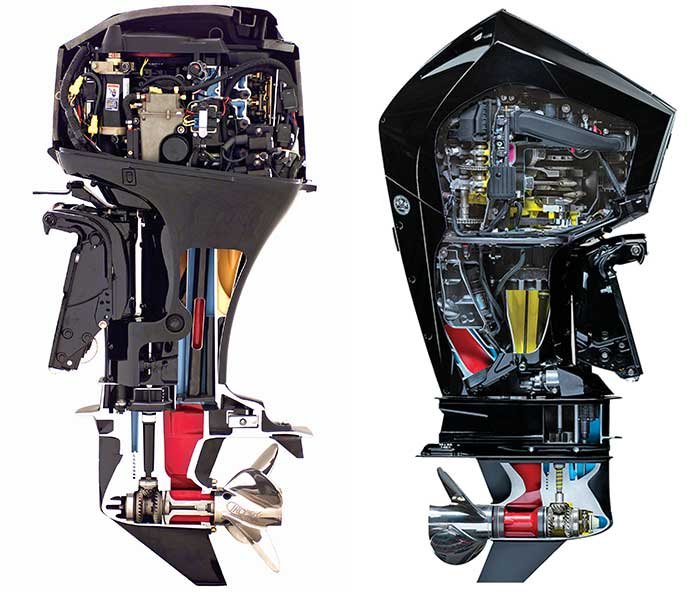
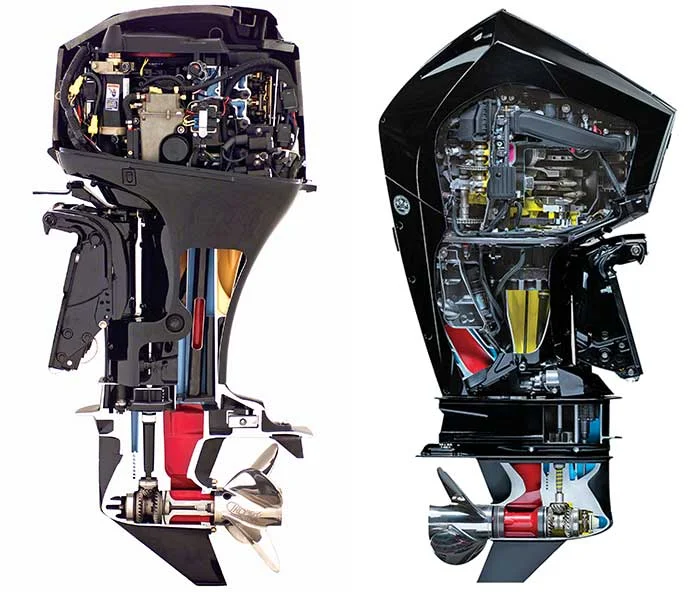
Marine Power Engines: Understanding Horsepower, Torque & Specs

A customer called us last month wanting “the most powerful engine that’ll fit” on a 22-foot center console, and about ten minutes into the conversation it became clear he didn’t actually want maximum horsepower — he wanted better hole shot pulling three passengers and tubes, plus enough top end to get back to the ramp before a storm rolled in. Those are different problems, and marine power engines aren’t a single number on a spec sheet you can just maximize. Displacement, torque curve, weight, and gearing all interact, and the “most powerful” engine on paper is often the wrong choice for what someone’s actually trying to do on the water.
We spend a lot of our day walking people through exactly this, so here’s the breakdown we usually give, minus the sales pitch.
What actually makes a marine engine “powerful”
Horsepower is the number everyone quotes, but it’s a peak figure measured at a specific RPM, and it doesn’t tell you how the engine behaves everywhere else in its operating range. Torque — the twisting force the engine produces — is what actually gets a heavy boat up on plane and determines how it handles a following sea or a loaded transom. A high-horsepower engine with a torque curve that peaks late can feel sluggish off the line compared to a slightly lower-horsepower engine that makes strong torque low in the RPM range, even though the spec sheet says the first one is “more powerful.”
Displacement — the total volume swept by the pistons — is the underlying driver of both numbers. Larger displacement generally means more torque available at lower RPM, which is why V6 and V8 outboards with bigger displacement tend to feel stronger pulling away from a stop than smaller-displacement engines tuned to rev higher for a similar peak horsepower figure.
Reading a real spec sheet: Yamaha’s F90 as an example
Rather than talk in the abstract, here’s a real spec sheet — the Yamaha 90 HP F90 series, a genuinely popular mid-range four-stroke we carry across multiple configurations:
| Spec | Value |
|---|---|
| Engine type | In-line 4-cylinder, DOHC, 16-valve |
| Displacement | 1,596 cc |
| Bore x stroke | 81.0 x 77.4 mm |
| Compression ratio | 10.4:1 |
| Maximum output | 90 HP (66.2 kW) @ 5,000–6,000 RPM |
| Fuel induction | Electronic fuel injection |
| Ignition | Transistorized, digital |
| Alternator output | 44 amp |
| Weight (dry, long shaft) | ~165 kg |
Reading this against a bigger engine — say the Yamaha 425 HP V8 XF425ESA — tells you more than the horsepower gap alone. The V8 platform’s much larger displacement is what actually delivers usable torque across a wide RPM band for a heavy offshore hull, not just a bigger peak number. Comparing displacement and compression ratio alongside horsepower gives you a real sense of how an engine will actually pull, not just how it’s marketed.
Four-stroke versus two-stroke power delivery
Modern four-stroke marine engines dominate new sales today, and for most buyers that’s the right call — they’re quieter, more fuel efficient, and don’t require mixing oil into the fuel. Where two-stroke technology still has a genuine performance edge is power-to-weight ratio at the extreme end: a two-stroke engine has no separate oil sump or complex valvetrain, so it’s mechanically simpler and lighter for a given displacement, which is part of why modern direct-injection two-strokes remain popular in racing and some high-performance applications where weight savings translate directly into speed.
For the vast majority of recreational and commercial buyers, though, four-stroke’s smoother, more linear power delivery and lower running cost outweigh that weight advantage, which is why nearly everything we stock new is four-stroke.
Fuel injection and how it changed marine power engines
Electronic fuel injection replaced carburetors on marine engines for largely the same reasons it did in automotive applications — more precise fuel metering across the RPM range, easier cold starts, better fuel economy, and power delivery that stays consistent regardless of altitude or temperature swings, which carbureted engines historically struggled with. EFI also enables the electronic engine management that makes modern features like automatic trim optimization and integrated digital gauges possible.
If you’re comparing an older carbureted engine against a similarly rated EFI model, expect the EFI engine to start easier, idle more smoothly, and deliver more consistent throttle response, even if the peak horsepower numbers look similar on paper.
Weight-to-power ratio: why it matters more than raw horsepower
Two engines can carry the same horsepower rating and perform very differently once bolted to a boat, because weight changes how much of that power actually goes toward acceleration versus just moving the engine itself. A lighter engine at a given horsepower rating generally delivers quicker acceleration and better fuel efficiency, which is one of the reasons outboard horsepower has been able to climb into territory that used to require heavier inboard or sterndrive setups — modern four-stroke outboards have gotten lighter relative to their output as manufacturing and materials have improved.
This is worth checking specifically when comparing two engines in the same horsepower class from different manufacturers or model years — the weight figure on the spec sheet, not just the horsepower number, often explains why one engine feels noticeably stronger than another with an identical rating.
Matching engine power to your boat, not just your budget
Every hull has an NMMA-rated maximum horsepower printed on a capacity plate, and that number exists because exceeding it changes how the boat handles, not just how fast it goes — an over-powered transom can make a boat harder to control at speed and may void insurance coverage if something goes wrong. Under-powering is its own problem, particularly for boats that need to get on plane quickly with a full load, since insufficient torque at low RPM means a sluggish, inefficient ride even if top speed is technically adequate.
We generally recommend shopping toward the middle-to-upper end of a hull’s rated horsepower range rather than the absolute maximum, which gives you margin for passengers, gear, and fuel weight without pushing past what the transom and hull were engineered for. A 16 to 18 foot fishing boat commonly pairs well with engines in the 60 to 75 horsepower range, while larger 20 to 24 foot center consoles and bay boats typically run the 90 horsepower class and up.
RPM range and why “full throttle range” matters on the spec sheet
Every marine engine has a manufacturer-specified full throttle RPM range, and running consistently outside that range in either direction causes real problems — too low and you’re likely over-propped and lugging the engine, risking excess heat and carbon buildup; too high and you’re under-propped, over-revving, and putting unnecessary wear on internal components. When you buy a new engine, checking actual wide-open-throttle RPM against the manufacturer’s specified range with a tachometer is one of the simplest, most useful diagnostics available, and it directly ties back to propeller selection — a prop with the wrong pitch for your boat’s weight and hull shape will push the engine outside its intended range even if the engine itself is in perfect condition.
Quick reference: horsepower classes and typical use
| Horsepower class | Typical boat type | Notes |
|---|---|---|
| 4 – 9.9 HP | Dinghies, canoes, small tenders | Portable, often one-person liftable |
| 25 – 60 HP | Jon boats, small skiffs | Common tiller-handle range |
| 75 – 150 HP | Bay boats, pontoons, mid-size fishing boats | Most popular recreational range |
| 175 – 300 HP | Larger center consoles, cruisers | Often paired in twins |
| 350 – 425+ HP | Offshore center consoles | V8 platforms, frequently twin or triple-rigged |
Emissions standards and how they’ve shaped modern marine power engines
Marine spark-ignition engine emissions in the US are regulated by the EPA, and similar frameworks exist in other major markets, which has pushed manufacturers toward the EFI, catalyst-equipped, four-stroke designs that now dominate the new-engine market. This isn’t purely a compliance exercise — the same technology that reduces emissions, tighter fuel metering and more complete combustion, is also what improves fuel economy and reduces unburned fuel smell at idle, so the regulatory push and the practical improvements have mostly moved in the same direction. The EPA’s marine spark-ignition engine emissions page is a useful reference if you want the underlying technical detail on how these standards are structured.
Cooling systems: the part that quietly protects your power engine
Marine power engines run hot, and unlike a car engine sitting in open air, they’re cooled almost entirely by drawing water through the lower unit, circulating it around the block, and expelling it back overboard. This water-cooling loop is why the small rubber impeller inside the water pump housing is one of the most consequence-heavy parts on the entire engine despite costing a fraction of what a major repair does — a worn or cracked impeller reduces water flow, the engine runs hotter than designed, and in the worst case you’re looking at a cracked block or a burned-out powerhead from what started as a twenty-dollar part.
This is also why running an engine dry, even briefly for a “quick test” on a trailer, is one of the fastest ways to damage an otherwise healthy power engine — without water flowing through the cooling passages, internal temperatures climb within seconds. If you ever need to run an engine out of the water, a flush-muff attachment connected to a hose is the only safe way to do it.
Corrosion resistance in saltwater power engines
Saltwater is genuinely harder on a marine power engine than freshwater, and manufacturers build specific saltwater-series or equivalent variants with more corrosion-resistant alloys, upgraded anodes, and sealed electrical components to handle it. If you’re running primarily in saltwater, checking whether an engine is rated or optioned for saltwater duty is worth doing before you buy, not after corrosion starts showing up in the powerhead or electrical connections.
Sacrificial anodes are the unsung part of this system — small zinc or aluminum components bolted to the lower unit and engine that corrode preferentially so the actual engine components don’t have to. Checking and replacing worn anodes is genuinely one of the cheapest, most effective things an owner can do to extend a saltwater engine’s working life, and it’s often skipped simply because it’s not visible day to day.
Maintenance intervals that actually keep a power engine performing
A marine power engine’s rated horsepower and efficiency numbers assume the engine is maintained on schedule — skip enough service intervals and both figures quietly degrade well before anything actually breaks. Oil and filter changes, spark plug replacement, gearcase oil changes, and water pump impeller replacement each run on their own interval, typically measured in hours of use as much as calendar time, and all of them affect how much of the engine’s rated power is actually reaching the water.
A neglected engine with fouled plugs or degraded oil doesn’t usually fail outright — it just quietly underperforms, running rougher and burning more fuel for the same output, until an owner who’s used to it almost forgets what the engine felt like new. Staying on schedule is the difference between an engine that still pulls hard at ten years and one that’s technically running but has lost a meaningful chunk of its original performance.
A few common questions
Is more horsepower always better for a boat?
No. Horsepower needs to match the hull’s rated capacity and your actual use case — overpowering a boat can hurt handling and safety, while underpowering hurts performance and fuel economy. The right number is on your boat’s capacity plate, not the top of the manufacturer’s lineup.
What’s the difference between horsepower and torque on a marine engine?
Horsepower is a peak output figure at a specific RPM; torque is the twisting force available across the RPM range and is what actually gets a boat moving and up on plane. A strong torque curve at low RPM often matters more for real-world performance than peak horsepower alone.
Do bigger engines always weigh more?
Generally yes within the same manufacturer’s lineup, but weight-to-power ratio varies significantly between brands and generations, so comparing the actual weight figure is more useful than assuming displacement alone tells the story.
How do I know if my engine is running at the right RPM?
Check your wide-open-throttle RPM against the manufacturer’s specified full throttle range using a tachometer. If you’re consistently outside that range, propeller pitch is usually the fix, not the engine itself.
Where to find marine power engines built for real-world performance
We carry four-stroke marine power engines across the full horsepower spectrum — from small portable units through 425 HP V8 platforms — across Yamaha, Suzuki, Honda, Mercury, Evinrude, and Tohatsu, with full spec sheets on every listing and worldwide shipping. If you’re deciding between propulsion layouts before getting to specific engine specs, our marine propulsion systems guide covers outboard, inboard, sterndrive, and pod drive trade-offs. For matching horsepower to a specific type of boat, our guides on fishing boat motors and boat motors online go deeper on fit and pricing, and if authenticity is part of your decision, our genuine outboard motors guide covers how to verify a real engine from a real manufacturer.
Posts Widget
- 1

- 2

- 3

- 4


S.H Continental Marine
USA HERALD MAGAZINE INC
Our team is dedicated to providing exceptional customer service.
Email: info@shcontinentalmarine.com
Choose S.H Continental Marine
for your outboard engine needs and enjoy superior quality, exceptional customer service, and unbeatable prices.
