
Marine Propulsion Systems Compared: Outboard, Inboard, Sterndrive & Pod

Somebody emails us about once a week asking some version of the same question: “should I go with an outboard or is sterndrive actually better for what I’m doing?” It’s a fair question and it doesn’t have one answer, because marine propulsion systems aren’t a single category — outboard, inboard, sterndrive, and pod drive setups all solve the job of moving a boat through water differently, with different trade-offs in maintenance, handling, and cost.
We sell outboards specifically, so you might expect us to just tell you outboards win every time. We won’t do that here — we’ll walk through how each layout actually works and where each one genuinely makes sense, and then talk about where outboards fit into that picture and why they’ve become the dominant choice for most recreational and commercial applications under about 40 feet.
The four main marine propulsion systems, in plain terms
Recreational and light commercial boats are propelled by one of four basic layouts. Outboard motors mount entirely outside the hull on the transom, with the engine, gearcase, and propeller as one removable unit. Inboard engines sit inside the hull and connect to a fixed propeller shaft that exits through the bottom of the boat. Sterndrive (inboard/outboard, or I/O) setups mount the engine inside the hull like an inboard but drive an external outdrive unit through the transom, similar in spirit to an outboard’s lower unit. Pod drives are a newer variation, mostly on larger boats, where steerable pod units hang below the hull and can be independently controlled for tight-quarters maneuvering.
Each of these is a genuinely different mechanical approach, not just a styling choice, and the right one depends heavily on boat size, use case, and how much maintenance access you want.
Outboard motors: the layout most recreational boats actually use
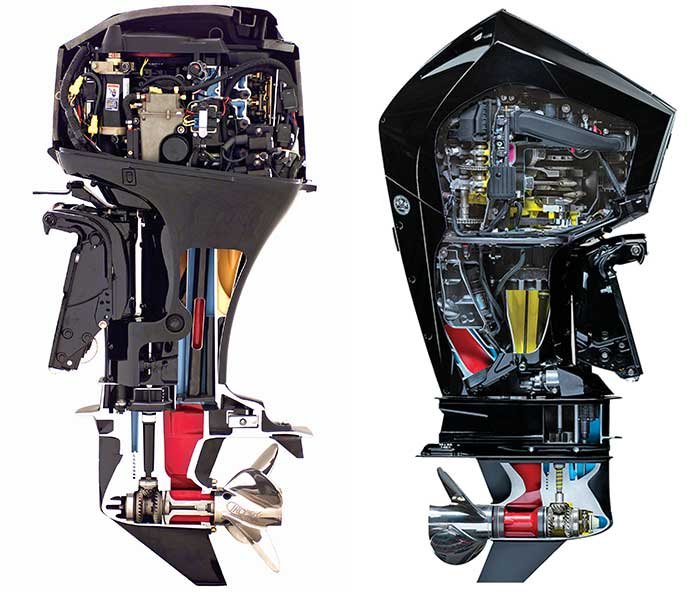
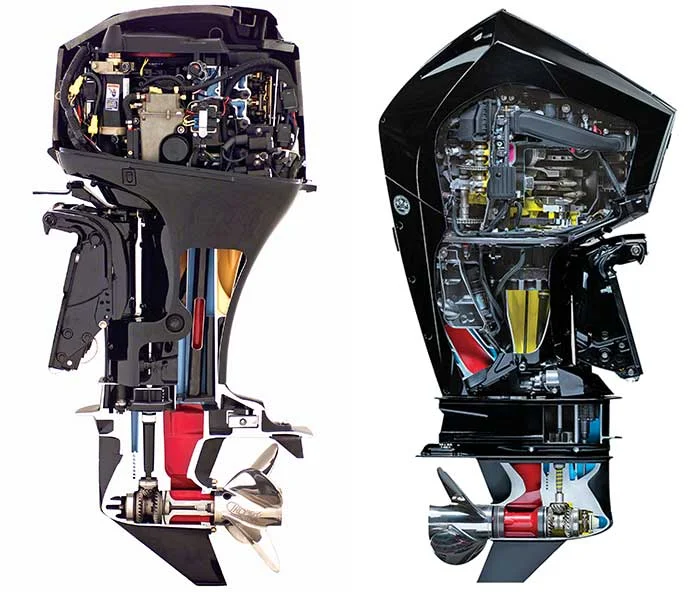
An outboard hangs off the back of the boat as a complete, self-contained propulsion system — engine, transmission, and drive unit all in one housing that tilts up out of the water when not running. This is the layout we sell, so we’ll be upfront about the bias, but the reasons outboards dominate the under-40-foot recreational market are mechanical, not marketing. Because the whole unit sits outside the hull, it frees up interior space that an inboard or sterndrive would eat into with an engine box. It’s also the easiest layout to service or swap entirely — a failed outboard can often be unbolted and replaced in an afternoon, where an inboard repower is a multi-day job involving hull access.
Modern four-stroke outboards range from small portable units under 10 horsepower up through V8 platforms pushing past 400 horsepower for offshore center consoles. We carry that full range, including workhorse mid-size options like the Yamaha 90 HP F90XB and the Yamaha 75 HP F75LB, and big-power V8 units like the Yamaha 425 HP XF425ESA for offshore-class boats.
Inboard engines: fixed shaft, deep in the hull
Inboards sit inside the hull, usually amidships or toward the stern, and drive a fixed propeller shaft angled down through the bottom of the boat. This layout is common on wakeboard and ski boats, where the weight sitting low and central in the hull produces the flatter wake those sports depend on, and on larger cruisers and workboats where the engine’s protected position matters more than easy removal.
The trade-off is access. Servicing an inboard means working inside the hull, often through a cramped engine compartment, and any major repair usually means the boat is out of the water for longer than an equivalent outboard job. Inboards also can’t be tilted out of the water, so the running gear stays submerged and exposed to marine growth and corrosion around the clock, which changes the maintenance rhythm compared to an outboard you can trailer with the lower unit lifted clear.
Sterndrive: the hybrid layout
Sterndrive, or inboard/outboard (I/O), splits the difference — the engine block lives inside the hull like an inboard, but power transfers through the transom to an external outdrive unit that steers and tilts similarly to an outboard’s lower unit. This gets you some of the wake characteristics of an inboard with some of the serviceability and shallow-water tilt capability of an outboard.
Sterndrives were extremely common on runabouts and cruisers through the 1990s and 2000s, and they’re still a solid choice for that category today. What’s shifted the balance toward outboards in recent years is largely horsepower parity — outboards used to lag sterndrives in top-end power for a given boat size, and that gap has mostly closed as manufacturers have scaled up four-stroke outboard platforms, removing one of the main reasons buyers chose sterndrive over outboard for bigger boats.
Pod drives: built for docking, not for most recreational buyers
Pod drives are steerable propulsion pods mounted under the hull, most commonly seen on larger cruisers and yachts, and their standout feature is joystick-controlled docking — each pod can be independently vectored, which lets a big, heavy boat pivot and slide sideways into a slip with a precision that’s genuinely hard to match with conventional single or twin-engine steering. That capability comes at a real cost premium and is mostly relevant on boats large enough to justify it. For the fishing boats, runabouts, pontoons, and center consoles most of our customers run, pod drives aren’t really in the conversation — it’s an outboard, sterndrive, or inboard decision.
How to actually choose between these marine propulsion systems
Boat size and intended use narrow this down faster than most people expect. Under about 26 feet, outboards cover the vast majority of hulls on the market today, from jon boats through center consoles, because the interior space and serviceability trade-offs favor them heavily at that size. Wakeboard and ski boats lean inboard specifically for the wake shape, regardless of overall length. Cruisers and runabouts in the 20 to 35 foot range are where sterndrive still competes seriously with outboard, often coming down to whichever layout the specific hull was designed around rather than a clean either-or choice. Larger yachts and cruisers above about 40 feet are where pod drives start entering the picture, mainly for the docking advantage.
If you already own a boat and you’re deciding whether to repower rather than choosing a layout from scratch, the honest answer is usually to stay within the propulsion system the hull was designed for. Converting a boat built around an inboard shaft to outboard power, or the reverse, is possible but it’s a significant structural project, not a simple swap.
Quick spec comparison across marine propulsion systems
| Propulsion type | Typical boat size | Serviceability | Best suited for |
|---|---|---|---|
| Outboard | Under 10 ft to 40+ ft | Easiest — unbolt and replace | Fishing boats, runabouts, pontoons, center consoles |
| Inboard | 18 – 40+ ft | Hardest — in-hull access required | Wakeboard/ski boats, workboats, cruisers |
| Sterndrive | 18 – 35 ft | Moderate | Runabouts, cruisers |
| Pod drive | 40 ft and up | Specialist service required | Larger yachts, docking-critical use |
Why outboards keep gaining share of the marine propulsion systems market
The clearest trend over the last decade has been outboard horsepower climbing into territory that used to be sterndrive or twin-inboard-only, and boat builders redesigning hulls around that shift. A 35-foot center console running twin or triple 350-450 horsepower outboards would have needed inboard diesels a generation ago to hit comparable performance. That horsepower growth, combined with outboards’ lighter weight-to-power ratio and easier maintenance, is why you’ll see outboards increasingly specified on boats that would have shipped with sterndrive or inboard power in the past.
Weight matters more than people realize here too. A modern four-stroke outboard producing 300 horsepower weighs meaningfully less than an equivalent-output sterndrive package once you account for the inboard engine block, transmission, and outdrive unit combined. On a performance-oriented hull, that weight difference shows up directly in top speed and fuel efficiency.
Fuel efficiency across propulsion types
Outboards generally lead on fuel efficiency per horsepower for a few structural reasons — modern four-stroke outboards run direct-drive with no additional driveline loss the way a sterndrive’s outdrive gearing introduces, and their lighter overall weight means the boat needs less energy to move through the water in the first place. Inboards can be more efficient at sustained cruising speed on larger, heavier hulls where a big displacement engine loafing along outperforms a smaller high-revving outboard, but for planing-hull recreational boats under about 35 feet, outboards typically come out ahead on fuel burn per mile.
None of this is an argument that outboards are strictly superior — it’s specific to the size and use case most of our customers are actually shopping for, which is exactly why we specialize in outboards rather than trying to be a one-stop shop for every propulsion type.
Steering, control, and how each layout actually feels to drive
The propulsion layout affects more than the engine room — it changes how the boat handles at the helm. Outboards steer by pivoting the entire lower unit, which gives sharp, direct turning response and lets the boat spin nearly in place at low speed by using the motor’s thrust angle, something that’s especially useful backing into a slip or working a tight marina. Sterndrives steer similarly, pivoting the outdrive, though the added weight and length of the drive unit typically makes the response a touch less immediate than a comparable outboard.
Inboards are the odd one out here, since the propeller shaft is fixed and steering comes entirely from a separate rudder behind the prop. This means an inboard boat has essentially no steering authority at very low speed or in neutral, which is part of why docking an inboard boat well is considered a genuine skill — you’re managing throttle and brief bursts of prop wash across the rudder rather than just pointing the drive where you want to go. Twin-engine inboard setups partially solve this by using differential throttle between the two engines to help rotate the boat, but it’s still a different feel than an outboard or sterndrive’s direct steering.
Noise, vibration, and the passenger experience
Because an outboard’s powerhead sits outside the hull, most of the engine noise and vibration radiates away from the boat rather than into it, which is one of the more underrated advantages for passenger comfort — conversation at cruising speed is noticeably easier on an outboard-powered boat than an inboard of comparable size, where the engine box sits a few feet from where people are sitting. Sterndrives split the difference again, with the engine block inside the hull contributing some noise even though the drive unit itself is external.
This matters more than spec sheets suggest for anyone using the boat for extended days on the water — fishing, family trips, or anything where people are talking to each other rather than just riding fast and getting somewhere. It’s a soft factor, but it’s one of the more consistent things we hear from customers who’ve owned both an inboard and an outboard boat and ended up preferring the outboard specifically for this reason.
Total cost of ownership, not just the purchase price
Sticker price on the engine itself is only part of what a propulsion system costs over the years you’ll own the boat. Outboards tend to win on routine maintenance cost because service work — impellers, spark plugs, gearcase oil, filters — happens on an accessible external unit rather than requiring hull access, and a full repower is a same-day bolt-on job in most cases rather than a haul-out project. Inboards and sterndrives carry higher labor costs for the same maintenance items simply because of access, even when the parts themselves cost about the same.
Where this shifts is at the high end of the size range. Large, heavy cruisers with sustained-cruising needs sometimes come out ahead with a diesel inboard on total lifetime fuel cost, even with higher maintenance labor, because diesel inboards are genuinely more efficient at steady, low-RPM cruising than gasoline outboards pushed to comparable speed on a heavy hull. For the recreational and light-commercial range most of our customers shop in — fishing boats, runabouts, pontoons, center consoles under about 35 feet — outboards usually win on total cost of ownership as well as purchase price, which is a big part of why the market has moved the direction it has.
A few common questions
Which marine propulsion system is cheapest to maintain?
Outboards generally have the lowest maintenance cost and complexity for boats under about 35 feet, mainly because the whole unit is external and accessible, and because a full engine swap is a straightforward bolt-on job rather than a haul-out project.
Can I convert my sterndrive boat to outboard power?
It’s technically possible on some hulls but it’s a major structural modification involving transom reinforcement and rerouting of controls, not a simple engine swap. Most owners find it’s more cost-effective to sell and buy a boat already rigged for the propulsion type they want.
Why do wakeboard boats still use inboard engines?
The engine’s weight sitting low and central in the hull, rather than hanging off the transom, produces the flatter wake and more predictable wake shape that wakeboarding and wake surfing depend on. This is a genuine mechanical reason, not just tradition.
Are pod drives worth it for a smaller boat?
Generally no — the cost premium is significant and the docking advantage matters most on larger, heavier boats that are genuinely difficult to maneuver conventionally. Most boats under 40 feet get more value from a well-chosen outboard or sterndrive setup.
Where outboard propulsion fits into your decision
If you’ve landed on outboard power after weighing the layouts above, we carry new and used engines across Yamaha, Suzuki, Honda, Mercury, Evinrude, Tohatsu, and Nissan, and ship worldwide. For a deeper technical look at what’s actually inside a modern outboard powerhead, our marine power engines guide breaks down displacement, fuel injection, and horsepower ratings in more detail. If authenticity and paperwork are part of your decision, our genuine outboard motors guide covers how to verify a motor before you buy. And for matching horsepower to a specific boat type, our guides on fishing boat motors and boat motors online go deeper on fit and pricing. Independent reading on how these systems compare is also worth a look — Discover Boating’s certified boats resource, produced by the National Marine Manufacturers Association, covers construction and propulsion standards from a brand-neutral angle.
Posts Widget
- 1

- 2
- 3
- 4


S.H Continental Marine
USA HERALD MAGAZINE INC
Our team is dedicated to providing exceptional customer service.
Email: info@shcontinentalmarine.com
Choose S.H Continental Marine
for your outboard engine needs and enjoy superior quality, exceptional customer service, and unbeatable prices.
