
Outboard Motor Gear Ratio: What It Means and Why Prop Choice Depends On It
Ask ten boat owners what their outboard’s gear ratio is and eight of them will shrug. Ask why their old engine felt sluggish off the line but flew at top end, or why a bigger prop suddenly made the boat feel slow, and the answer is usually sitting right there in the spec sheet: the outboard motor gear ratio. It is one of the least talked-about numbers on an engine, and one of the most important for matching power to prop to boat.
We spec every engine we sell with its gear ratio listed, because it genuinely changes how the boat performs, and because pairing the wrong prop pitch to the wrong ratio is one of the most common reasons a brand-new engine feels underwhelming. Here is the plain-language version, with real numbers pulled from engines currently in our stock.
In this guide:
What Outboard Motor Gear Ratio Actually Means
The outboard motor gear ratio describes how many times the crankshaft spins for every one turn of the propeller shaft. A gear ratio of 2.15:1 means the crank spins 2.15 times for each single revolution of the prop. A lower number, like 1.75:1, means the prop turns closer to crank speed — less reduction, faster prop spin at a given engine rpm.
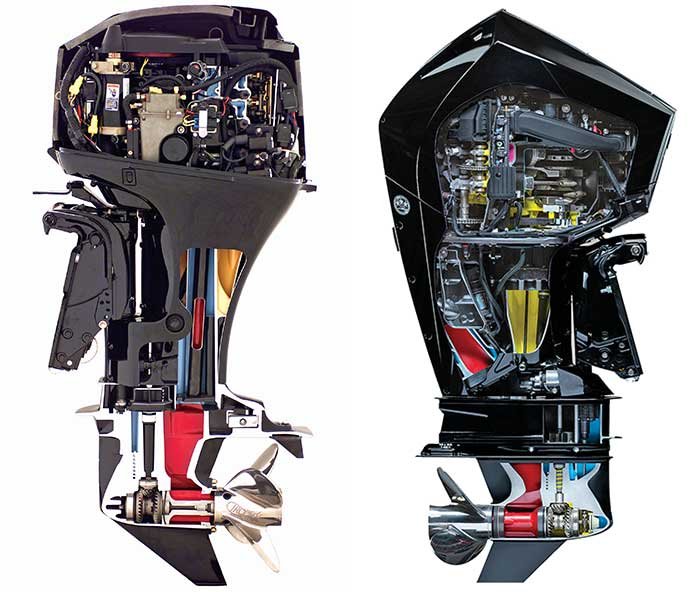
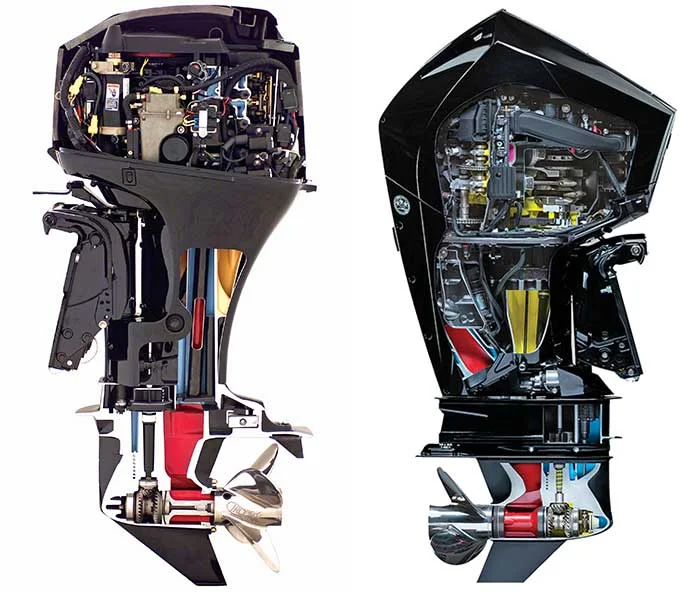
This reduction happens inside the lower unit, through a set of bevel gears. It exists because propellers and engine crankshafts want to spin at very different speeds to do their jobs well. An engine makes its best power spinning fast, often 5,000 to 6,000 rpm at wide-open throttle. A propeller moving that fast would cavitate, lose grip in the water, and destroy efficiency. The gear ratio slows the prop down to a speed where it can actually bite and push water effectively.
Higher Ratio vs Lower Ratio — What Changes
A higher outboard motor gear ratio (a bigger reduction, like 2.29:1) spins the prop slower relative to the engine. This generally means more torque delivered to the prop shaft, better ability to swing a larger-diameter or higher-pitch propeller, and stronger low-end thrust for pushing heavy loads — think towing, or a boat loaded with fuel, gear, and passengers.
A lower ratio (closer to 1:1, like 1.75:1 or 1.79:1) spins the prop faster for a given engine rpm. This favors top-end speed on lighter, faster hulls where the priority is velocity rather than raw shove. High-performance outboards built for speed often run lower ratios paired with smaller, higher-pitch props designed to work efficiently at higher prop rpm.
Neither number is “better” in isolation. The right outboard motor gear ratio depends entirely on the boat, the load it typically carries, and what the owner actually uses it for.
Real Gear Ratios From Engines We Stock
Numbers help more than theory here. These are actual gear ratios from current inventory, spanning small portable engines up to the largest V8 we carry.
| Engine | HP | Gear Ratio | What It’s Built For |
|---|---|---|---|
| Tohatsu 6 HP MFS6DWS | 6 HP | 2.15:1 | High reduction for a small engine, gives a light tender or dinghy real push off idle |
| Tohatsu 5 HP MFS5DLPGS | 5 HP | 2.15:1 | Same reduction class, steady thrust for small sailboats and inflatables |
| Suzuki 350 HP DF350ATXX2 | 350 HP | 2.29:1 | High reduction on a big V6 to swing large-diameter dual props for offshore load hauling |
| Yamaha 425 HP XF425ESA2 | 425 HP | 1.79:1 | Lower ratio V8 built to spin a high-pitch prop fast for top-end speed on large offshore hulls |
Notice the pattern. The small Tohatsu engines and the massive Suzuki V6 both run higher reduction ratios, just for different reasons — the small engines need help generating usable thrust from limited horsepower, while the big V6 needs the reduction to handle the torque load of two large contra-rotating propellers. The Yamaha V8, built more for outright speed on lighter offshore hulls, runs a notably lower ratio to keep prop rpm higher.
How Gear Ratio and Propeller Pitch Work Together

Gear ratio and prop pitch are not separate decisions, they are one decision made in two parts. A given outboard motor gear ratio determines what range of prop pitch will let the engine reach its rated wide-open-throttle rpm range with a normally loaded boat. Bolt on too much pitch for the ratio and load, and the engine will not reach its rated rpm range, robbing power and risking long-term wear from lugging. Too little pitch, and the engine will overrev, which is just as hard on internals and wastes fuel without adding real speed.
This is why a prop that worked perfectly on your old engine might be completely wrong on a new one, even at the same horsepower, if the gear ratio is different between the two model years or brands. Always match pitch to the specific gear ratio of the actual engine going on the transom, not to a prop that “seemed to work fine” on a different setup.

Gear Ratio and Towing or Heavy Loads
If you regularly tow water skiers, wakeboarders, or tubers, or you run a boat that is consistently loaded heavy with fuel, gear, and passengers, a higher outboard motor gear ratio paired with a higher-pitch prop generally serves you better. The added mechanical advantage helps the engine push a heavier load onto plane without over-revving before the boat has enough speed to get up.
Commercial and fishing applications that carry variable loads — sometimes light, sometimes loaded with fish, ice, and gear — tend to favor a slightly conservative pitch choice matched to a higher-reduction gear ratio, prioritizing consistent performance across load conditions over outright top speed.
Gear Ratio and Fuel Efficiency
There is a quiet fuel-economy angle to gear ratio that gets overlooked. An engine that is properly matched — correct gear ratio for the application, correct pitch for the gear ratio — reaches its most efficient operating rpm range at a normal cruise throttle setting. An engine fighting the wrong prop pitch for its gear ratio either labors under load (burning more fuel to make the same speed) or spins too freely without translating that rpm into forward thrust efficiently. Getting the gear ratio and pitch combination right is one of the simplest, cheapest ways to improve real-world fuel economy on an existing boat.
Does Gear Ratio Affect Reliability?
Indirectly, yes. An engine consistently run outside its rated wide-open-throttle rpm range because of a mismatched prop and gear ratio combination is under more stress than one operating in its intended band. Lugging a high-reduction engine with too much pitch stresses connecting rods and bearings under sustained high cylinder pressure at low rpm. Overrevving a low-reduction engine with too little pitch pushes internal components past their designed rpm ceiling. Correct gear ratio and pitch matching is not just a performance question, it protects the engine over the long run.
How to Check Your Outboard Motor Gear Ratio
The gear ratio is printed on the manufacturer’s spec sheet for every engine, usually expressed as a ratio like 2.15:1. If you no longer have the paperwork, the model number often encodes enough information for a dealer to look it up from the manufacturer’s parts database using the serial number stamped on the lower unit. We can pull gear ratio and recommended pitch range for any engine we sell, and for most competitor engines too if you are troubleshooting an existing setup.
Common Mistakes With Gear Ratio and Prop Selection
Buying a prop based on what worked on a friend’s boat with a different engine. Assuming all engines in a horsepower class share the same gear ratio — they frequently do not, even within the same brand across model years. Ignoring gear ratio entirely when repowering and reusing the old prop, which was matched to the old engine’s ratio, not the new one. Chasing top speed with a low-pitch prop on a high-reduction engine designed for load-hauling, which wastes the engine’s actual strength.
FAQs — Outboard Motor Gear Ratio
What is a good outboard motor gear ratio for a fishing boat? It depends on load and hull, but many fishing boats that carry variable weight do well with a moderate to higher ratio, in the 2.0:1 to 2.3:1 range, paired with pitch selected for typical loaded weight.
Does a higher gear ratio mean more power? Not more raw horsepower, but more usable torque at the prop shaft, which often feels like more power when pushing a load or getting a heavy boat on plane.
Can I change my outboard’s gear ratio? No. Gear ratio is fixed by the internal gear set built into the lower unit and is not user-adjustable. You can only change engines or change prop pitch to work within the existing ratio.
Why does my new engine need a different prop than my old one? Almost always because the gear ratio changed between the old engine and the new one, even if the horsepower rating stayed the same.
Order the Right Engine for Your Application
Every engine we sell ships with full documented specifications, including gear ratio, so you are not guessing at prop compatibility after the fact. Whether you need the high-reduction pull of the Suzuki 350 HP DF350ATXX2 or the speed-oriented lower ratio of the Yamaha 425 HP XF425ESA2, tell us your boat, typical load, and how you use it, and we will match the right gear ratio and pitch combination for your hull.
Browse the full outboard motor inventory or reach us through our contact page for a specification-matched recommendation and a worldwide shipping quote.
For a deeper technical reference on propeller theory and how it interacts with lower unit gearing, the Discover Boating educational library covers the mechanics in more depth, and the American Boat and Yacht Council publishes the technical standards that manufacturers design lower units around.
Why Gear Ratios Differ Between 2-Stroke and 4-Stroke Designs
Older 2-stroke outboards typically ran lower gear ratios than today’s 4-stroke engines of similar horsepower. Part of the reason is how each engine builds torque. A 2-stroke fires once every revolution and tends to make peak torque higher in the rpm range, so a lower reduction kept the prop spinning fast enough to use that top-end power. A 4-stroke fires once every two revolutions and typically builds a broader, more usable torque curve lower in the rpm range, which is part of why many modern 4-stroke outboards run a higher outboard motor gear ratio than the 2-strokes they replaced — the engine has more low-end grunt to put through a bigger reduction and still spin an appropriately sized prop.
If you are repowering a boat that had an older 2-stroke and moving to a modern 4-stroke, do not assume the old prop will work. The gear ratio and the torque curve shape have both likely changed, and reusing the old prop is one of the most common reasons a repower feels disappointing on day one.
Gear Ratio in Twin-Engine and Counter-Rotating Setups
When two engines run side by side, matching gear ratio between them is not optional. If one engine has a different reduction than the other, even by a small margin, one side will reach its optimal rpm range before the other under identical throttle input, and the boat will pull toward whichever side is lagging. This is a common oversight when buyers pair engines from different model years, assuming “same horsepower” means “same everything.” It does not. Always confirm gear ratio matches exactly when ordering a matched twin pair, standard rotation on one side and counter-rotating on the other, both sharing the same internal reduction.
How Hull Type Should Guide Gear Ratio Selection
A deep-V offshore hull pushing through chop benefits from the extra bite a higher outboard motor gear ratio provides, since it is regularly working against wave resistance and variable load. A flat-bottom jon boat or a light aluminum skiff running mostly flat, calm water can often make better use of a lower ratio matched to a higher-pitch prop, since there is less resistance to overcome and more benefit from raw prop speed. Pontoon and tritoon owners frequently land in the middle, needing enough low-end thrust to get a wide, heavy platform on plane without sacrificing all top-end cruise speed once up and running.
A Quick Way to Tell If Your Current Setup Is Mismatched
Run the boat at wide-open throttle with a normal load aboard and check the tachometer against the engine’s rated wide-open-throttle rpm range from the owner’s manual. If the engine falls short of that range, the prop pitch is too aggressive for the gear ratio and load — too much pitch, not enough reduction advantage to turn it. If the engine spins past the top of the rated range, the pitch is too low and the engine is overrevving. Either condition points to a pitch that does not suit the installed gear ratio and should be corrected before it causes premature wear.
Gear Ratio Numbers Across Common Horsepower Classes
While every manufacturer and model differs, general trends hold across the outboard market. Small portable engines under 15 HP frequently run gear ratios in the 2.0:1 to 2.15:1 range, prioritizing usable thrust from a small displacement. Mid-range engines from 25 HP to 115 HP vary more widely depending on whether the model is tuned for utility or performance, often landing between 1.85:1 and 2.3:1. High-horsepower V6 and V8 engines built for large offshore boats can run anywhere from roughly 1.75:1 on speed-focused models up to 2.3:1 or higher on models designed to swing large-diameter or dual contra-rotating propellers. None of these are hard rules — always confirm the specific number for the specific engine, never assume based on horsepower class alone.

Case Comparison: Same Horsepower, Different Gear Ratio
Take two hypothetical 90 HP engines from different manufacturers, one running a 2.15:1 ratio and the other running a 1.86:1 ratio. At the same 5,500 rpm engine speed, the higher-ratio engine spins its prop noticeably slower than the lower-ratio engine. To reach the same boat speed, the higher-ratio engine typically needs a lower-pitch prop than the lower-ratio engine would use, and it will generally deliver stronger hole shot from a stop, while the lower-ratio engine tends to feel quicker to build speed once already moving. Neither engine is faster or slower in an absolute sense — they simply reach their power differently, and the right choice depends on whether your priority is getting a loaded boat out of the hole or maximizing cruise efficiency once on plane.
This is exactly why comparing two engines by horsepower number alone tells you less than you think. Two “90 HP” outboards from different manufacturers can feel completely different on the same hull once gear ratio and prop matching enter the picture, and it is one of the first things our team checks when a customer asks us to compare options across brands.
Posts Widget
- 1

- 2

- 3

- 4


S.H Continental Marine
USA HERALD MAGAZINE INC
Our team is dedicated to providing exceptional customer service.
Email: info@shcontinentalmarine.com
Choose S.H Continental Marine
for your outboard engine needs and enjoy superior quality, exceptional customer service, and unbeatable prices.
