
Counter Rotating Outboard Motor: 6 Key Facts Every Twin-Engine Owner Should Know
Walk around any marina with center consoles lined up on twin power, and you’ll notice something a lot of boat owners never think to ask about: the propellers on the port and starboard engines spin in opposite directions. That’s not a manufacturing accident. It’s a deliberate setup called a counter rotating outboard motor, and understanding how it works can save you from steering problems, uneven handling, and a very confusing conversation with a mechanic if you ever need to replace just one engine in a matched pair.
We get asked about this constantly by customers moving from a single engine to twins, or buying a pre-owned boat that already has a counter-rotating pair installed and want to understand what they actually own. Here’s the full picture, from how rotation direction is defined to what happens if a pair gets mismatched.
What “Counter Rotating” Actually Means
Standard outboard motors are built with what’s called right-hand rotation: viewed from behind the engine looking toward the bow, the propeller spins clockwise. A counter rotating outboard motor is built with left-hand rotation instead, meaning the crankshaft, driveshaft, and propeller all spin the opposite direction. Manufacturers achieve this with a different gear set inside the lower unit, not just a different propeller, so you can’t turn a standard engine into a counter-rotating one by swapping the prop alone.
Why Twin-Engine Boats Use One of Each
A single outboard’s propeller rotation creates torque that pulls the stern slightly to one side, an effect sometimes called prop walk or torque steer. On a single-engine boat this is manageable and most drivers compensate for it without thinking. On a twin-engine boat, if both engines had the same rotation, their combined torque would push the boat noticeably off-center, forcing constant trim tab or steering correction and uneven load on the steering system. By pairing one standard-rotation engine with one counter-rotating engine — almost always the port-side motor — the torque from each side cancels the other out, giving the boat balanced, predictable handling at all speeds.
Which Side Gets the Counter-Rotating Engine
The convention nearly every manufacturer follows is standard rotation on the starboard engine and counter rotation on the port engine, which is why counter-rotating models are frequently labeled with an “L” designation in their model code — Yamaha, Mercury, Suzuki, and Honda all use some variation of this convention. If you’re shopping for a matched pair or replacing one engine in an existing twin installation, getting the port and starboard assignment right isn’t optional. Installing two standard-rotation engines side by side defeats the entire purpose of the setup and brings back the handling problems counter rotation was designed to solve.
Real Specifications: What Changes Inside the Lower Unit
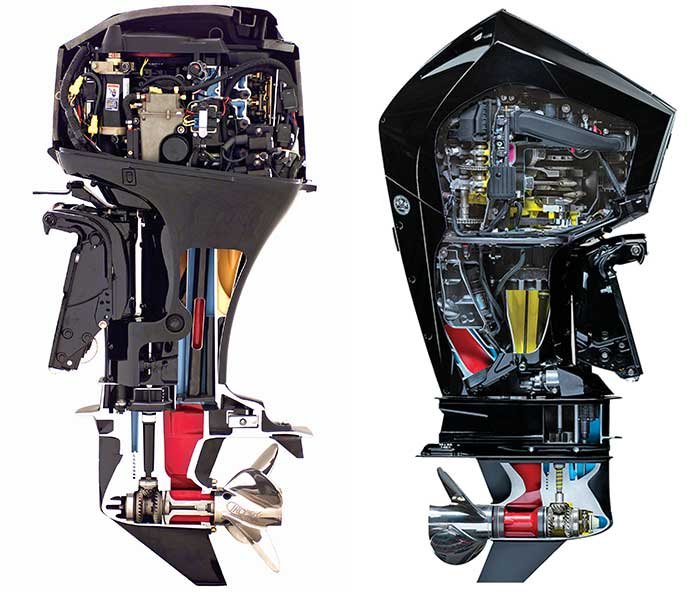
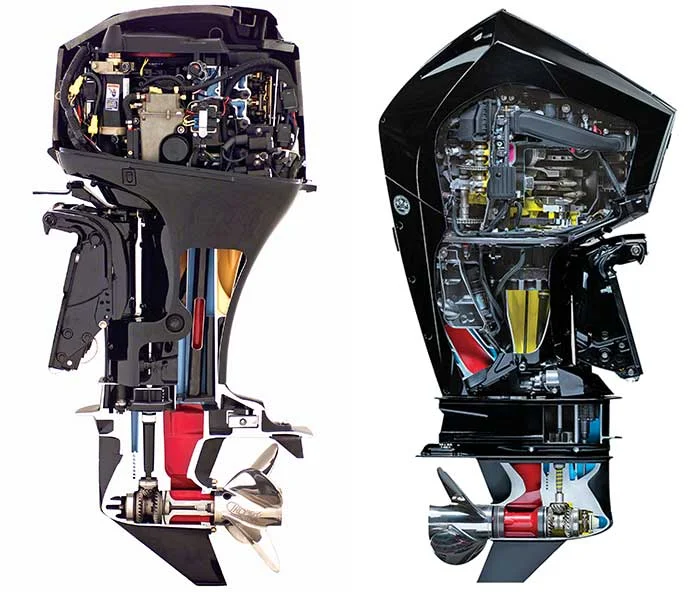
The difference between standard and counter-rotating lower units comes down to gear arrangement. In a standard lower unit, the forward gear engages the propeller shaft directly for forward thrust. In a counter-rotating unit, the gear train is arranged so the reverse gear becomes the effective forward gear, reversing the direction of spin while keeping the same shift pattern at the helm — forward is still forward, reverse is still reverse, only the propeller’s spin direction has changed. This means the gear ratio can differ slightly between standard and counter-rotating versions of the same engine model, which is worth checking against our outboard motor gear ratio guide if you’re trying to match performance between a matched pair.
Propellers Are Not Interchangeable Between the Two
A standard-rotation propeller will not work correctly on a counter-rotating lower unit, and vice versa. The blade pitch and angle are cut specifically for the direction of rotation, so putting a standard prop on a counter-rotating engine doesn’t just spin the “wrong way,” it actually loses a significant amount of thrust and can damage the lower unit under load. Counter-rotating propellers are usually marked clearly by the manufacturer, but if you’re ever unsure, our outboard motor propeller guide explains how to identify rotation direction before you buy a replacement.
Buying a Counter-Rotating Engine as a Standalone Unit
If one engine in an existing twin pair fails and needs replacement, you need a counter-rotating unit that matches, not just any engine of the same horsepower. We stock and source counter-rotating models specifically for this situation, and it’s one of the more common calls we get — an owner with a healthy starboard engine whose port motor needs replacing, trying to track down the exact rotation and model match. Larger pairs, like a matched 300 HP pair, are sometimes sold together specifically because sourcing a single matching counter-rotating replacement years later can be harder than buying both new engines at once.
Counter Rotation and Big V6/V8 Outboards
On larger offshore-class outboards — V6 and V8 platforms in the 250 to 425 HP range — counter rotation becomes even more important because the torque forces involved are considerably higher. A twin or triple installation of big V8s without correctly paired rotation would produce handling that’s not just inconvenient but genuinely difficult to control at speed. Manufacturers like Yamaha build dedicated counter-rotating variants of their large V8 platforms specifically for this reason, and offshore-rigged boats running triple or quad big-block setups typically alternate rotation direction across the transom for the same torque-canceling reason as a simple twin pair.
Does Counter Rotation Affect Fuel Efficiency or Top Speed?
Counter rotation itself doesn’t inherently cost or gain performance — a correctly paired twin installation runs just as efficiently as it would with a theoretical torque-neutral setup. What actually affects fuel efficiency and top speed is proper propeller selection and matched gear ratios between the two engines, which is a separate consideration from rotation direction. The performance problems people sometimes blame on “counter rotation” almost always trace back to mismatched propellers or uneven trim between the two engines, not the rotation setup itself.
How to Tell If Your Boat Already Has a Counter-Rotating Pair
The simplest way to check is to look at the propellers directly: viewed from behind the boat, if one spins clockwise and the other counterclockwise when engaged in forward gear, you have a counter-rotating pair. You can also check the model plate on each engine — a counter-rotating unit will usually carry an “L” or similar suffix distinguishing it from the standard version of the same model. If you’re not sure and need to replace one engine, bring us the model number from the plate rather than guessing based on appearance alone.
Maintenance Differences Between Standard and Counter-Rotating Units
Day-to-day maintenance — oil changes, water pump service, spark plugs — is identical between standard and counter-rotating versions of the same engine. The only meaningful difference shows up during lower unit service, where a technician needs to know which gear configuration they’re working on before disassembly, since the internal gear arrangement differs even though the external service points look the same. Always tell your mechanic which side of a twin pair they’re servicing so gear oil and shim specifications are checked against the correct configuration.
The Physics Behind Torque Steer, Explained Simply
Every spinning propeller pushes back against the water with an equal and opposite force, and that reaction force tries to rotate the entire boat around its own axis, not just the propeller shaft. On a single engine, that reaction shows up as a mild pull to one side, which most drivers correct for without noticing. Stack two engines with identical rotation side by side and that reaction force doubles instead of canceling, which is why an improperly matched twin installation feels noticeably harder to keep tracking straight, especially at low speed when steering input has less water flowing past the rudder to correct it. A properly paired counter rotating outboard motor setup eliminates this by making the two reaction forces work against each other instead of adding together.
How Manufacturers Label Counter-Rotating Models
Every major brand uses a slightly different model code to flag a counter-rotating unit, which matters a great deal if you’re sourcing a replacement engine yourself rather than through a dealer who already knows the system. Yamaha typically adds an “L” suffix paired with specific model families. Mercury and Mariner use “L” designations as well, often combined with shaft length codes in the same string, which is why reading a full model plate carefully matters — a model number can encode horsepower, shaft length, and rotation direction all at once, and misreading any one of those three can lead to ordering the wrong engine entirely. Suzuki and Honda follow similar logic within their own numbering systems. When in doubt, the safest approach is giving us the complete model number stamped on the engine plate rather than trying to decode it yourself.
Triple and Quad Engine Rigging
Once you move beyond a simple pair into triple or quad outboard installations, common on larger offshore center consoles running big V8 power, the rotation pattern typically alternates across the transom rather than simply mirroring a single pair. A common arrangement on a quad installation pairs the two outer engines as counter-rotating opposites while doing the same with the two inner engines, balancing torque symmetrically around the boat’s centerline rather than just left to right. Rigging shops that specialize in offshore multi-engine setups plan this out engine by engine, and it’s a significant part of why professional installation matters once you’re beyond a basic twin.
What It Costs to Source a Replacement for One Engine in a Pair
Replacing one failed engine in an existing counter-rotating pair is usually straightforward if the model is still in production, but it becomes more involved with older or discontinued platforms, where finding a specific counter-rotating variant secondhand can take considerably longer than sourcing a standard-rotation engine of the same size. This is part of why some owners choose to replace both engines in an aging pair at once rather than gambling on finding one matching counter-rotating unit later, especially on less common brands or older two-stroke platforms where parts availability is already limited. If you’re in this situation, it’s worth having us check current availability before committing to a single-engine replacement plan.
Counter Rotation Isn’t Unique to Outboards
The same principle shows up on twin-engine aircraft, twin-screw inboard boats, and even some automotive applications with dual differentials, anywhere torque cancellation between two power sources matters for stable handling. Outboard motors simply package the same idea into a bolt-on lower unit rather than a custom-built drivetrain, which is part of why it’s such a well-refined, reliable system across every major manufacturer today. Understanding the underlying principle also makes it easier to explain to a boat partner or family member why the “backwards” propeller on one side isn’t a defect.
Inspecting Rotation Before You Buy a Used Twin-Engine Boat
If you’re looking at a used boat with twin outboards and the listing doesn’t specify rotation, check the propellers yourself before making an offer, or ask the seller to run both engines in gear briefly so you can observe rotation direction firsthand. A twin installation running two standard-rotation engines because a previous owner replaced one incorrectly is more common than people expect, and it’s a detail that’s easy to miss on a test drive if you’re focused on how the boat rides rather than how it tracks in a straight line at idle speed.
The Engineering Term Behind the Concept
If you want to read further into the underlying mechanics, the effect being cancelled here is formally described as torque steer, a term that shows up across marine, automotive, and aviation engineering wherever a single rotating power source creates an uneven turning force on the vehicle carrying it. The general concept of a propeller’s rotational direction and its effect on thrust and handling is well documented in general marine engineering references, and it’s worth a read if you want the deeper mechanical explanation beyond what applies specifically to outboard rigging.
Which Boats Actually Benefit From Twin Power
Not every boat needs a counter-rotating pair — plenty of runabouts, pontoons, and smaller center consoles run happily on a single engine for their entire service life. Twin power starts making sense once you’re looking at larger offshore boats where redundancy matters for safety, where total horsepower requirements exceed what a single engine can practically deliver, or where the hull is wide enough that a single engine can’t provide balanced thrust. If you’re upgrading from a single engine to twins for the first time, it’s worth talking through hull size, typical routes, and horsepower needs with us before committing to a specific pair, since the right total power and the right rotation pairing both matter for how the finished rig actually performs on the water. Larger buyers often start by browsing our Mercury outboard inventory or our guide to genuine Mercury marine engines to get a feel for what a matched big-block pair actually costs before deciding between new and reconditioned options.
Frequently Asked Questions
Can I convert a standard outboard into a counter rotating outboard motor?
Not by changing the propeller alone. The gear set inside the lower unit needs to be built for counter rotation, so converting an existing standard engine typically means replacing the lower unit or the entire engine with a factory counter-rotating version.
Do I need a counter rotating outboard motor for a single-engine boat?
No. Counter rotation only matters when pairing two or more engines to cancel torque between them. A single-engine boat runs a standard-rotation motor with no downside.
How do I know which engine in a pair should be counter-rotating?
The overwhelming industry convention places the counter-rotating engine on the port side, with standard rotation on starboard, though it’s always worth confirming against the specific boat builder’s rigging documentation.
Is a counter rotating outboard motor more expensive than a standard one?
Pricing is usually very close between standard and counter-rotating versions of the same model, since the difference is a specific gear set rather than an entirely different engine.
What happens if a mismatched pair gets installed by mistake?
The boat will pull noticeably to one side under power, steering effort will be uneven between turns in each direction, and the hull won’t track straight at cruising speed until the rotation mismatch is corrected.
Counter Rotating Outboard Motor: The Bottom Line
A counter rotating outboard motor isn’t a specialty item, it’s a standard and well-engineered solution to a real physics problem that shows up the moment you bolt two engines onto one transom. Whether you’re rigging a new twin installation, replacing a single failed engine in an existing matched pair, or simply trying to understand why your boat’s propellers spin different directions, matching rotation correctly is what keeps a twin-engine boat handling the way it was designed to. If you’re shopping for a matched set or need help identifying what you currently have, our team can source the correct standard and counter-rotating pairing for nearly any brand we carry.
Posts Widget
- 1

- 2

- 3
- 4


S.H Continental Marine
USA HERALD MAGAZINE INC
Our team is dedicated to providing exceptional customer service.
Email: info@shcontinentalmarine.com
Choose S.H Continental Marine
for your outboard engine needs and enjoy superior quality, exceptional customer service, and unbeatable prices.
