
Marine Outboard Mechanics: The Complete Guide to How These Engines Actually Work (2026)

Marine Outboard Mechanics: The Complete Guide to How These Engines Actually Work
An outboard motor looks like a sealed black box to most owners: turn the key, it runs, and what happens inside stays a mystery until something goes wrong. Understanding the basic marine outboard mechanics underneath that cowling doesn’t just satisfy curiosity, it makes you a much better judge of whether a repair quote makes sense, whether a used engine is actually sound, and when a job genuinely needs a qualified mechanic instead of a weekend attempt with a socket set.
We sell complete outboard motors across most major brands, and every one that comes through our shop is inspected and prepped by mechanics who work on nothing but marine powerheads all day. That hands-on experience is what tells us the difference between a motor that’s genuinely sound and one that’s been cosmetically cleaned up to hide a problem underneath.
The powerhead: where combustion turns into motion
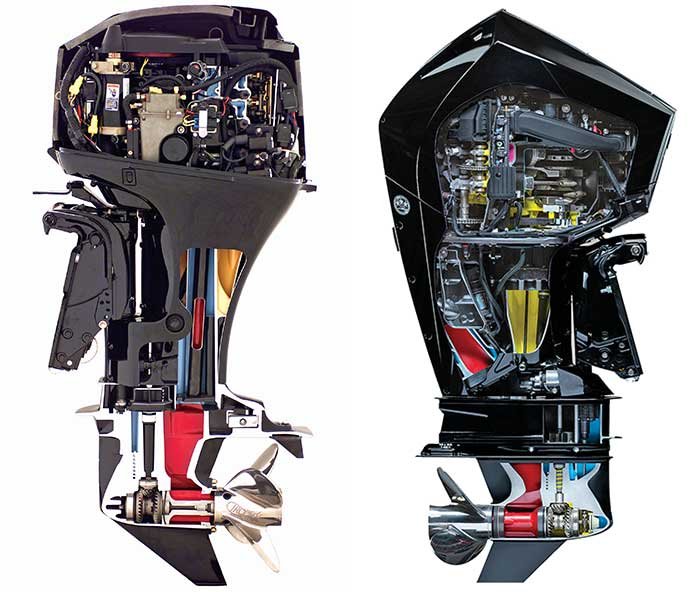
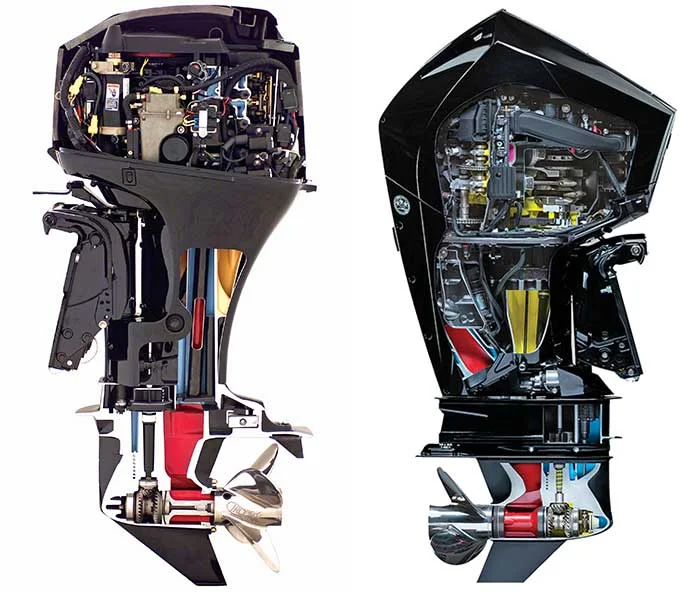
The powerhead is the engine block itself, sitting above the water on every outboard, and it’s mechanically similar to a car engine in the basics: pistons moving in cylinders, a crankshaft converting that linear motion into rotation, and valves (on four-strokes) timing when air and fuel enter and exhaust leaves. What’s different from an automotive engine is orientation (the crankshaft runs vertically, not horizontally) and duty cycle, since outboards spend far more time at sustained high RPM than the average car engine ever does. Four-stroke outboards dominate the modern market for emissions and fuel economy reasons, though two-strokes remain common on portable and older engines for their simplicity and power-to-weight ratio.
The gearcase: turning vertical rotation into forward thrust
Below the powerhead, the driveshaft runs down through the leg of the motor into the gearcase, where bevel gears redirect that rotation ninety degrees to spin the propeller shaft. This is one of the more elegant pieces of marine outboard mechanics on the whole engine: a simple gear arrangement that also houses the shift mechanism, letting the same set of gears engage forward, neutral, or reverse depending on which gear the shift linkage engages. The gearcase runs in its own sealed oil bath, completely separate from the crankcase above it, and a failed seal here is one of the most common points where water intrusion causes expensive damage if it isn’t caught early.
Cooling: pulling heat out of an engine that can’t use a radiator
Unlike a car, an outboard doesn’t carry its own coolant loop with a radiator. Instead, it draws water directly from the lake, river, or ocean it’s running in, pumps it through a water jacket surrounding the cylinders to absorb heat, and discharges it back overboard, visibly, through the tell-tale stream every operator learns to watch. The water pump itself is a simple but critical mechanical component: a rubber impeller spinning inside a housing, flexing as it rotates to move water through the system. It’s also one of the more routine wear items in marine outboard mechanics, since the rubber degrades with heat and age even without a specific failure event, which is why manufacturers publish a replacement interval regardless of whether the impeller shows obvious damage.
Fuel delivery: carburetors versus electronic fuel injection
Older and smaller outboards often still use carburetors, mechanical devices that mix fuel and air using pressure differentials rather than any electronic control. They’re simple, rebuildable with basic tools, and don’t depend on a computer to run, which is part of why portable and entry-level outboards still favor them. Electronic fuel injection, standard on most modern mid-size and larger four-strokes, uses sensors and a computer to precisely control fuel delivery based on real-time conditions, improving cold starts, fuel economy, and emissions at the cost of added complexity that generally requires diagnostic equipment to troubleshoot properly rather than a simple visual inspection.
| System | Carbureted | EFI |
|---|---|---|
| Cold starting | Requires choke, can be finicky | Consistent, automatic enrichment |
| Serviceability | Rebuildable with basic tools | Requires diagnostic tools for most faults |
| Fuel economy | Less precise, more variance | More efficient, adapts to conditions |
| Common on | Portable and older engines | Most modern mid-size and larger engines |
Ignition: what actually makes the spark happen
Modern outboards use some form of electronic ignition, typically a capacitor discharge system (CDI) or a transistorized system, that times a precise spark to each cylinder based on crankshaft position and RPM. This replaced the older points-and-condenser ignition systems entirely on virtually all modern engines, trading a wear-prone mechanical contact point for a solid-state trigger that rarely needs adjustment. Understanding this piece of marine outboard mechanics matters mainly for troubleshooting purposes: a failing ignition coil or trigger produces symptoms, misfire under load, hard starting, that look mechanical but are actually electrical in origin.
Trim and tilt: hydraulics doing the heavy lifting
Power trim and tilt systems use a small hydraulic pump and ram to adjust the engine’s angle relative to the transom, both for performance tuning while underway (trim) and for raising the motor clear of the water when docked or trailering (tilt). It’s a self-contained hydraulic circuit, similar in principle to power steering, and the most common failure point is worn seals allowing the ram to slowly lose pressure and drift down over time, rather than a sudden catastrophic failure.
Corrosion: the mechanical enemy unique to marine engines
Automotive mechanics rarely have to think seriously about galvanic corrosion, the process where two dissimilar metals in electrical contact through an electrolyte (salt water especially) cause one metal to corrode faster than it would alone. Outboards are full of dissimilar metal junctions: aluminum housings, stainless fasteners, bronze or brass fittings, all bolted together and regularly submerged. Sacrificial anodes, deliberately less noble metal blocks bolted to the gearcase and transom bracket, exist specifically to corrode first and protect the more expensive components around them. Understanding this piece of marine outboard mechanics explains why anode inspection and replacement is such a routine part of marine maintenance in a way that has no real automotive equivalent, and why a boat kept in saltwater needs far more frequent anode checks than one that only ever sees fresh water.
How EFI diagnostics actually work on modern engines
Late-model electronically fuel-injected outboards run on a network of sensors, crank position, throttle position, oxygen sensors on some models, manifold pressure, all feeding a central engine control unit that adjusts fuel and timing in real time. When something goes wrong, the ECU typically logs a fault code, and reading that code requires manufacturer-specific diagnostic software connected through a dedicated interface cable, not a generic automotive code reader in most cases. This is one of the clearest examples of why modern marine outboard mechanics has moved well beyond wrenches and feeler gauges into genuine electronics diagnostic work, and it’s also why a shop’s software licensing and hardware investment for specific brands matters as much as the mechanic’s hands-on experience.
What certification actually means in this trade
Manufacturer-specific certification programs, offered by the major outboard brands, train mechanics on that brand’s specific systems, diagnostic procedures, and common failure points, and completing them typically requires both classroom instruction and hands-on assessment. A certified technician isn’t automatically better than an experienced uncertified one, but certification does guarantee a baseline of structured training on that specific engine family rather than knowledge picked up entirely through trial and error. For complex EFI or electronic ignition work in particular, certification tends to correlate strongly with faster, more accurate diagnosis simply because the technician has seen the manufacturer’s own documentation of known issues rather than having to work them out independently.
What qualified marine outboard mechanics actually bring to a job
A good mechanic isn’t just someone who can turn wrenches. Real expertise in marine outboard mechanics means recognizing which symptoms point to which system without needing to disassemble everything to find out, knowing the specific quirks and common failure points of particular engine families, and having the diagnostic tools, a proper compression tester, a marine-rated multimeter, manufacturer-specific diagnostic software for late-model EFI engines, that a general home toolbox doesn’t include. It also means knowing when a repair doesn’t make financial sense compared to a repower, and saying so honestly rather than running up a bill on an engine that’s genuinely near the end of its service life.
What’s reasonable to do yourself, and what isn’t
Oil changes, spark plug replacement, impeller replacement, and grease service are all well within reach of an owner with basic tools and a service manual for their specific engine. Carburetor rebuilding is doable for a patient owner willing to follow a manual carefully, though it’s easy to get wrong on the first attempt. Anything involving powerhead disassembly, timing adjustment, or EFI diagnostic work generally calls for a mechanic with the right tools and experience, since the cost of getting it wrong (a scored cylinder, a misdiagnosed sensor swapped unnecessarily) usually exceeds what the shop labor would have cost in the first place.
Engines prepped by mechanics who specialize in this
Every used outboard we sell goes through a full mechanical inspection before it’s listed: compression check, gearcase inspection, fuel system cleaning, and a real-world running test under load, not just a dockside idle. A sample of what’s currently in stock, already inspected and serviced:
| Motor | HP | Type | Approx. Price (USD) |
|---|---|---|---|
| Yamaha F6LMHA | 6 HP | 4-Stroke | $1,690.99 |
| Yamaha E75BMHL | 7.5 HP | 2-Stroke | $2,800 |
| Yamaha 25HP Long Shaft (Used) | 25 HP | 4-Stroke | $1,795 |
| Yamaha F30LA | 30 HP | 4-Stroke | $3,690 |
| Yamaha T60LB High Thrust | 60 HP | 4-Stroke | $4,900 |
Questions worth asking any mechanic before you hire one
What specific brands and engine families do they work on most, since experience with your exact engine matters more than general mechanical aptitude. Do they have manufacturer diagnostic software for EFI systems, or are they limited to carbureted and older engines. What’s their standard turnaround time, and do they document what was actually found and repaired, or just hand back a bill with a vague description. A mechanic who can explain, in plain terms, what was wrong and why the fix addresses it is worth more than one who’s simply fast and cheap but leaves you no wiser about what actually happened.
Red flags in a mechanic’s diagnosis
Vague explanations that don’t name a specific failed part or system. Recommending a full rebuild before ruling out simpler, cheaper causes first. No willingness to show you the failed part they removed. And parts-swapping without a clear diagnostic basis, replacing an ignition coil, say, without first testing it, just because it’s a common failure point on that engine family. Reputable expertise in marine outboard mechanics comes with the ability to explain the reasoning, not just the invoice.
The tools that separate a shop from a garage
A home toolbox handles the routine maintenance items well, but professional marine outboard mechanics rely on equipment most owners never invest in: a proper compression tester with the right adapters for marine cylinder heads, a fuel pressure gauge for diagnosing EFI delivery issues, manufacturer-specific diagnostic laptops and interface cables, and a test tank or dedicated dyno setup for running an engine under real load conditions without needing to put it in the water first. That equipment investment is part of why shop labor rates reflect more than just time; it reflects access to diagnostic accuracy that a guess-and-check approach at home simply can’t match on anything beyond the basics.
How engine families differ mechanically
Not every outboard brand solves the same problems the same way. Some manufacturers favor inline four-cylinder layouts across a wide horsepower range for parts commonality and lighter weight, while others use V6 or V8 configurations at higher horsepower for smoother power delivery at the cost of added weight and complexity. Direct fuel injection versus traditional port injection changes both performance characteristics and service requirements. None of these differences make one brand categorically superior mechanically, but they do mean a mechanic experienced with one engine family isn’t automatically equally sharp on another, which is part of why asking about specific brand experience actually matters when choosing who works on your engine.
Worldwide sourcing and mechanical support
We ship complete outboards worldwide, and every engine leaves with documentation of the mechanical inspection it passed before listing. If you’re located somewhere without easy access to a specialist in marine outboard mechanics for your specific brand, we can often talk you through basic diagnostics remotely or help source the right replacement part shipped directly to wherever the engine is running.
Frequently asked questions
Do I need a marine-specific mechanic, or will an auto mechanic do?
A marine-specific mechanic is strongly recommended. Cooling systems, gearcases, and corrosion-related issues are specific to marine engines and outside most automotive mechanics’ regular experience.
How much does a full outboard inspection typically involve?
A thorough inspection covers compression testing, gearcase oil condition, fuel system cleanliness, and an actual running test under load, not just a visual check and a dockside idle.
Is it worth learning basic marine outboard mechanics myself?
Yes, at least the fundamentals. Understanding how your engine’s systems work makes you far better at describing symptoms accurately and judging whether a repair quote is reasonable.
What’s the most commonly misdiagnosed outboard problem?
Fuel-related issues are frequently mistaken for ignition or mechanical failures, since the symptoms often look identical without an actual fuel sample check.
Do you inspect used engines before selling them?
Yes, every used outboard in our inventory goes through a full mechanical inspection and running test before it’s listed for sale.
Why do outboards need sacrificial anodes when cars don’t?
Because they’re submerged in water, often saltwater, where dissimilar metals in contact cause galvanic corrosion. Anodes are designed to corrode first and protect the more expensive components around them.
Does manufacturer certification actually matter when choosing a mechanic?
It’s a meaningful signal, especially for EFI and electronic ignition work, since certified technicians have typically seen manufacturer-specific documentation of known issues that an uncertified mechanic may not have access to.
The bottom line
Understanding marine outboard mechanics, even at a basic level, makes you a sharper buyer, a more accurate symptom-reporter, and a better judge of whether a repair or a mechanic’s explanation actually holds up. Every engine in our current inventory has already been through a full mechanical inspection by people who specialize in exactly this, so browse what’s in stock or reach out with questions about a specific engine you’re considering. For more on keeping systems running once you own one, see our guide to marine engine parts online, and for current pricing across brands, check our marine engine discounts. For the industry standards referenced by marine mechanics and surveyors, see the ABYC standards library.
Posts Widget
- 1

- 2

- 3
- 4


S.H Continental Marine
USA HERALD MAGAZINE INC
Our team is dedicated to providing exceptional customer service.
Email: info@shcontinentalmarine.com
Choose S.H Continental Marine
for your outboard engine needs and enjoy superior quality, exceptional customer service, and unbeatable prices.
