
Nissan Outboard Motors for Sale: A Buyer’s Guide to the 6HP-9.8HP Class
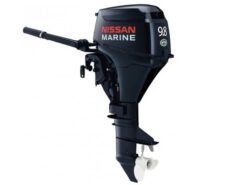
Ask five different boat dealers what “Nissan outboard” means and you’ll get five slightly different answers, because the brand has meant a few different things over the decades. But if you’re shopping Nissan outboard motors for sale right now, you’re almost certainly looking at the small stuff — the 6HP through 9.8HP portable four-strokes that show up on inflatable dinghies, aluminum jon boats, sailboat transoms, and as the spare motor tucked in the lazarette of a bigger boat. That’s the class we stock, and it’s a genuinely good one if you understand what you’re buying and why it exists.
We currently have several of these in stock and ready to ship worldwide, including the Nissan 9.8 Hp NSF9.8A3EPT2 and the Nissan 6 Hp NSF6CD2, along with a handful of other model-year variants in this same horsepower range. This guide walks through what these motors actually are, where they come from, what the specs mean in practice, and who should — and shouldn’t — be shopping this brand.
Table of Contents
Who Actually Builds a Nissan Outboard
Here’s the part that trips people up. Nissan the car company doesn’t design or build these engines. Nissan Marine’s small outboard lineup has, for a long time, come off the same production lines as Tohatsu — a Japanese outboard manufacturer that’s been building small marine engines since the 1950s.
The two companies had a long-standing partnership where Nissan-branded motors in this horsepower class were engineered and assembled by Tohatsu, then sold under the Nissan Marine name through Nissan’s own dealer network. It’s a well-documented arrangement, not a rumor or a knockoff situation — you can read about Tohatsu’s own outboard history and engineering on Tohatsu’s official site if you want the manufacturer’s side of it.
What that means for you as a buyer is pretty simple: a Nissan 6HP or 9.8HP shares its bones with the equivalent Tohatsu model. Same block architecture, same basic engineering philosophy, same reputation for being light and reliable in this size class. The parts bin overlaps heavily too, which is one of the reasons these small Nissan motors have stayed easy to service for as long as they have.
We’re not going to oversell the relationship — they’re not identical badge-for-badge in every trim and year — but if someone tells you a Nissan portable outboard is “just a rebadged something,” they’re not far off, and that’s not a knock on the motor. Tohatsu-built small outboards have a solid track record.
What You’re Actually Looking At: The 6HP–9.8HP Class
Nissan outboard motors for sale in this range aren’t trying to be your main boat engine unless your boat is small. They’re portable four-strokes built to be carried, clamped on, and forgotten about until you need them. Think dinghy tenders getting rowed or motored out to a mooring, 10-14 foot aluminum boats on a farm pond or small lake, sailboats that need an auxiliary for getting in and out of a marina, and — very commonly — a backup motor riding in a rack on a bigger boat in case the main engine quits offshore.
The defining trait of this class is weight. A 6HP model typically comes in around 55-60 lbs and a 9.8HP model in the 90-100 lb range depending on shaft length and whether it’s got electric start — light enough for one person to lift onto a transom, which matters a lot more than people expect until they’re standing on a dock trying to hang a 200 lb motor by themselves.
Typical Specs Across the 6HP-9.8HP Nissan Outboard Class
Exact numbers shift a little from model year to model year, but here’s what’s typical across this horsepower class so you know what you’re comparing when you’re looking at listings:
| Spec | Typical Range (6HP-9.8HP class) |
| Displacement | Roughly 123cc to 212cc, single or twin cylinder depending on model |
| Weight | Approx. 55-98 lbs (25-42 kg) depending on HP, shaft length, and start type |
| Shaft length options | Short (15″) and Long (20″) |
| Cooling | Water-cooled with a water pump (not air-cooled — a common misconception on small outboards) |
| Fuel tank | Integral top-mounted tank on most models, some with external tank option |
| Starting | Manual pull-start standard, electric start available on higher-spec 9.8HP models |
| Gear ratio | Typically in the 2.08:1 to 2.15:1 range for this class |
| Recommended oil | 4-stroke marine oil, typically 10W-30 FC-W rated (check your specific model’s manual) |
| Noise level | Notably quiet at idle and trolling speed compared to two-stroke portables of the same era |
| Portability | Built with an integrated carry handle; one-person liftable in most configurations |
A quick note on that water-cooling line because it comes up a lot: people sometimes assume a motor this small must be air-cooled like a lawnmower engine. It’s not. These run a proper water pump pulling from the lower unit, same basic principle as a much bigger outboard, just scaled down. That’s part of why they hold up to sustained running better than you’d expect from something you can carry with one hand.
The Models We Carry
Right now our stock includes several Nissan outboard motors for sale across this exact size range, and the model number differences are worth understanding before you pick one. On the 9.8HP side, we’ve got the Nissan 9.8 Hp NSF9.8A3EPT2, which is the electric-start, power-tilt configuration — the “EPT” in the model code tells you that — and the Nissan 9.8 Hp NSF9.8A31, a more basic manual-start version. Same core engine, different feature set, different price point.
We also stock what’s technically the 8HP variant of that same engine family, the Nissan 8 Hp NSF9.8A32, plus two other 8HP models — the Nissan 8 Hp NSF8A3EF2 and the Nissan 8 Hp NSF8A3. On the lighter end, the 6HP lineup includes the Nissan 6 Hp NSF6CD2, the Nissan 6 Hp NSF6CD1, and the Nissan 6 Hp NSF6C4.
If you’re not sure which model code maps to which features, ask us directly before you order — the digits after the HP number aren’t marketing fluff, they’re a real spec shorthand for shaft length, start type, and control setup.
Short Shaft or Long Shaft: Which Do You Need
This is the spec people get wrong most often when they’re shopping Nissan outboard motors for sale on their own, and it’s an easy mistake to avoid if you just measure first. Shaft length has to match your transom height, not your boat’s overall size. Short shaft (15″) suits most dinghies, small tenders, and low-transom aluminum boats. Long shaft (20″) is what you want on most sailboats with a motor well or bracket, and on boats with a taller transom generally.
Mount the wrong length and you’ll either have the propeller too shallow — cavitating and losing thrust — or too deep, dragging and creating unnecessary drag and noise. Measure from the bottom of the transom straight up to the top before you order, and if you’re unsure, send us that measurement and we’ll tell you which of our in-stock models fits.
Why Four-Stroke Matters More on a Small Motor Than a Big One
Every Nissan outboard in this class we carry is a four-stroke, and on a small portable that difference is more noticeable than it is on a big engine. A two-stroke this size runs a gas-oil mix, smells like it, and idles rough. A four-stroke runs straight gas with oil in its own separate sump, idles smoother, uses noticeably less fuel at trolling speed, and doesn’t leave a sheen on the water behind your dinghy.
For a tender you’re rowing passengers in, or a sailboat auxiliary you’re running near a marina, that’s not a minor comfort detail — it’s the difference between an outboard that’s pleasant to use every day and one you only start when you have to. It’s also part of why the noise level on these tends to surprise people the first time they run one; at idle and trolling speed a well-tuned four-stroke in this class is genuinely quiet compared to older two-stroke portables of similar horsepower.
Who Should Actually Buy One
This isn’t a motor for everybody, and we’d rather tell you that upfront than sell you the wrong engine. A small Nissan outboard makes sense if any of these describe you:
- You’ve got a dinghy or tender under 12 feet that needs to get from the mooring to shore and back without drama.
- You’re running a small aluminum boat on lakes or protected water and don’t need to fight current or big chop.
- You’ve got a sailboat and need a reliable auxiliary that isn’t going to weigh down the transom or your budget.
- You want a genuine backup motor for a bigger boat — something you can actually lift into a rod locker or lazarette instead of a second full-size engine.
- You value being able to carry the whole motor by yourself, on and off a dock, in and out of a car trunk, without a hoist.
If instead you’re planning to push a heavier boat, run offshore regularly, or need to plane out with passengers and gear, this class isn’t it — you’d want to be looking further up the horsepower ladder, and our post on how to choose the right outboard motor for your boat walks through that sizing decision in more depth.
Nissan vs. Buying a Bigger Motor From an Unfamiliar Brand
We see this comparison a lot: someone’s cross-shopping a used 9.8HP Nissan against a new but unfamiliar-brand 15HP motor for roughly the same money. It’s tempting to think more horsepower always wins. It doesn’t, not automatically.
A Nissan in this class has decades of established engineering behind it through the Tohatsu relationship, a mature parts ecosystem, and a track record you can actually research. An unfamiliar brand’s 15HP might genuinely be a fine motor, or it might be a rebadge of something with thin parts support and a service network that doesn’t exist outside its home country.
Horsepower on a spec sheet doesn’t tell you anything about whether you’ll find a water pump impeller for it in three years, or whether the shop down the road has even heard of the brand. For a small tender or backup motor especially, we’d rather see someone buy a well-supported 6HP than an unsupported 15HP they’re guessing about.
There’s also a resale angle worth thinking about. A recognized name with a real parts trail holds value better at the point you decide to sell it, because the next buyer can research it the same way you’re doing right now. An obscure brand’s motor, even a decent one, tends to sit on the used market longer and sell for less relative to its condition, simply because buyers can’t verify what they’re looking at. That’s less true of engines in this class than it used to be, but it still shows up in how quickly a listing moves.
That said, brand pedigree isn’t a substitute for buying the motor itself in good condition — which brings us to the part of this that actually matters most if you’re shopping used.
Why Buying Genuine, Tested Units From a Specialist Dealer Matters
Small portable outboards are exactly the size and price point that attract sketchy listings — because they’re cheap enough to ship internationally in bulk and small enough that a buyer can’t easily verify what they’re getting from photos alone. A few things we’d tell anyone shopping this category, Nissan or otherwise:
- Serial numbers should match across the block, the lower unit, and the paperwork. A mismatched serial number is one of the clearest signs a motor’s been rebuilt from parts of two or three donor engines, or that a stolen unit’s tag has been swapped.
- Counterfeit parts circulate more in this size class than people realize — gaskets, impellers, and carb components especially. A motor that’s been “serviced” with off-brand parts can run fine for a while and then fail in ways that are hard to diagnose later.
- Compression and spark testing before sale isn’t optional if you’re buying sight unseen. A dealer who actually runs and tests every unit before it ships is doing work a private seller usually can’t or won’t do.
- A specialist who handles outboard motors for sale internationally understands export documentation, crating that actually protects a motor in transit, and customs paperwork — which matters a lot more once you’ve paid for the engine and don’t want it stuck at a border. Our guide on outboard motor shipping, crating, freight, and customs covers what that process should look like.
This is really the whole reason to buy from a dealer that specializes in outboards rather than a general classifieds listing. We’re not just moving boxes — every Nissan outboard we sell gets checked before it goes out, and we can tell you the actual condition and history of what you’re buying instead of hoping the photos told the whole story.
If you’re weighing a used unit generally, our piece on what to check before buying a used outboard motor is worth reading alongside this one — a lot of the same red flags apply whether it’s a Nissan, a Tohatsu, or anything else in this size class.
Keeping a Small Nissan Outboard Running
These motors reward basic maintenance more than most people expect, precisely because they’re simple. Fresh gas — not stuff that’s sat in a can for a year — a yearly water pump impeller check if it’s seeing regular use, correct oil at the recommended interval, and flushing after saltwater use will keep a 6HP or 9.8HP Nissan running for a very long time.
We’ve got a full breakdown of the routine work in our outboard motor maintenance guide covering the essential tasks that actually keep engines like these alive, and most of it applies directly to this class of motor.
One thing specific to this size class: because the fuel tank is usually small and integral, these motors get run dry or nearly dry more often than bigger outboards with separate tanks, and running low on fuel repeatedly can pull sediment into the carburetor. It’s a small thing, but it’s the single most common issue we see reported on portables in this range, more than anything mechanical.
Storage matters too, more than owners of bigger boats sometimes expect from something this size. Because these motors are light enough to remove from the transom entirely, a lot of owners store them indoors over winter or between uses rather than leaving them mounted outdoors year-round — and that habit alone adds years to the life of the powerhead and the electrical components. If you’re new to owning a Nissan outboard motor, that portability isn’t just about carrying it to the dock; it’s a maintenance advantage most owners of full-size outboards don’t get to use.
Shipping a Small Outboard Worldwide
One advantage of this size class that doesn’t get talked about enough: shipping cost and complexity. A 60-100 lb outboard crates up smaller and cheaper than a big four-stroke, and we ship these worldwide on a regular basis — whether that’s to a customer restoring a small sailboat in Europe or someone outfitting a fleet of tenders somewhere the local dealer network for Nissan or Tohatsu parts is thin.
Wherever you’re located, if you’re looking at Nissan outboard motors for sale and want the shipping logistics explained before you commit, ask us — we’d rather answer that question upfront than have it be a surprise after checkout.
Common Questions We Get About Nissan Outboard Motors for Sale
Is a used Nissan outboard worth buying over new? Often, yes, especially in this size class. These motors are simple enough mechanically that a well-maintained used unit with moderate hours can outlast a lot of buyers’ actual needs, and the price gap between a tested used unit and a new one is usually significant. The catch is the word “tested” — see the section above on why that matters.
Can I still get parts for an older Nissan outboard? Generally yes, because of the shared parts ecosystem with Tohatsu. It’s one of the practical advantages of this brand relationship — a part that fits the equivalent Tohatsu model frequently fits the Nissan, which keeps older motors serviceable well past when a more isolated brand would leave you stuck.
What’s the difference between the model number suffixes, like A3 vs A3EF2? Those letters and numbers after the horsepower figure encode real differences — shaft length, start type (manual vs electric), tiller vs remote control, and power tilt. It’s worth asking us to confirm the exact configuration on any specific unit rather than assuming from the horsepower alone, since two motors with the same HP rating can be set up very differently.
How long should a small four-stroke Nissan outboard last? With reasonable care — fresh fuel, regular oil changes, a water pump impeller that gets replaced on schedule rather than only when it fails — many owners get well over a decade of use out of these, even with fairly regular running. Hours matter more than calendar age, but low-hour units in this class that have simply sat unused for years need a closer inspection than the hour meter alone would suggest.
The Bottom Line
A small Nissan outboard isn’t trying to be everything to everyone, and that’s exactly its appeal. Built on Tohatsu engineering, light enough to carry with one hand, and simple enough to maintain yourself, it’s the right tool for tenders, small boats, sailboat auxiliaries, and backup power — not for pushing a big boat fast.
If that matches what you actually need, these are dependable, well-supported motors with a real track record behind them. We keep genuine, tested Nissan outboard motors for sale in stock across the 6HP to 9.8HP range and ship them worldwide — reach out and we’ll help you match the right model to your boat instead of guessing from a spec sheet alone.
Posts Widget
- 1

- 2
- 3
- 4


S.H Continental Marine
USA HERALD MAGAZINE INC
Our team is dedicated to providing exceptional customer service.
Email: info@shcontinentalmarine.com
Choose S.H Continental Marine
for your outboard engine needs and enjoy superior quality, exceptional customer service, and unbeatable prices.
