
Marine Engine Oil: The Essential Guide to What to Run and Why It Matters (2026)

Marine Engine Oil: The Essential Guide to What to Run and Why It Matters
Ask ten boat owners what oil they run and you’ll get ten different answers, half of them borrowed from a car manual that has nothing to do with how an outboard actually works. That’s how engines end up with varnished rings, sticky lifters, or a lower unit that smells burnt after one hard season. Getting marine engine oil right isn’t complicated once you know what the engine is actually asking for, but it does mean unlearning a few habits from land-based vehicles.
We sell complete outboard motors across most major brands, new and used, and every one of them leaves our shop with the correct oil already run through it and the right spec written down for the next change. That’s not a small detail. The wrong oil in the crankcase of a modern four-stroke outboard can quietly shorten its life by years, and the failure usually doesn’t show up until well past the point where anyone remembers what was poured in at the start.
Why marine engine oil isn’t just car oil with a boat sticker
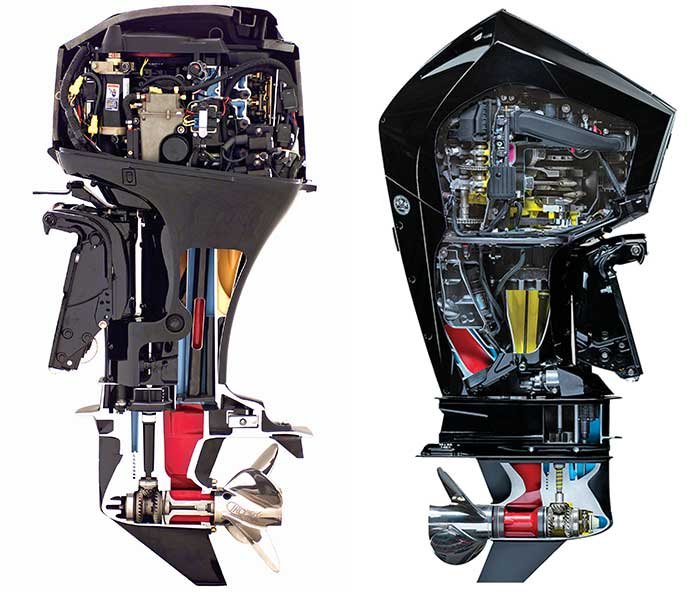
Outboards live a harder life than a car engine in a few specific ways. They run at a much narrower, higher average RPM band for long stretches, they sit vertically instead of horizontally which changes how oil drains and pools, and they’re constantly exposed to moisture, whether that’s humid air, splash, or condensation building up when the engine cools after a run. Car engine oil isn’t formulated to fight rust the way marine oil is, and it isn’t tested for foam resistance the way it needs to be when an engine is being pushed hard at high RPM near open water.
This is why the marine industry has its own certification, FC-W, developed jointly by engine manufacturers and the oil industry specifically for four-stroke outboards and personal watercraft. An oil that meets this standard has been tested for rust protection, foam control, and wear protection under conditions that actually resemble what a boat engine goes through. A bottle that says “marine” on the label without the FC-W mark on it is a marketing claim, not a certification.
Two-stroke and four-stroke: different oil, different job entirely
If you’re running an older two-stroke outboard, the oil isn’t sitting in a crankcase waiting to be circulated by a pump. It’s mixed with fuel (or injected separately on oil-injected models) and burned along with the gasoline, lubricating the piston, rings, and bearings on its way through the engine. Two-stroke marine engine oil is formulated to burn cleanly with minimal ash and carbon buildup, since anything left behind coats the piston crown and spark plugs. Four-stroke oil, in contrast, is not meant to burn at all. It’s designed to stay in the crankcase for the full service interval, so it carries additive packages for detergency, oxidation resistance, and shear stability that a two-stroke oil doesn’t need and shouldn’t have.
Using four-stroke oil in a two-stroke mix, or vice versa, isn’t a small mismatch. It’s a fast way to foul plugs, gum up a two-stroke’s ports, or leave a four-stroke starved of the additive protection it needs over a full season of running.
Viscosity grades: what the numbers actually tell you
Viscosity grade describes how the oil flows at different temperatures, not how “good” it is. A common outboard spec looks like 10W-30 or 25W-40. The number before the W (which stands for winter) describes cold-flow behavior, so a lower number flows more easily on a cold morning start. The number after describes viscosity at operating temperature. Manufacturers publish a recommended grade for a reason: it’s matched to bearing clearances and oil pump capacity for that specific engine, not a rough guideline you can substitute freely. Picking the right grade of marine engine oil before you even open the bottle saves a lot of second-guessing once it’s already in the crankcase.
| Viscosity Grade | Typical Climate Fit | Common Use Case |
|---|---|---|
| 10W-30 | Cold to moderate climates | Most recreational four-stroke outboards, easier cold starts |
| 25W-40 | Warm to hot climates, high load | Sustained high-RPM running, commercial and charter use |
| 0W-40 / 5W-30 synthetic | Wide temperature range | High-performance four-strokes, frequent cold-to-hot cycling |
| TC-W3 two-stroke oil | All climates (mix or injected) | Two-stroke outboards, oil-injected models |
Full synthetic versus conventional: is the extra cost worth it
Conventional marine engine oil does the job it’s rated for and costs less per change, which is why it’s still common in lower-hour recreational engines that get modest seasonal use. Full synthetic holds its viscosity better across temperature swings, resists oxidation longer, and generally allows for a slightly longer interval between changes on engines rated for it. Where synthetic earns its price is in engines that see a lot of hours, run at sustained high RPM, or sit through hot climates where oil breaks down faster. A charter boat running four hours a day benefits from synthetic in a way that a boat used six weekends a season simply doesn’t need to pay for.
Semi-synthetic blends split the difference and are a reasonable middle ground for owners who want better protection than conventional oil without the full synthetic price tag, though they’re less common on marine-specific formulations than in the automotive aisle. Whichever tier you land on, the certification mark matters more than the marketing on the front label.
How often to actually change marine engine oil
Most four-stroke outboard manufacturers call for the first oil change at around 20 hours or after the initial break-in period, since that first run sheds more metal particulate than any change after it. After that, 100 hours or once a year, whichever comes first, is the standard interval for the majority of recreational engines. Engines that see heavy use, saltwater exposure, or sustained high-RPM running (think offshore fishing or towing) often benefit from shortening that interval rather than stretching it. Oil doesn’t wear out on a fixed clock. It wears out based on heat cycles, contamination, and hours run, and a boat that sits most of the year but gets used hard on the weekends it does run should still get changed at least once a season regardless of hour count, because moisture and acid buildup happen even when the engine isn’t turning.
Signs you’re running the wrong oil, or oil that’s overdue
A few things tend to show up before a bigger problem does. Oil that looks milky or has a coffee-with-cream color usually means water intrusion, which is a bigger issue than the oil itself and needs to be tracked down. Oil that smells burnt or has visible metal flecks on the dipstick points to overheating or wear that’s already underway. Harder starting, rougher idle, or a slight increase in exhaust smoke on a four-stroke that didn’t smoke before are all worth paying attention to rather than writing off as normal aging.
| What You’re Seeing | Likely Cause |
|---|---|
| Milky or foamy oil | Water intrusion, possible head gasket or seal issue |
| Burnt smell, dark and gritty texture | Overheating, extended interval, or excess wear |
| Rough idle after a fresh change | Wrong viscosity or non-marine oil used |
| Oil level rising between changes | Fuel dilution, often from prolonged idling or a rich mixture |
Storage season is where oil habits actually get tested
Changing the oil right before winter storage, rather than right after, is one of the more overlooked habits in outboard care. Used oil carries acidic combustion byproducts and moisture that sit in the crankcase all winter, slowly working on bearing surfaces while the engine isn’t running to circulate anything. Fresh marine engine oil going in before a long layup means the engine wakes up in spring coated in clean oil instead of months-old acidic residue. It’s a small step that costs one oil change’s worth of money and materially changes what condition the internals are in when the season starts again.
Engines that leave already correctly specified
Every outboard we sell is delivered with the correct oil type and viscosity documented for that specific engine, so you’re not left guessing between what a generic bottle recommends and what the manufacturer actually calls for. A sample of what’s currently in stock, spanning the range from portable kickers to full-size four-strokes:
| Motor | HP | Displacement | Approx. Price (USD) |
|---|---|---|---|
| Yamaha F30LEHA | 30 HP | 747cc, 3-cyl | $3,400 |
| Yamaha T50LB High Thrust | 50 HP | 996cc, 4-cyl | $4,350 |
| Tohatsu MFS60D | 60 HP | 956cc, 4-cyl EFI | $5,450 |
| Yamaha F60LB | 60 HP | 996cc, 4-cyl | $4,780 |
| Yamaha F90XB | 90 HP | 4-cyl EFI | $5,130 |
| Yamaha LXF425ESA V8 | 425 HP | V8, 35" shaft | $24,800 |
Mixing brands and the myth of “any oil that fits the grade”
Viscosity grade and API service category are only part of the picture. Marine-specific additive packages differ between manufacturers, and while most FC-W certified oils are broadly compatible with each other, switching brands mid-season isn’t the concern it’s sometimes made out to be as long as both products carry the correct certification for your engine type. What actually causes problems is reaching for whatever’s on the shelf at a gas station without checking for the FC-W mark at all, or assuming an oil labeled for small engines like lawn equipment is interchangeable with outboard-rated oil. It usually isn’t, and the additive packages are built for a completely different duty cycle.
Oil filters matter as much as the marine engine oil itself
An oil change that skips the filter is only half a job. Contaminants suspended in old oil get trapped in the filter media, and running fresh marine engine oil through a saturated old filter reintroduces exactly what you just paid to remove. Most four-stroke outboards use a spin-on filter that should be replaced at every oil change, not every other one. It’s a small part of the total cost of a service and one of the easiest things to skip when someone’s trying to save a few dollars on a routine change.
What actually happens inside the engine when oil is neglected
Oil does more than reduce friction between moving parts. It carries heat away from the cylinder walls and bearings, suspends combustion byproducts so they don’t settle on internal surfaces, and forms a thin protective film that prevents metal-to-metal contact during startup, which is when engines see the most wear. Neglected oil loses viscosity, breaks down under heat, and stops doing all three jobs well before it looks obviously dirty. By the time oil looks black and gritty on the dipstick, the engine has usually already been running on reduced protection for longer than most owners realize.
Common mistakes we see from new outboard owners
Topping off instead of fully draining and replacing, which just dilutes old oil rather than replacing it. Using automotive oil because it was already in the garage. Skipping the interval because the boat “doesn’t get used that much,” ignoring that time and moisture do damage independent of hours run. Guessing at viscosity instead of checking the owner’s manual or the tag on the engine itself. And overfilling, which on some four-strokes causes the crankshaft to churn the oil into foam, reducing lubrication rather than improving it.
What using the wrong oil does to your warranty
Most outboard manufacturers write warranty language that ties coverage to documented maintenance, and oil is usually the first thing an adjuster checks when a claim comes in for an internal failure. If a bearing spins or a cam lobe wears prematurely and the service record shows a non-certified oil or a skipped interval, that’s grounds to deny the claim even if the oil itself wasn’t the direct cause. Keeping receipts, or at minimum a log of dates, hours, and the specific marine engine oil product used, is cheap insurance against a dispute that could otherwise cost thousands. We provide documented service records with every engine we sell precisely so that history is never in question if a warranty question comes up down the line.
What an oil analysis report actually tells you
For owners running higher-hour engines or commercial fleets, sending a used oil sample to a lab for analysis is a cheap way to catch problems before they become expensive ones. The report typically flags wear metals like iron, copper, and aluminum in parts-per-million, along with coolant contamination, fuel dilution, and remaining additive strength. A single reading in isolation tells you less than a trend across two or three consecutive changes; a slow climb in a specific wear metal often points to a specific component wearing, well before it would show up as a performance problem you could actually feel at the helm. It’s not a step most weekend boaters need, but for anyone running an engine hard and often, it turns oil changes from a routine chore into an actual diagnostic tool.
Climate and regional buying considerations
Owners in consistently hot climates, the Gulf Coast, Southeast Asia, the Mediterranean in summer, tend to lean toward the heavier end of the viscosity range and shorter change intervals, since sustained high ambient temperature accelerates oil breakdown. Owners in colder, more seasonal climates benefit more from a lighter winter-weight oil that flows properly on a cold morning start after the boat’s been sitting. Because we ship marine engine oil and complete engines worldwide, we factor destination climate into the recommendation rather than defaulting to a single generic spec regardless of where the boat is actually going to run. A recommendation built for a lake in a temperate climate isn’t automatically right for a boat that’s going to sit in tropical heat most of the year, and the difference shows up in how fast the oil actually breaks down between changes.
Keeping a simple maintenance log
A surprising number of oil-related engine problems trace back to nothing more complicated than losing track of when the last change actually happened. A logbook, or even a strip of tape on the cowling with a written date and hour reading, removes the guesswork. Note the date, engine hours if the model tracks them, the specific product and viscosity used, and the filter part number. It takes thirty seconds after each change and pays for itself the first time you’re trying to remember whether this season’s change actually happened or you’re thinking of last year’s.
Buying marine engine oil and engines worldwide
We ship both complete outboards and oil worldwide, and pairing a new engine order with a first-service oil supply matched to that exact model is a straightforward add to any order rather than a separate errand once the motor arrives. Import duties and freight costs vary by destination country, and we walk through the landed total before anything ships so there’s no surprise at delivery. If you already own an engine and just need the correct spec confirmed, send us the model and serial number and we’ll tell you exactly what it takes, not a generic range.
Frequently asked questions
Can I use automotive oil in my outboard in an emergency?
It’s not recommended as a regular practice, but in a genuine emergency where no FC-W oil is available, a high-quality automotive oil of the correct viscosity is better than running the engine dry. Change it out for proper marine oil as soon as you reasonably can.
How do I know what grade my engine takes?
Check the owner’s manual or the specification tag near the oil fill cap. If you bought the engine from us, the correct grade and interval are documented in your paperwork, and we’re happy to confirm it by serial number.
Does synthetic oil really extend the change interval?
On engines rated for it, yes, though most manufacturers still cap the maximum interval regardless of oil type. Check your specific engine’s documentation rather than assuming synthetic doubles the interval automatically.
Why does my oil look milky right after a cold start?
A small amount of condensation is normal in cold, humid climates and usually clears once the engine reaches operating temperature. Oil that stays consistently milky across multiple runs points to a real water intrusion issue worth having checked.
Do you sell oil separately from engines?
Yes. Tell us your engine model and we’ll confirm the correct viscosity and certification and get it shipped alongside parts or on its own.
Is more expensive marine engine oil always better?
Not automatically. Price often reflects synthetic content and additive quality, but the right question is whether your engine’s duty cycle actually benefits from that upgrade. A lightly used weekend boat doesn’t need the same spec as a charter boat running four hours a day.
Can I switch between conventional and synthetic oil each season?
Generally yes, as long as both meet the correct FC-W certification and viscosity grade for your engine. There’s no seal-compatibility issue with modern marine oils the way older myths about automotive synthetics once suggested.
The bottom line
Getting marine engine oil right isn’t about finding the most expensive bottle on the shelf. It’s about matching FC-W certified oil, correct viscosity, and a sensible interval to the specific engine you own, and treating storage-season changes as seriously as mid-year ones. Every engine in our current inventory ships with the correct spec documented from day one, so browse what’s in stock or send us your engine details if you’re sourcing oil for a motor you already own. For more on keeping the rest of the engine in good shape, see our guide to outboard motor spare parts, and if a full repower is on the table, check our current marine engine discounts. For the industry certification standard referenced above, see the NMMA FC-W oil certification program and the API engine oil service categories.
Posts Widget
-
1

-
2

-
3

-
4


S.H Continental Marine
USA HERALD MAGAZINE INC
Our team is dedicated to providing exceptional customer service.
Email: info@shcontinentalmarine.com
Choose S.H Continental Marine
for your outboard engine needs and enjoy superior quality, exceptional customer service, and unbeatable prices.