
Outboard Motor Testing: How We Verify Every Engine Before It Ships

If you’ve ever stood on a dock watching a mechanic run an outboard up to wide-open throttle with a flush hose clamped on, you’ve watched outboard motor testing in action. It looks almost casual from the outside — a guy listening to the engine, glancing at a tachometer, maybe sniffing the exhaust. But that fifteen-minute routine is the difference between an engine that runs clean for the next decade and one that leaves you drifting two miles offshore with a dead battery and a boat full of people who trusted you to plan ahead.
We test every engine that comes through our shop before it ever gets listed for sale, and honestly, it’s the part of the job that separates a real marine dealer from someone flipping engines off a container ship. Anyone can bolt a motor to a transom and snap a photo for the listing. Proper outboard motor testing means running the thing hard enough, long enough, and with enough instrumentation that you actually know what you’re selling — or what you’re about to buy.
What outboard motor testing actually covers
There’s a lot more to it than “does it start.” A full test sequence usually runs through five or six distinct checks, and skipping any one of them is how bad engines end up in good boats.
Compression testing comes first, before the engine even touches water. A compression gauge threaded into each cylinder tells you whether the rings, valves, and cylinder walls are still doing their job. On a healthy four-stroke outboard you’re generally looking for cylinders within about 10% of each other — a big spread between cylinders is usually the first sign of a tired engine, long before it shows up as rough idle or a check-engine code.
Cold start behavior gets checked next, because a motor that’s been sitting tells you things a warmed-up motor hides. Does it fire on the second or third pull (or first key-turn, if it’s electric start)? Does it settle into a smooth idle within thirty seconds, or does it hunt and surge? Smoke color matters here too — light haze on first start is normal on a lot of four-strokes, but blue smoke that lingers past the first minute usually means oil is getting into the combustion chamber somewhere it shouldn’t be.
Water testing on a flush attachment lets us run the lower unit and cooling system without putting the boat in the water. We’re watching the tell-tale stream (the little jet of water that confirms the water pump is circulating coolant), listening for gear whine in neutral and in gear, and checking the shift linkage moves cleanly between forward, neutral, and reverse without grinding.
Wide-open throttle (WOT) testing is where you really find out what an engine is made of. This is the test most private sellers skip entirely, because it takes a proper test tank or open water, a tachometer, and about ten minutes of running an engine flat out — something a lot of people are nervous to do on a motor they don’t own. But WOT RPM is one of the single most useful numbers in outboard motor testing, because every manufacturer publishes a target WOT range for each model, and if the engine can’t reach it, something’s wrong — a fouled prop, a lean fuel mix, timing that’s drifted, or worse.
The ISO 8665 standard, and why it matters more than most buyers realize
Outboard horsepower ratings aren’t just a number a manufacturer picked because it sounded good. Power measurement and declaration for small craft propulsion engines is governed internationally by ISO 8665, which sets out exactly how crankshaft power has to be measured, corrected for atmospheric conditions, and declared. It’s a bit dry to read, but it’s the reason a “60 HP” engine from one manufacturer performs roughly like a “60 HP” engine from another, instead of horsepower being a marketing number that means whatever a company wants it to mean.
When we run outboard motor testing on anything in our inventory, we’re essentially checking that the engine still lives up to its factory rating under that same logic — corrected for the day’s air temperature and humidity, not just “it revved to some number that sounded about right.” That’s a meaningfully different standard than what you get from a private seller who ran the boat around the lake once and called it good.
What we actually look for, HP class by HP class
Every horsepower class has its own personality, and part of good outboard motor testing is knowing what “normal” looks like for the specific engine on the bench. A 2.5 HP portable behaves nothing like a 425 HP V8, and testing them the same way misses problems in both directions.
Small portables — think a 2.5 HP single-cylinder or a 4 HP — run a tight, high WOT RPM band, usually somewhere in the 4,500 to 6,000 RPM range depending on the model, because there’s so little displacement that the engine has to spin fast to make usable power. Testing these is mostly about clean carburetion, since these are simple engines with no electronics to hide behind — if the idle is rough or it bogs on acceleration, it’s almost always a fuel or spark issue you can diagnose on the spot.
Mid-range four-strokes — the 9.9 HP, 15 HP, 30 HP, and 40 HP class — are the engines we see most often for tenders, small skiffs, and pontoon boats. WOT testing on these typically targets somewhere around 5,000 to 6,000 RPM, and because most buyers in this range are running the boat as daily transportation rather than a toy, we spend extra time on the shift testing and idle stability, since that’s what gets used every single trip.
Move up to the 60 HP and 70 HP range, plus the Tohatsu 60 HP we carry, and outboard motor testing starts to include a real load test — running the engine under a propeller load that approximates what it’ll see on a mid-size center console or bay boat, not just free-revving on a flush hose. A motor can sound perfectly healthy revving with no load and still fall flat once there’s a hull and a load of gear pushing against it.
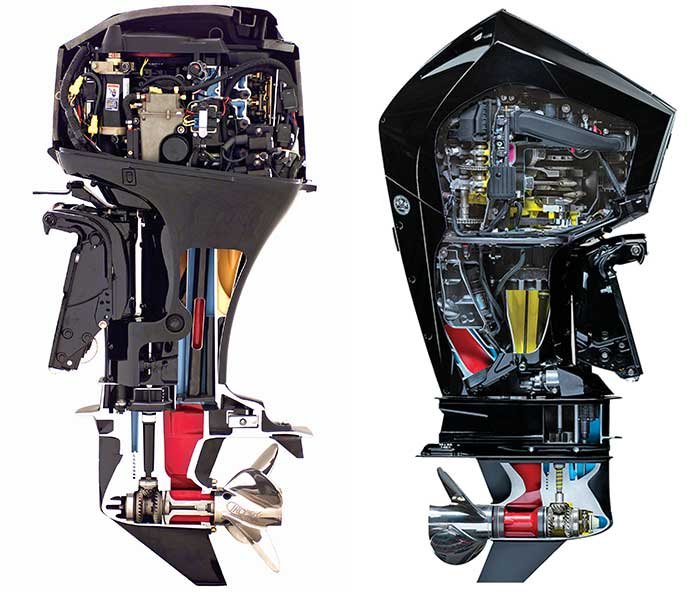
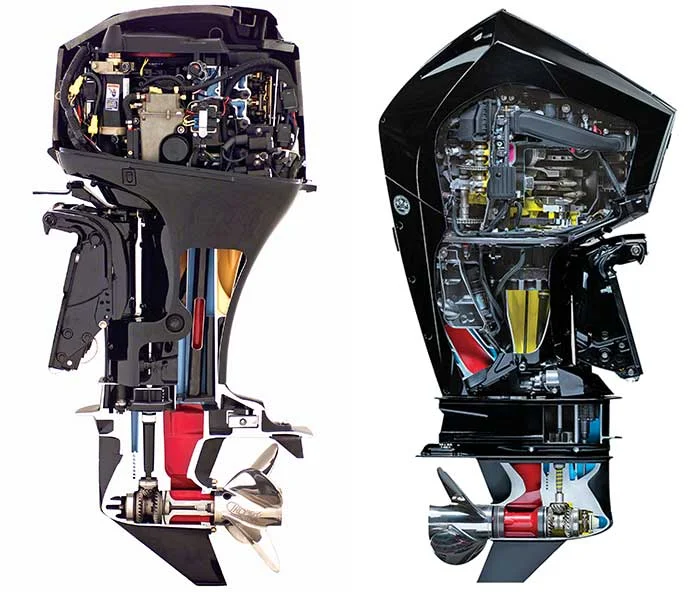
At the top end — our 90 HP V MAX SHO and the 425 HP V8 lineup — testing gets a lot more involved. These are engines with multiple cylinder banks, electronic fuel injection, and drive-by-wire throttle bodies, so we’re pulling diagnostic codes through the manufacturer’s software in addition to the mechanical checks, checking fuel rail pressure, and confirming all cylinders are contributing evenly under load. A big V8 running on seven of eight cylinders can still start, idle, and even push a boat — it just does it while burning noticeably more fuel and making noticeably less power than it should, which is exactly the kind of problem that outboard motor testing is designed to catch before it becomes your problem.
Fuel consumption testing
Fuel burn is one of the most useful — and most ignored — numbers in outboard motor testing. Most manufacturers publish a fuel consumption curve across the RPM range, and a properly tuned engine should track fairly close to that curve at cruise and at WOT. As a rough real-world guide across the four-stroke lineup we carry, a 9.9 HP engine at cruise typically burns somewhere around 0.5 to 1 gallon per hour, a 60 HP engine around 3 to 5 gallons per hour at cruise, and a 90 HP SHO — which is built specifically to burn less fuel than older engines in its class — often comes in noticeably better than that at the same load, which is part of why the V MAX SHO series built a reputation among guides and charter operators who run engines hard every single day.
When a used engine burns noticeably more fuel than its published curve suggests it should, that’s rarely random. It usually points to a fouled injector, a fuel-air mixture running rich, or timing that’s drifted from spec — all things that show up clearly during a proper fuel-flow test but are invisible if you just look at the engine sitting on a transom.
Sea trial testing: what actually happens on the water
Bench and flush testing tell you a lot, but nothing replaces putting the engine on a hull, in open water, and running it the way it’ll actually be used. A real sea trial checks:
- Time to plane and hole-shot acceleration, which tells you whether the prop pitch actually matches the boat and load
- WOT RPM under real load, compared against the factory-published range for that model
- Steering feel and vibration at cruise speed, since a vibration that only shows up at 4,000 RPM often means a bent prop shaft or an out-of-balance prop that a dockside check would never catch
- Trim and tilt response, both under power and at rest
- Cooling system performance under sustained running, not just the first two minutes
- How the engine settles back to idle after a hard run — a slow, hunting return to idle can point to a carburetor or idle-air-control issue that only shows up once the engine’s fully warmed
Reputable sea trial checklists, including guidance published by the American Boat and Yacht Council, cover most of this same ground for a reason — these aren’t arbitrary checks we invented, they’re the industry-standard points that catch real problems before a buyer does. This is also where prop matching gets confirmed. An engine can pass every bench test and still underperform badly on the water if the propeller pitch is wrong for the boat and load — too much pitch and the engine can’t reach its rated WOT RPM, too little and it over-revs without translating into real speed. Good outboard motor testing always includes checking the WOT RPM against spec on the actual boat it’ll be used on, or as close to that load as we can simulate.
Reading a spec sheet against real test numbers
A spec sheet tells you what an engine is supposed to do. Outboard motor testing tells you what it actually does. The gap between those two numbers, if there is one, is usually small on a healthy engine and gets bigger fast on one that’s been neglected. Here’s a rough snapshot of what we look for across a few of the horsepower classes we carry regularly, based on manufacturer specifications we confirm during testing:
| Engine class | Typical dry weight | Target WOT RPM range | Approx. cruise fuel burn |
|---|---|---|---|
| 2.5–4 HP portable | 29–37 lbs | 4,500–6,000 RPM | 0.2–0.4 gph |
| 9.9–15 HP | 84–101 lbs | 5,000–6,000 RPM | 0.5–1.2 gph |
| 30–40 HP | 165–210 lbs | 5,000–6,000 RPM | 1.5–3 gph |
| 60–75 HP | 224–260 lbs | 5,000–6,000 RPM | 3–5 gph |
| 90 HP (incl. V MAX SHO) | 335–359 lbs | 5,000–6,000 RPM | 4–7 gph |
| 425 HP V8 | ~660–730 lbs | 5,000–6,300 RPM | 25–35+ gph |
These numbers shift a bit by exact model and prop, which is exactly why outboard motor testing on the specific unit matters more than trusting the printed spec sheet alone. Two engines with an identical listing can behave differently on the water depending on hours run, how they were stored, and whether they’ve had consistent maintenance — a test tells you which one you’re actually getting.
What a proper test report should include
If a seller can’t hand you actual numbers — compression per cylinder, WOT RPM achieved, fuel type and mix ratio for two-strokes, hours if known, and notes on cosmetic or mechanical condition — you’re not getting a tested engine, you’re getting a guess with a price tag. A written record from outboard motor testing should be specific enough that you could hand it to your own mechanic and they’d know exactly what was checked and what the results were, not a vague “runs great” in a listing description. We put this in writing for every engine we sell because it’s the only fair way to sell something a buyer can’t inspect in person before it ships.
Two-stroke versus four-stroke: different tests, different tells
We still carry the occasional two-stroke, like our E75BMHL, and testing one of these is a genuinely different process from testing a four-stroke. Two-strokes run on a fuel-oil mixture (or oil injection), so part of the test is confirming the oil injection pump is actually delivering oil at the right ratio across the RPM range — starve a two-stroke of oil for even a few minutes at high RPM and you can seize a piston. Compression testing matters just as much, but the acceptable idle behavior is different too; a two-stroke idling a little rougher than a four-stroke is often completely normal, not a red flag, and knowing that distinction is part of what real outboard motor testing experience looks like.
Testing used engines versus new engines
New engines still get tested — every new outboard leaving a dealership should get a run-in and functional check — but the stakes are different with used inventory. A new engine’s problems, if any exist, are usually manufacturing defects that show up in the first hours of running. A used engine’s problems are usually wear, neglect, or damage from however the previous owner treated it, and those don’t always announce themselves.
That’s why every used engine we sell goes through the full sequence: compression check, cold start, flush test, and a WOT run either on a test tank or a sea trial, plus a visual inspection of the powerhead, lower unit gear oil (checking for the milky look that means water intrusion), and the anodes. We’d rather find a problem before it’s listed than have a buyer find it a week after delivery.
Buying with confidence, wherever you’re located
We ship outboard motors worldwide, and that distance is exactly why documented outboard motor testing matters so much to us. If you’re buying an engine for a fishing operation in Southeast Asia, a tender for a charter fleet in the Mediterranean, a workboat in West Africa, or a bay boat on the Gulf Coast, you’re not going to be standing next to us when the engine leaves the shop. The test results, the compression numbers, the WOT RPM on the water — that’s the paper trail that lets you buy an engine you’ve never touched in person and still know exactly what you’re getting.
Every listing includes the specifications that matter: horsepower, shaft length, weight, displacement, and fuel type, alongside the condition and testing notes for that specific unit. If you’re comparing options, our 90 HP F90JB and F90XB sit at similar horsepower but different shaft lengths and control setups, and that kind of detail is exactly what a pre-sale test confirms — nobody wants to find out the shaft length is wrong after the engine’s already on a pallet headed to port. If you want to go deeper on how horsepower, prop pitch, and RPM all interact once the engine’s actually running, our breakdown of marine engine performance covers that side of things in detail.
Export packaging is part of the process too, not an afterthought tacked on after testing wraps up. An engine that passed every stage of outboard motor testing can still show up damaged if it wasn’t drained, crated, and braced properly for a multi-week ocean crossing. We flush the cooling system, stabilize the fuel, secure the lower unit, and crate to freight standards before anything leaves the warehouse, so the engine that arrives performs the same as the engine we tested — not a corroded, rattled version of it.
Frequently asked questions about outboard motor testing
How long should an outboard run during testing before you trust the results?
A short run tells you almost nothing. We like to see at least fifteen to twenty minutes of running time across idle, cruise, and WOT before calling an engine sold-ready, since a lot of cooling and fuel-delivery issues only show up once the engine’s fully up to operating temperature.
Can you test an outboard without putting it in the water?
Yes, using a flush attachment (sometimes called earmuffs) or a test tank, you can safely run most outboards through idle and moderate RPM. Full WOT testing, though, should really happen on a test tank rated for it or on an actual hull, since flush attachments alone don’t move enough water at very high RPM to properly cool some engines.
What’s the biggest red flag during outboard motor testing?
Inconsistent compression between cylinders and an inability to reach the manufacturer’s published WOT RPM range are the two we take most seriously. Either one usually means there’s an underlying mechanical issue, not just a minor tune-up item.
Does testing tell you about the lower unit too?
It should. A full test includes running the engine in forward and reverse to check for gear noise or slipping, plus a check of the gear oil for water contamination, which is one of the most common (and most expensive to ignore) lower-unit problems on used outboards.
Is outboard motor testing different for saltwater versus freshwater engines?
The core testing steps are the same, but we pay extra attention to corrosion on anodes, the powerhead, and the lower unit on any engine that’s spent its life in saltwater. Galvanic corrosion can quietly eat away at components that still test fine mechanically, so a visual inspection alongside the performance testing matters more on saltwater-run engines than freshwater ones.
Ready to look at tested, ready-to-run engines?
Every engine in our current inventory — from the smallest 2.5 HP portable up through the 425 HP V8s — has been through this same testing process before it’s listed. If you want the full test notes and specifications on a specific model, or you’re trying to figure out which horsepower class fits your boat and how it’s used, reach out and we’ll walk through it with you. We’d rather spend twenty extra minutes answering questions before you buy than have you find out something the hard way after.
Posts Widget
- 1

- 2
- 3
- 4


S.H Continental Marine
USA HERALD MAGAZINE INC
Our team is dedicated to providing exceptional customer service.
Email: info@shcontinentalmarine.com
Choose S.H Continental Marine
for your outboard engine needs and enjoy superior quality, exceptional customer service, and unbeatable prices.

One thought on “Outboard Motor Testing: How We Verify Every Engine Before It Ships”
Pingback: Torqeedo Cruise 6.0 TS Price: What This Electric Outboard Costs