
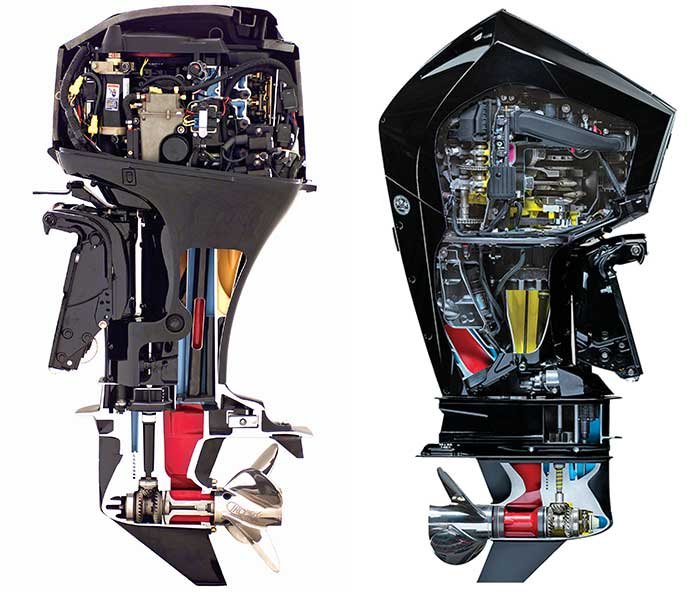
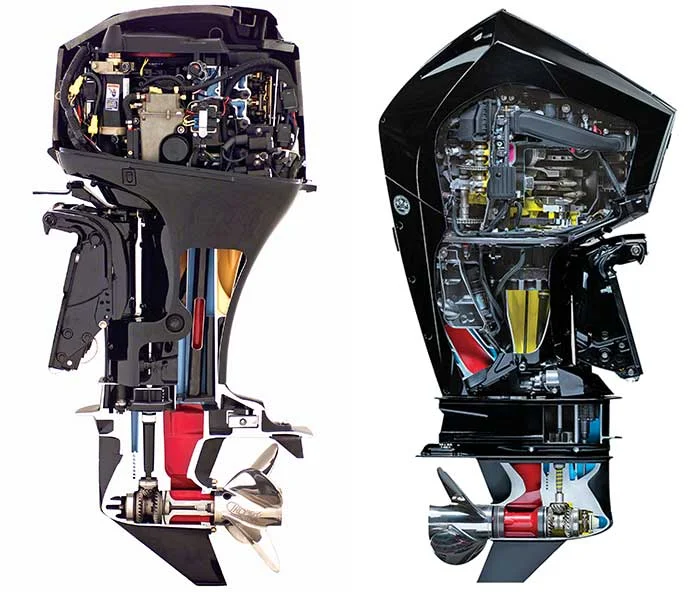
Marine Engine Performance: What Actually Drives Speed, Power, and Efficiency

Ask ten boat owners what “marine engine performance” means and you’ll get ten different answers. For a bass angler it’s hole shot — how fast the boat gets up on plane. For a charter captain it’s cruise-speed fuel burn over an eight-hour day. For someone running a workboat it’s whether the engine holds power under a heavy load without overheating in August. They’re all right, and they’re all measuring the same underlying thing from a different angle: how efficiently an engine converts fuel into usable thrust, and how consistently it does that over time.
We spend a lot of our week talking buyers through exactly this — matching an engine to a hull, a load, and a use case, because marine engine performance isn’t a fixed number stamped on the cowling. It’s the result of several things working together, and getting even one of them wrong quietly costs you speed, fuel, and engine life.
The variables that actually drive marine engine performance
Horsepower gets all the attention because it’s the number on the sticker, but it’s really just one input — and that sticker number itself comes from a standardized measurement process, governed internationally by ISO 8665, so at least the starting point is consistent across manufacturers. Displacement, compression ratio, RPM range, propeller selection, boat weight, and hull design all interact, and changing any one of them shifts how the whole system performs.
Displacement and compression ratio set the ceiling for how much power an engine can make. A larger displacement engine, all else equal, can move more air and fuel per cycle and make more torque at lower RPM — which is part of why our 90 HP V MAX SHO, built around a larger displacement inline-four than older 90 HP engines in its class, holds a reputation for stronger midrange pull than its horsepower number alone would suggest.
RPM range is where a lot of buyers get surprised. Every outboard has a manufacturer-specified wide-open-throttle RPM band — typically somewhere around 5,000 to 6,000 RPM on most modern four-strokes — and marine engine performance depends heavily on the engine actually reaching that range under load. Undercrop it (running below the range at WOT) and you’re leaving power on the table and loading the engine unevenly. Overrev it and you risk real mechanical damage. The propeller is what tunes an engine into its correct RPM range for a given boat, which is why prop selection matters as much as horsepower selection.
Propeller pitch: the adjustment most owners never make
If there’s one lever that affects marine engine performance more than owners realize, it’s propeller pitch. Pitch is the theoretical distance a prop would travel through a solid medium in one rotation, and it directly sets how much load the engine sees. Lower pitch means less load — the engine can rev higher, which is good for lighter, faster boats and better hole shot, but past a certain point you’re just spinning the engine without making proportional speed. Higher pitch means more load per rotation, better for pushing a heavier boat efficiently at cruise, but taken too far, the engine can’t reach its rated WOT RPM at all, which drags down power across the whole rev range and increases wear because the engine is constantly lugging.
A rough rule of thumb: for many outboards, each inch of pitch change shifts WOT RPM by roughly 150 to 200 RPM in the opposite direction. That’s not exact — hull shape, weight, and water conditions all shift it — but it’s close enough to explain why two identical boats with different loadouts often need different props to both reach their correct RPM range. Boat and engine manufacturers that belong to the National Marine Manufacturers Association generally publish prop-selection charts for exactly this reason. Getting this dialed in is one of the highest-value, lowest-cost things you can do for marine engine performance, and it’s often overlooked because the boat “runs fine” even when it’s ten percent off its potential.
Two-stroke versus four-stroke performance characteristics
The performance profile of a two-stroke and a four-stroke of similar horsepower is genuinely different, not just a fuel-type preference. Two-strokes, like our Yamaha E75BMHL, fire once per revolution instead of once every two revolutions, which historically gave them a power-to-weight advantage and sharper throttle response — part of why plenty of racers and tournament anglers still prefer them for pure acceleration. Four-strokes, which now make up the bulk of our inventory across every horsepower class, trade a little of that snap for smoother running, better fuel economy at cruise, quieter operation, and generally longer service intervals. Neither is “better” for marine engine performance in the abstract — it depends entirely on whether you’re optimizing for peak acceleration or sustained, efficient running.
How weight and hull design change the equation
The same engine can feel completely different on two different boats, and it’s not the engine’s fault. A 60 HP engine pushing a light aluminum jon boat will plane almost instantly and cruise efficiently. The identical engine on a heavier fiberglass bay boat loaded with gear, a livewell full of water, and three passengers will take longer to plane, run at a lower cruise speed, and burn more fuel per mile — same engine, completely different performance outcome, because the load changed.
This is why we always ask about the boat, not just the desired horsepower, when someone’s shopping our lineup. Someone comparing our 60 HP F60LB against the 60 HP T60LB tiller model needs to think about boat weight and typical load just as much as the horsepower figure, because marine engine performance is always a relationship between the engine and the hull it’s bolted to, never the engine in isolation.
Fuel efficiency and performance aren’t opposites
There’s a persistent myth that better fuel efficiency means giving up performance. In older two-strokes that was often true. In modern electronic fuel injected four-strokes, it mostly isn’t. Precise fuel metering across the RPM range means the engine gets exactly what it needs at any given throttle position, instead of running rich (wasting fuel, fouling plugs) or lean (risking detonation and heat damage) the way carbureted engines often did away from their tuned sweet spot. That’s a big part of why our SHO-series engines are popular with people running boats commercially — guides, charter operators, ferry services — where fuel cost over a season matters just as much as top speed on any single trip.
Trim angle: the free performance adjustment
Trim doesn’t cost anything to adjust and most owners still leave it alone once they find “good enough.” That’s leaving marine engine performance on the table. Trimming the engine out (bow up) once a boat is on plane reduces the amount of hull dragging through the water, which drops resistance and lets the same RPM translate into more speed and better fuel economy. Trim too far out, though, and the prop starts to ventilate — pulling air down along the shaft and losing bite — which shows up as an RPM flare with no matching speed gain, almost identical to what happens with a damaged prop. The sweet spot is usually a narrow window, and it shifts with load, sea state, and speed, which is why performance-minded operators are constantly making small trim adjustments rather than setting it once and leaving it.
Trim tabs, where a boat has them, work alongside engine trim rather than replacing it — tabs adjust hull attitude independent of the engine, which matters more on heavier boats or when weight is distributed unevenly (all the fuel and gear in the stern, for example). Getting trim and tab adjustment right together is one of the most underrated ways to improve marine engine performance without spending a dollar on the engine itself.
Reading the gauges: what the numbers are actually telling you
Modern outboards, especially anything from about 60 HP up in our lineup — including the 90 HP F90XB and F90JB — come with digital gauges that report far more than speed and RPM. Fuel flow rate, engine temperature, oil pressure, and voltage are all available in real time, and each one is a performance indicator, not just a warning light waiting to trip.
Fuel flow at a given RPM is one of the most honest performance numbers available, because it’s hard to fake. If fuel burn at a set cruise RPM climbs noticeably from what the engine used to burn at that same RPM, something has changed — timing drift, a dirty air filter restricting intake, or an injector not atomizing fuel properly. Catching that early, from the gauge, is a lot cheaper than catching it later from a compression test after the problem’s had months to get worse.
Engine temperature that runs a few degrees higher than normal, even within the “safe” range on the gauge, is worth paying attention to rather than ignoring because it hasn’t hit the alarm threshold yet. A slightly restricted water intake, a thermostat starting to stick, or salt buildup in the cooling passages all show up this way before they show up as an overheat alarm, and all of them quietly cost marine engine performance well before they become an emergency.
Twin and multi-engine performance: staying in sync
On boats running twin, triple, or quad outboard setups — increasingly common on larger center consoles paired with our higher-horsepower engines — marine engine performance depends on more than each engine individually running well. The engines have to stay synchronized in RPM and trim, or the boat pulls to one side, burns fuel unevenly between engines, and puts more load on whichever engine is working harder to compensate. Digital throttle and shift systems on modern engines handle a lot of this automatically, but it still starts with each individual engine performing to spec — a multi-engine setup with one underperforming unit doesn’t average out to “pretty good,” it usually means the whole boat runs worse than if every engine were healthy and simply smaller.
Maintenance and its direct line to performance
An engine’s performance the day it’s tested and its performance eighteen months later are only the same if maintenance kept pace. A few things degrade marine engine performance quietly, without throwing an obvious warning:
- A partially clogged fuel filter reduces fuel delivery at high RPM specifically, since idle and low-speed running need far less flow — so an engine can idle perfectly and still fall short of its rated WOT RPM
- Fouled spark plugs cause misfires under load that aren’t always noticeable at idle but cost real horsepower at cruise and WOT
- A prop that’s picked up even minor edge damage from a light strike creates cavitation, which shows up as an RPM spike without a matching speed increase — the engine’s spinning faster but not translating that into thrust
- Old, degraded lower unit gear oil increases internal drag and can mask early bearing wear that gradually eats into transmitted power
- Corroded or loose electrical connections cause intermittent misfires that are maddening to diagnose because they often only show up under load, not at idle
None of these show up on a static inspection. They show up under load, which is exactly why performance testing on the water — not just a dockside look-over — is part of how we evaluate every engine before it’s listed.
Break-in procedure: the first hours set the tone
How an engine is broken in has a real, lasting effect on marine engine performance for the rest of its service life. Most four-stroke manufacturers specify a variable-RPM break-in period for roughly the first hour or two of running — periods at low RPM followed by brief periods at moderate RPM, avoiding sustained wide-open throttle — to let piston rings seat properly against the cylinder walls. Skip this and run a brand-new engine hard right out of the crate, and you can permanently reduce compression and, with it, the ceiling on how much performance that engine will ever deliver, even if nothing ever technically “breaks.”
What good performance looks like across our lineup
Marine engine performance scales differently than most people expect as horsepower climbs. Small engines in the 2.5 to 15 HP range are almost entirely about reliability and efficient low-speed running — nobody’s chasing top speed on a 9.9 HP tiller or a 15 HP F15SEHA. In the 30 to 75 HP range, performance starts to mean a balance of hole shot, cruise economy, and towing capability for watersports — engines like the 30 HP F30LEHA or the 75 HP F75LB sit right in that balance point. From 90 HP up through our 425 HP V8 lineup, performance becomes about sustained high-speed running, holding power consistently over long offshore runs, and doing it while multiple engines (on twin or triple installations) stay synchronized in RPM and trim.
The 425 HP LXF425ESA and its siblings across shaft lengths represent the far end of that scale — big-block V8 architecture built for boats that need serious, sustained thrust, whether that’s a center console running offshore or a heavier vessel that simply needs a lot of continuous power to move efficiently. Testing and tuning an engine at that scale is a different exercise than a 9.9 HP portable, but the underlying principle is identical: performance is the product of the whole system, not the horsepower number alone.
A quick reference: horsepower class versus typical use
Matching horsepower to actual use is the fastest way to land on good marine engine performance without overspending or underpowering the boat. This is a rough guide based on what we typically recommend, not a hard rule — hull weight and typical load can shift any of these up or down a class:
| Horsepower class | Typical application | Performance priority |
|---|---|---|
| 2.5–6 HP | Dinghies, small tenders, trolling | Reliability, portability |
| 8–15 HP | Small skiffs, kayaks with mounts, backup/kicker use | Low-speed control, fuel efficiency |
| 30–40 HP | Jon boats, light pontoons | Balanced hole shot and economy |
| 60–75 HP | Bay boats, mid-size pontoons | Load-carrying, towing capability |
| 90 HP (incl. SHO) | Center consoles, bass boats | Top speed and acceleration |
| 425 HP V8 | Large center consoles, twin/triple installs | Sustained high-speed offshore performance |
Notice that “performance” means something different in every row of that table. A 2.5 HP engine performing well looks nothing like a 425 HP V8 performing well — the metric that matters shifts with the application, which is really the whole point: marine engine performance is never one universal number, it’s how well the engine does the specific job you bought it for.
Should I upsize horsepower for better resale value?
Sometimes, but it’s not automatic. A boat that’s reasonably powered and well maintained typically holds value better than one that’s overpowered and shows signs of being run hard, because buyers evaluating a used boat are looking at wear just as much as the horsepower rating on the transom.
Buying for performance, wherever you’re running the boat
We sell and ship engines worldwide, and the performance conversation looks a little different depending on where a boat operates. Warmer water temperatures in tropical regions affect cooling system demands. Higher-altitude freshwater lakes change air density and, with it, actual power output versus the sea-level rating on the spec sheet. Saltwater operation changes maintenance intervals and corrosion protection needs, which circles back to sustained performance over the engine’s life. Whether you’re running a fishing fleet in Southeast Asia, a dive tender in the Caribbean, or a workboat on a river system in West Africa, the fundamentals of marine engine performance — correct prop match, clean fuel delivery, disciplined maintenance — apply everywhere, even though the specific conditions shift.
Frequently asked questions about marine engine performance
What’s the single biggest factor most owners get wrong?
Propeller selection, by a wide margin. People will spend hours comparing horsepower numbers between models and then run whatever prop came on the boat, even when it’s clearly mismatched to their load and never lets the engine reach its correct RPM range.
Does more horsepower always mean better performance?
Not necessarily. A boat overpowered for its hull can actually perform worse — harder to trim correctly, more prone to porpoising at certain speeds, and often less fuel-efficient at normal cruise than a properly matched, slightly smaller engine running comfortably within its optimal range.
How much does regular maintenance actually affect performance?
Substantially, and the effect compounds over time. An engine on a consistent maintenance schedule — oil changes, filter changes, gear oil changes, periodic compression checks like the ones covered in our piece on outboard motor testing — typically holds close to its original performance for years. A neglected engine of the same model can lose measurable power and fuel efficiency within a single season.
Can altitude or water temperature really change how an engine performs?
Yes. Air density drops at higher altitude, which reduces the mass of oxygen available for combustion and can measurably cut power output compared to the sea-level rating on the spec sheet. Warmer water reduces cooling efficiency, which is part of why cooling system maintenance matters more in tropical operating conditions.
Talk to us before you decide on horsepower
If you’re trying to figure out what will actually deliver the marine engine performance you need — not just the biggest number you can afford — tell us about your boat, typical load, and how you use it, and we’ll help you match the right engine and configuration. Every engine in our inventory, from the smallest portables to the 425 HP V8s, is tested and specified so you know exactly what performance profile you’re buying before it ships.
Posts Widget
- 1

- 2

- 3

- 4


S.H Continental Marine
USA HERALD MAGAZINE INC
Our team is dedicated to providing exceptional customer service.
Email: info@shcontinentalmarine.com
Choose S.H Continental Marine
for your outboard engine needs and enjoy superior quality, exceptional customer service, and unbeatable prices.
