Outboard Engine Lubrication: The Complete Guide to Every Point That Needs Attention (2026)

Outboard Engine Lubrication: The Complete Guide to Every Point That Needs Attention
Crankcase oil gets all the attention, but it’s only one part of a much bigger picture. A modern outboard has a gearcase full of its own oil, a dozen grease points that never get looked at until something binds up, and moving linkages that quietly corrode themselves stiff if nobody’s paying attention. Complete outboard engine lubrication covers all of it, not just the one dipstick everybody knows to check.
We sell complete outboard motors across most major brands, and part of handing over a motor correctly means walking new owners through every point that needs grease or gear oil, not just the crankcase change interval most people already know about. Skipping the parts nobody talks about is exactly how a perfectly good engine develops a seized tilt tube or a stripped shift linkage a few seasons in.
The gearcase: the lubrication point most owners forget
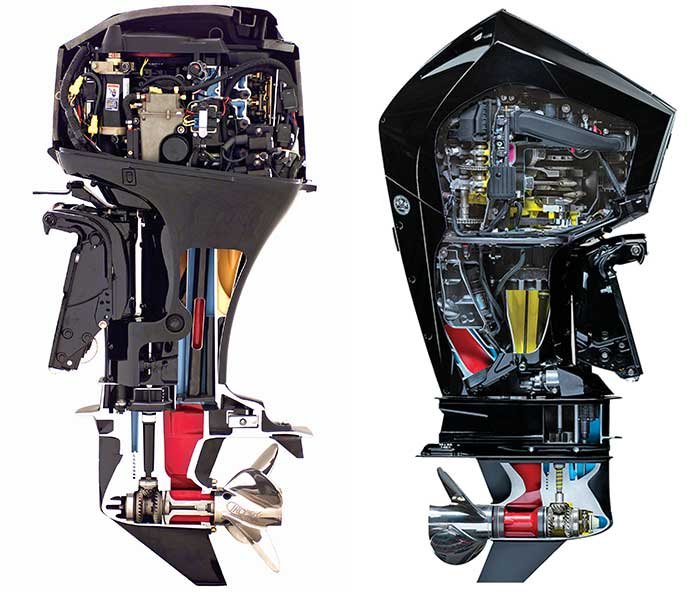
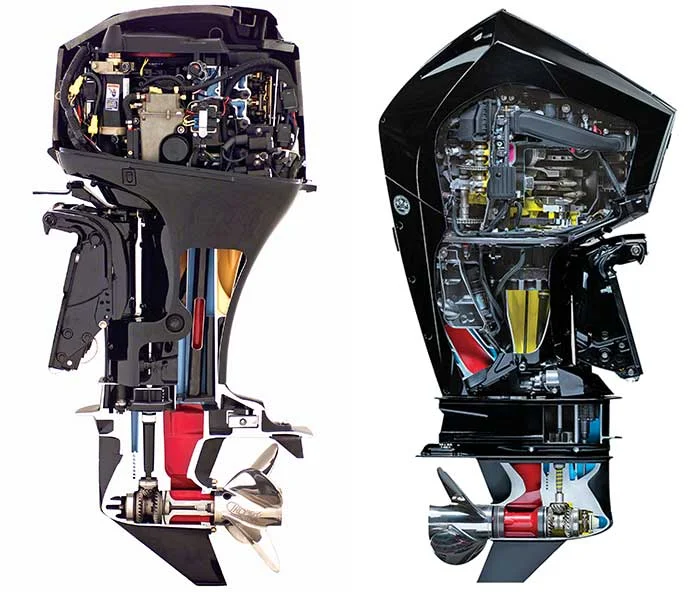
Below the waterline, the lower unit houses gears that transfer power from the driveshaft to the propeller shaft, and they run in their own dedicated gear oil, completely separate from the crankcase. This oil takes a beating: it’s exposed to water intrusion risk through prop shaft seals, it runs hot under load, and it’s the first place a fishing line wrapped around the prop shaft tends to cause damage by cutting a seal. Most manufacturers call for gear oil changes at the same interval as the crankcase oil, once a season or every 100 hours, but the signs of a problem are different. Gear oil that comes out milky or has a metallic sheen almost always means water has gotten in through a worn seal, and running the engine on contaminated gear oil for another season is how a minor seal leak turns into a full gearcase rebuild.
Grease points that get skipped more than any other maintenance item
Beyond oil, proper outboard engine lubrication includes grease at every pivot point that moves: the tilt tube, the swivel bracket, the steering cable fittings, the throttle and shift linkage, and the propeller shaft splines. These points don’t fail dramatically the way a low-oil engine seizes; they just get stiffer and stiffer over a few seasons until steering feels heavy or the motor won’t tilt smoothly, and by then corrosion has usually already set into the fitting itself.
| Grease Point | Recommended Interval | What Happens if Skipped |
|---|---|---|
| Tilt tube and swivel bracket | Every 60 days in saltwater, seasonally in fresh | Corrosion seizure, hard or uneven tilting |
| Steering cable fittings | Seasonally | Stiff or notchy steering feel |
| Propeller shaft splines | Every prop removal, at least annually | Prop seizes onto the shaft, difficult removal |
| Throttle and shift linkage | Seasonally | Rough shifting, delayed throttle response |
| Trim and tilt pivot pins | Seasonally | Binding, uneven trim movement |
Saltwater versus freshwater: the interval actually changes
Saltwater accelerates every corrosion-related failure on an outboard, which means proper outboard engine lubrication in a saltwater environment isn’t optional seasonal maintenance, it’s closer to a monthly habit for anything with a grease fitting. Freshwater owners can generally stretch grease intervals to once or twice a season without much risk, but saltwater owners who skip a few months of tilt tube grease often find the fitting has already started seizing by the time they get around to it. If you trailer between fresh and saltwater regularly, treat the interval as if you’re running saltwater full time, since the exposure adds up even on occasional trips.
Choosing the right grease, not just any grease
Marine grease is formulated to resist washout, since a general-purpose automotive grease breaks down and rinses away with water exposure far faster than a marine-rated product. Look for a grease specifically labeled for marine or trailer bearing use, ideally one with corrosion inhibitors built into the formulation rather than relying on the grease alone to keep water out. Waterproof lithium-complex or calcium-sulfonate greases are common choices for outboard fittings, and mixing incompatible grease types at the same fitting can cause the mixture to break down faster than either product would on its own, so it’s worth sticking with one product line rather than topping off with whatever’s in the garage.
How corrosion actually starts at a grease point
It doesn’t take standing water to start corrosion at a fitting. Humid air alone, combined with the dissimilar metals often present at a pivot point, is enough to start galvanic corrosion over time if the grease barrier has thinned out or washed away. Once corrosion starts inside a tilt tube or swivel bracket, it doesn’t just sit there; it expands slightly as it forms, which is exactly what causes previously free-moving parts to bind. Proper outboard engine lubrication isn’t just about reducing friction, it’s about maintaining a physical barrier that keeps oxygen and moisture away from bare metal in the first place.
Cables and linkages: the parts that fail quietly
Steering cables and shift cables have their own internal lubrication needs, separate from the external fittings you can see and reach with a grease gun. A dry steering cable doesn’t usually seize outright; it gets progressively heavier to turn over a season or two, and a lot of owners chalk that up to “just how the boat steers” rather than recognizing it as a lubrication problem with a straightforward fix. Cable lubricant, applied through the fitting at the cable’s end or by disconnecting and working lubricant down the housing, restores smooth movement and adds years to a cable’s service life before replacement becomes necessary.
Engines that ship already correctly lubricated
Every outboard we sell leaves fully serviced, gearcase oil checked or changed, every grease point addressed, and a written record of what was done so you’re not starting from zero on outboard engine lubrication the moment it arrives. A sample of current inventory:
| Motor | HP | Shaft | Approx. Price (USD) |
|---|---|---|---|
| Yamaha T9.9XPHB | 9.9 HP | Extra Long | $2,065 |
| Yamaha F15SEHA | 15 HP | Standard | $1,930 |
| Yamaha F40LA | 40 HP | 20" | $4,365 |
| Yamaha F70LA | 70 HP | 20" | $5,145 |
| Yamaha VF90LA V MAX SHO | 90 HP | 20" | $5,950 |
Signs your lubrication schedule has slipped
Heavy or notchy steering that wasn’t there last season. Tilt or trim that hesitates or moves unevenly on one side. A prop that takes real effort to remove, sometimes requiring heat or penetrating oil where it used to slide off by hand. A shift lever that feels vague or requires more force than it used to. None of these show up overnight; they build gradually enough that owners often don’t notice until they’re comparing this season to a memory of how the boat used to feel, which is exactly why a fixed schedule matters more than waiting for a symptom to prompt action.
Tools worth having on hand
A marine grease gun loaded with the correct grease, a can of dedicated cable lubricant, a small pick or dental tool for cleaning old hardened grease out of fittings before reapplying, and a gearcase oil pump designed to fill from the bottom vent hole (which prevents air pockets that a top-fill approach can leave behind). None of this is expensive or specialized equipment. It’s the kind of kit that pays for itself the first season it prevents a seized fitting from turning into a shop visit.
A practical seasonal checklist
At the start of the season: check and top off or change gearcase oil, grease every fitting listed above, and inspect cables for stiffness. Mid-season, especially in saltwater: hit the tilt tube and swivel bracket again if you’re running the boat regularly. End of season, before storage: full gearcase oil change (not just a top-off), full grease service, and cable lubrication before the engine sits idle for months. Consistent outboard engine lubrication on this rhythm is a fraction of the cost of the repairs that come from skipping it.
Why outboard engine lubrication gets overlooked more than oil changes
Crankcase oil changes have a visible dipstick and a widely known interval, which makes them easy to remember. Grease points don’t have a dashboard warning light, and gearcase oil is out of sight below the waterline where nobody checks it without deliberately looking. That’s the entire reason lubrication beyond the crankcase gets neglected so much more often: nothing reminds you until something already feels wrong. Building it into the same seasonal routine as an oil change is the simplest fix, since you’re already in maintenance mode at that point anyway.
What a professional service actually covers that a DIY oil change misses
A shop-level outboard engine lubrication service checks gear oil condition (not just level), inspects prop shaft seals for early signs of wear, greases every fitting to spec rather than a quick pass with a grease gun, and checks cable tension and movement by hand. It’s the difference between an oil change and complete outboard engine lubrication coverage, and it’s worth understanding the distinction even if you’re doing the work yourself, so you know what “full service” should actually include rather than assuming an oil change alone covers it.
Two-stroke oil injection systems have their own lubrication logic
On oil-injected two-stroke outboards, a separate oil tank feeds a metering pump that varies oil delivery based on throttle position and RPM, rather than relying on a fixed fuel-to-oil mix ratio. This system depends entirely on the injection lines staying clear and the pump’s calibration staying accurate, since a failing pump can either starve the engine of oil at high RPM or oversupply it at idle, fouling plugs over time. Proper outboard engine lubrication on an injected two-stroke means periodically checking the injection lines for air bubbles or kinks and confirming the pump is delivering oil at the rate the manufacturer specifies, not just assuming the system is working because the tank still has oil in it.
Electric outboards still have lubrication needs
Owners moving toward electric propulsion sometimes assume lubrication becomes a non-issue without a combustion engine involved, but that’s only partly true. Electric outboards still have a lower unit with gears, still have a prop shaft seal, and still have pivot points for steering and tilt that need the same grease attention as a combustion engine. The crankcase oil concern disappears entirely, which simplifies things, but outboard engine lubrication as a broader category, gearcase oil and grease fittings, doesn’t go away just because there’s no longer a piston and cylinder involved.
What a pre-purchase survey checks for lubrication history
When we inspect a used outboard coming into inventory, lubrication history is one of the first things we check, well before we look at cosmetic condition. A gearcase with milky oil, fittings that are visibly seized or show grease that’s clearly years old and hardened, or a prop that fights removal all point to an engine where outboard engine lubrication was treated as optional rather than routine. None of these are necessarily deal-breakers on their own, but they tell us how the previous owner treated the motor overall, and that history shapes what gets serviced before the engine goes back on sale. A boat with meticulous lubrication records but a few cosmetic scratches is usually the better buy over one that looks pristine but has clearly never seen a grease gun.
How manufacturers actually arrive at service intervals
Published lubrication intervals aren’t arbitrary numbers. They come from accelerated wear testing under controlled conditions, then get adjusted downward with a safety margin to account for real-world variables like saltwater exposure, extended idling, and inconsistent owner habits. That’s worth knowing because it means the published interval is already a conservative estimate, not an aggressive one, and stretching it further to save time or money is working against a margin that was already built in deliberately. Manufacturers who publish shorter intervals for saltwater or commercial use aren’t being overly cautious; they’ve seen the failure data that justifies the difference.
Regional climate and lubrication breakdown rates
Beyond crankcase oil, gear lubricant and grease also break down faster in sustained heat and humidity. Owners in tropical and subtropical climates often find grease dries out or washes out faster than the same product would last in a temperate region, simply because higher ambient temperatures accelerate the process. If your boat lives somewhere hot and humid year-round, shortening the grease interval by a third to a half compared to a temperate-climate recommendation is a reasonable adjustment, and it costs very little compared to the fitting replacement that comes from waiting too long between services.
Common lubrication mistakes that shorten engine life
Greasing over old, hardened grease instead of cleaning the fitting out first, which traps grit against moving surfaces rather than removing it. Using whatever grease is on hand rather than a marine-rated product, especially common with owners who also maintain trailers and reach for the same tub for both. Assuming a “sealed” fitting never needs attention, when most outboard fittings are designed to be re-greased periodically rather than lubricated once for life. And treating gearcase oil changes as optional because the level “still looks fine,” when level alone doesn’t tell you anything about water contamination or additive depletion.
Buying lubricants in bulk for fleets and multiple boats
Charter operators, rental fleets, and dive shops running several engines benefit from standardizing outboard engine lubrication on one gear oil and one marine grease across every boat, which simplifies inventory and typically brings volume pricing into reach that a single-boat owner wouldn’t have access to at retail. If you’re managing more than a couple of engines, it’s worth asking directly about fleet-level lubricant pricing and scheduled delivery rather than restocking one boat at a time as supplies run low.
Worldwide shipping for lubricants matched to your engine
We ship gear oil, marine grease, and cable lubricant matched to specific engine models worldwide, alongside complete engines or as standalone orders for owners maintaining a motor they already have. Tell us the engine model and we’ll confirm exactly which products and quantities you need rather than leaving you to guess at generic equivalents that may not carry the right corrosion protection for your climate.
Frequently asked questions
How often should gearcase oil actually be changed?
Most manufacturers call for once a season or every 100 hours, whichever comes first. Saltwater use or heavy loads can justify shortening that interval.
What does milky gearcase oil mean?
Almost always water intrusion through a worn propeller shaft seal. It needs to be addressed before the water reaches the gears themselves and causes more serious damage.
Can I use automotive grease on outboard fittings?
It’s not recommended. Marine-rated grease resists washout and corrosion in ways general automotive grease isn’t formulated to handle.
How do I know if my steering cable needs lubrication?
Progressively heavier or stiffer steering feel over a season is the main sign. It’s a gradual change, so comparing to how the boat felt when it was new is more reliable than judging it in isolation.
Do you provide lubrication service records with used engines?
Yes. Every engine we sell includes documentation of what was serviced, including gearcase oil and grease points, before it ships.
Does an electric outboard still need lubrication service?
Yes, for the gearcase and mechanical pivot points, even though there’s no crankcase oil involved. The lower unit and steering hardware still need the same grease attention as a combustion engine.
How can I tell if my oil-injection pump is working correctly?
Watch for fouled plugs, excess smoke, or an oil tank that empties much faster or slower than expected relative to fuel use. Any of those point to a metering issue worth having checked rather than ignored.
The bottom line
Complete outboard engine lubrication means treating the gearcase, every grease fitting, and the cables as seriously as the crankcase oil most owners already know to check. It’s not complicated or expensive to stay on top of, and it’s a fraction of the cost of the seized fittings and gearcase rebuilds that come from skipping it for a season or two. Every engine in our current inventory ships fully serviced and correctly lubricated at every point, so browse what’s in stock or send us your engine details if you’re maintaining a motor you already own. For more on keeping the rest of the engine running right, see our guide to marine spare parts, and if you’re comparing new engines, check our current inventory guide. For the certification standard behind marine-rated oils referenced above, see the NMMA FC-W oil certification program.
Posts Widget
-
1

-
2

-
3

-
4


S.H Continental Marine
USA HERALD MAGAZINE INC
Our team is dedicated to providing exceptional customer service.
Email: info@shcontinentalmarine.com
Choose S.H Continental Marine
for your outboard engine needs and enjoy superior quality, exceptional customer service, and unbeatable prices.
One thought on “Outboard Engine Lubrication: The Complete Guide to Every Point That Needs Attention (2026)”
Pingback: Outboard Motor Testing: How We Confirm an Engine Actually Performs Before It Ships (2026) - S.H Continental Marine