
Yamaha 200HP Outboard Motor: Specs, Prices & Worldwide Shipping

A Yamaha 200hp outboard is where a lot of serious boaters land once they’ve outgrown a midrange engine and want real offshore-capable performance without committing to the size and cost of a big V6. Yamaha actually sells two completely different architectures at this horsepower: the newer inline-four F200, and the older, heavier V6 F200 that’s been around for years. Knowing the difference matters, because it affects weight, fuel burn, and price in ways that catch a lot of buyers off guard if nobody explains it up front. We stock a full range of Yamaha 200hp outboard motors across both configurations, and this guide breaks down what you’re actually buying.
In this guide:
- Two Different 200hp Engines: Inline-Four vs V6
- Full Specifications: F200 Inline-Four
- Yamaha 200HP Units We Have In Stock
- What Boats This Horsepower Fits
- V MAX SHO: The Performance Variant
- Fuel Economy and Running Costs
- Yamaha vs Suzuki and Mercury at 200HP
- Maintenance Schedule
- Worldwide Shipping
- What Affects Pricing on a Used Yamaha 200hp
- Inline-Four, V6, or SHO: How to Decide
- What to Check Before Buying Used at This Horsepower
- FAQs
Two Different 200hp Engines: Inline-Four vs V6
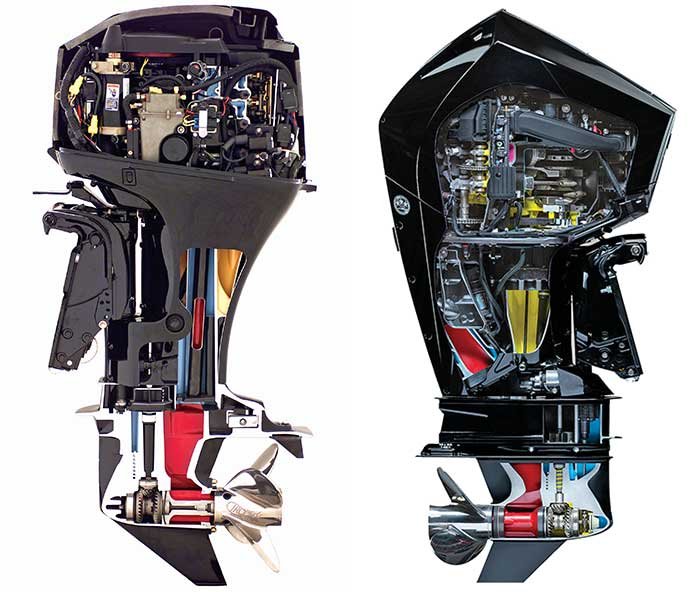
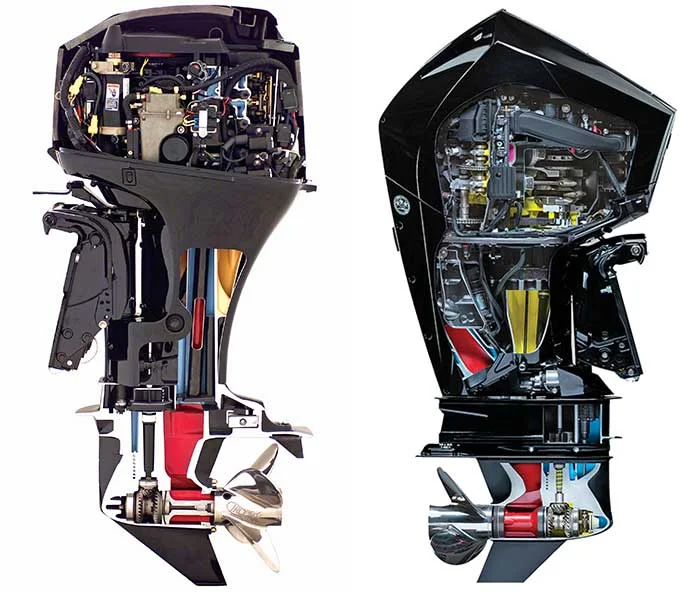
This is the single most important thing to understand before you buy. Yamaha’s inline-four F200 displaces 2.8 liters across four cylinders and weighs around 487 pounds in the base 20 inch shaft configuration. The older V6 F200 is built on Yamaha’s 3.3-liter V6 block, shares its architecture with the 225 and 250hp V6 family, and weighs considerably more, typically in the 500 to 600 pound range depending on configuration. Both produce the same rated 200 horsepower, but they get there very differently, and the weight difference alone is enough to change how a boat handles and how much fuel it burns.
The inline-four is the newer design and the one Yamaha positions as the lightest four-stroke 200hp outboard currently available, built specifically as a repower option for boats originally rigged with lighter two-strokes where a heavy V6 would sink the stern and change the boat’s running angle. The V6 remains available and is often the choice for buyers who want extra low-end torque for pushing a heavier hull or towing, and for twin installations where the added weight matters less relative to the total boat weight.
Full Specifications: F200 Inline-Four
| Spec | Detail |
|---|---|
| Engine Type | Inline 4-cylinder, DOHC, 16-valve |
| Displacement | 2,785cc (2.8L) |
| Bore x Stroke | 96mm x 96.2mm |
| Prop Shaft Horsepower | 200hp @ 5,500 rpm |
| Full Throttle RPM Range | 5,000 – 6,000 rpm |
| Compression Ratio | 10.3:1 |
| Fuel Induction | Electronic Fuel Injection (EFI) |
| Alternator Output | 50 amp |
| Gear Ratio | 1.86:1 |
| Weight | 487-525 lbs depending on shaft length and model |
| Shaft Length | 20″ (L) or 25″ (X) |
| Recommended Fuel | 89 octane minimum, regular unleaded |
The 50-amp alternator on the inline-four is a genuine upgrade over the older V6’s charging output and matters if you’re running serious electronics, a livewell system, or planning to keep a trolling motor battery bank charged while underway. It’s a 13 percent bump over the equivalent output on the older V6 3.3-liter unit.
Yamaha 200HP Units We Have In Stock
We keep one of the deepest Yamaha 200hp inventories we carry, across multiple V6 configurations. Current stock includes the Yamaha 200 HP F200LB, the Yamaha 200 HP F200LCA, the Yamaha 200 HP F200XB extra-long shaft, and the Yamaha 200 HP F200XCA.
For counter-rotation twin installations, we stock the Yamaha 200 HP LF200LCA, the Yamaha 200 HP LF200XB, and the Yamaha 200 HP LF200XCA. If you’re after the performance-tuned variant, we also carry the Yamaha 200 HP VF200LA V MAX SHO, covered in more detail below.
Every unit is run-tested, checked for compression and lower unit condition, and listed with honest documentation of hours and cosmetic wear before it goes up for sale.
What Boats This Horsepower Fits
24 to 27 foot center consoles and bay boats are the most common home for a 200hp outboard, along with larger deck boats and cabin cruisers needing genuine offshore-capable cruising speed. This is also a very common twin-engine size, where two 200hp units on a wider offshore hull deliver both redundancy and enough combined power for serious open-water running, often replacing an aging single big-block V8 outboard from an older generation.
Pontoons at the extreme performance end of the market occasionally spec 200hp as well, though this is a smaller share of what we see, mostly limited to purpose-built performance pontoons designed to genuinely get up and run rather than just cruise.
V MAX SHO: The Performance Variant
The VF200LA V MAX SHO deserves its own mention because it’s tuned differently from the standard F200. Built on Yamaha’s V6 3.3-liter block rather than the inline-four, the SHO series is specifically optimized for hole shot and acceleration, aimed at bass boat and performance-oriented buyers who want the fastest possible time to plane rather than maximum fuel efficiency. If your priority is top-end speed and quick acceleration out of the hole on a lighter, faster hull, the SHO variant is worth the look over the standard inline-four F200, even though it carries a weight penalty for that extra low-end punch.
Fuel Economy and Running Costs
At a typical offshore cruising speed in the low-to-mid 30s mph range, a Yamaha 200hp outboard generally burns somewhere between 12 and 18 gallons per hour depending on hull, load, and whether you’re running the lighter inline-four or the heavier V6. The inline-four’s weight advantage translates directly into better fuel economy on an appropriately matched hull, which is a big part of why Yamaha positions it as the preferred repower option for owners moving up from an older, lighter two-stroke.
For twin-engine setups specifically, the fuel economy math changes meaningfully based on which variant you choose for both engines, and it’s worth running the numbers with us directly if you’re planning a repower, since the difference between two inline-fours and two V6 units adds up fast over a season of real offshore hours.
Yamaha vs Suzuki and Mercury at 200HP
Suzuki’s DF200A is the closest direct competitor, built on a similar inline-four architecture and landing in a comparable weight class to Yamaha’s F200. Mercury’s Verado 200 takes a different approach entirely with a supercharged inline-four design, trading some fuel economy for strong low-end torque and notably quiet operation thanks to the enclosed cowling design.
Yamaha’s advantage in this comparison, beyond the global parts network that benefits every horsepower class we sell, is the sheer breadth of configuration options at 200hp, standard, counter-rotation, and the SHO performance variant, giving buyers more ways to match the engine precisely to the boat and use case rather than a one-size-fits-all offering.
Maintenance Schedule
The F200 follows Yamaha’s standard schedule for this class: oil and filter change every 100 hours or annually, spark plug inspection yearly using the specified LFR6A-11 plug, and water pump impeller service every one to two seasons depending on operating environment. The EPA’s guidance on ethanol-blended fuel applies here as with any EFI outboard, and it’s worth noting this engine calls for a minimum 89 octane, higher than the 87 octane spec on smaller Yamaha midrange engines, due to the higher compression ratio.
Given the higher-performance nature of this engine class, we also recommend more frequent professional inspection of the fuel system and ignition components than you might on a smaller midrange engine, particularly for boats running heavy annual hours offshore.
Worldwide Shipping
We ship Yamaha 200hp outboard motors worldwide by both air and ocean freight, and given the larger size and weight of engines in this class, ocean freight is typically the more cost-effective option for most international destinations, though we quote both so you can compare landed cost directly. We handle all export paperwork and provide a full quote to your address or nearest port before you commit to a purchase.
For buyers rigging a twin installation, we can coordinate crating both engines together to bring the combined freight cost down compared to shipping them separately.
What Affects Pricing on a Used Yamaha 200hp
Which architecture you’re buying, inline-four versus V6, is the first thing that separates price on paper even before hours and condition come into play, since these are genuinely different engines with different build costs and different used-market demand. Beyond that, hours and documented compression readings drive value the way they do on any outboard, but at this horsepower class we also weight lower unit and gearcase condition more heavily, since repair costs scale up with engine size and a damaged gearcase on a 200hp unit is a considerably bigger expense than the same issue on a 60hp engine.
Counter-rotation units command a modest premium over standard rotation in the used market simply because demand is more specific, tied directly to twin-engine buyers, while standard rotation units move faster since they fit both single and twin (with a second standard unit) applications. Shaft length again plays a role, with 20 inch covering most single-engine center console applications and 25 inch serving taller transom boats and some twin setups.
Inline-Four, V6, or SHO: How to Decide
If your priority is fuel economy and keeping weight off the transom, particularly on a repower where the boat was originally rigged with a lighter two-stroke, the inline-four F200 is the right starting point. If you’re pushing a heavier hull, need stronger low-end torque for towing or quick recovery after a wave, or you’re not as concerned about the weight difference because you’re running twins on a wide offshore boat, the V6 remains a completely valid choice and plenty of owners prefer its torque character.
The SHO variant is a narrower recommendation, really aimed at buyers who are chasing acceleration and top speed on a lighter, faster hull like a bass boat or a performance-oriented bay boat, where hole shot matters more than outright fuel economy. For most center console and offshore cruising applications, the standard inline-four or V6 is the more sensible everyday choice.
What to Check Before Buying Used at This Horsepower
Compression across all cylinders remains the first and most telling check, and at this engine size we look for consistency across the bank as much as the absolute numbers, since uneven readings between cylinders often point to a developing issue even when every individual reading looks acceptable in isolation. Corrosion around the powerhead, particularly near the alternator, ECU, and wiring harness connectors, deserves close attention on any engine in this class given the amount of electronics packed into a modern 200hp outboard.
Lower unit and gearcase inspection matters more here than on smaller engines simply because the cost of getting it wrong is higher. We check gear oil condition, look for any signs of impact damage to the skeg or gearcase housing, and verify smooth operation through the full range of shift positions before any unit goes up for sale. For twin-engine buyers specifically, we also confirm both engines in a matched pair have comparable hours and service history, since mismatched wear between two engines on the same boat creates handling and maintenance headaches down the road.
FAQs
What’s the difference between the Yamaha F200 inline-four and V6?
The inline-four displaces 2.8 liters and weighs around 487 pounds, while the older V6 displaces 3.3 liters and weighs considerably more. Both produce 200 rated horsepower but deliver it differently, with the inline-four favored for lighter weight and fuel economy.
What is the V MAX SHO version built for?
The VF200LA V MAX SHO is tuned for maximum hole shot and acceleration on performance-oriented hulls like bass boats, trading some fuel efficiency for stronger low-end punch.
What size boat needs a 200hp outboard?
Typically 24 to 27 foot center consoles, bay boats, and deck boats, and very commonly used in pairs on wider offshore hulls for twin-engine setups.
How much fuel does a Yamaha 200hp outboard burn?
Roughly 12 to 18 gallons per hour at typical offshore cruising speed, varying with hull, load, and whether it’s the inline-four or V6 configuration.
Do you have counter-rotation Yamaha 200hp units for twin setups?
Yes, we stock the LF200 series specifically built for counter-rotation twin installations.
Do you ship the Yamaha 200hp outboard internationally?
Yes, we ship worldwide by air or ocean freight and provide a full landed cost quote before purchase.
We stock one of the widest ranges of Yamaha 200hp outboard motors available, across standard, counter-rotation, and performance SHO configurations, all tested and ready to ship worldwide. Browse our current stock above or send us your boat’s rigging details and we’ll match you to the right unit with a same-day shipping quote.
Posts Widget
- 1

- 2

- 3
- 4


S.H Continental Marine
USA HERALD MAGAZINE INC
Our team is dedicated to providing exceptional customer service.
Email: info@shcontinentalmarine.com
Choose S.H Continental Marine
for your outboard engine needs and enjoy superior quality, exceptional customer service, and unbeatable prices.
