
Yamaha 425HP Outboard Motor: Full V8 Specs, Prices & Worldwide Shipping
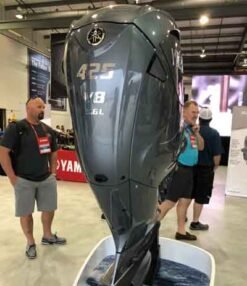
Most people shopping for a Yamaha 425hp outboard motor already know what they want power for. Nobody stumbles into a 5.6-liter V8 by accident. You’ve got a heavy center console, maybe 38 to 45 feet, loaded down with fuel, tackle, a tower, and four or five people, and you need an engine that doesn’t work hard to get that boat on plane and hold it there in a chop. That’s exactly what this motor was built for. We keep several Yamaha 425hp outboard motors in stock across different shaft lengths and colors, and this guide walks through what the engine actually is, what the real numbers look like, and what to check before you commit two dealers’ worth of money to one repower.
In this guide:
- What the Yamaha 425hp Outboard Motor Actually Is
- Full Specifications
- Shaft Lengths and Trim Levels
- Yamaha 425HP Units We Have In Stock
- What Boats This Engine Actually Fits
- Fuel, Range, and Running Costs
- How It Compares to Mercury and Suzuki’s Big V8s
- Maintenance on a V8 This Size
- Worldwide Shipping
- What Affects Pricing on a Yamaha 425hp Outboard
- Matching the 425hp to Your Boat
- What to Check Before Buying One Used
- FAQs
What the Yamaha 425hp Outboard Motor Actually Is
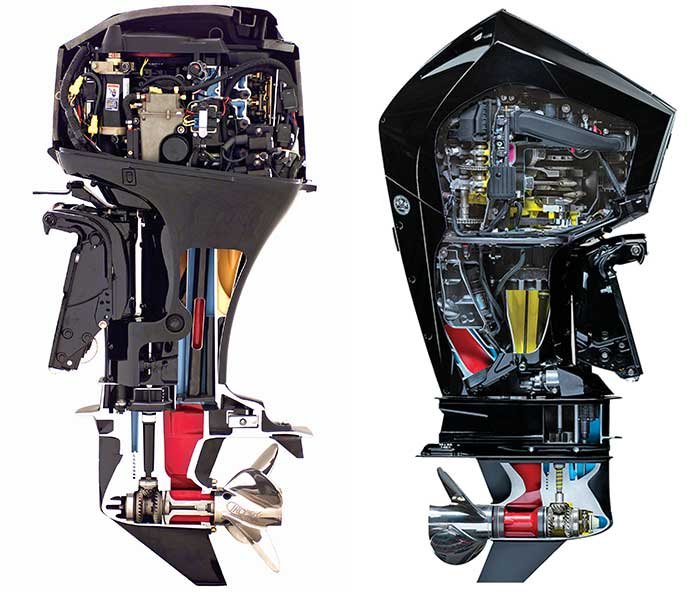
The Yamaha 425hp outboard, sold under the XTO Offshore line and badged F425 on the cowling, is built around a 5.6-liter, 60-degree V8 with double overhead cams and 32 valves. It’s a naturally aspirated four-stroke, which surprises some buyers who assume that kind of output has to come from forced induction. It doesn’t. Yamaha got there with displacement, a perfectly square 96mm bore and 96mm stroke, and a compression ratio north of 12:1, which is unusually high for a marine engine and part of why the torque curve feels so different from a smaller, higher-revving V6.
What actually sets this engine apart from nearly everything else on the market, including Yamaha’s own smaller outboards, is direct fuel injection. Every other four-stroke outboard on the water uses port injection, spraying fuel into the intake tract before the valve opens. The 425hp Yamaha injects fuel straight into the combustion chamber at roughly 2,900 psi through five separate high-pressure pumps. That’s a first for a gasoline four-stroke outboard, and it’s the reason this engine can run on regular 89-octane fuel while making the kind of power that would normally demand premium. It also helps the motor hit a three-star ultra-low emission rating under EPA marine engine standards, which matters if you’re shipping into a market with tighter marine emissions rules than the US.
None of that would matter much if the engine wasn’t also built to survive saltwater abuse for a decade or more offshore, and that’s really the point of the design. Yamaha put an integrated electric steering system into the powerhead itself rather than relying on a separate hydraulic steering ram, and the exhaust routes through a diverter that redirects flow when you’re in reverse, which Yamaha says gives up to 300 percent more reverse thrust than the outboard it replaced. For anyone who’s backed a big center console down on a sailfish or held position against a current at the boat ramp, that’s not a marketing footnote, it’s a genuinely useful feature.
Full Specifications
Here’s the full spec sheet for the current Yamaha 425hp outboard, covering every variant we carry regardless of shaft length or color.
| Spec | Detail |
|---|---|
| Engine Type | 4-Stroke V8, DOHC, 32 valves (60-degree bank angle) |
| Displacement | 5,559 cc (5.6L) |
| Bore x Stroke | 96mm x 96mm |
| Horsepower at Propshaft | 425hp @ 5,500 rpm |
| Full Throttle RPM Range | 5,000 – 6,000 rpm |
| Trolling RPM Range | 600 – 1,000 rpm |
| Compression Ratio | 12.2:1 |
| Fuel System | Direct Fuel Injection (DFI), 2,900 psi |
| Max Torque | 546 N·m @ 4,200 rpm |
| Alternator Output | 90 Amps gross max |
| Ignition | TCI Microcomputer |
| Lubrication | Wet Sump |
| Starting Method | Electric with integrated Power Trim & Tilt |
| Steering | Integrated electric steering |
| Recommended Fuel | Regular unleaded, minimum 89 octane |
| Weight (25″ shaft) | 952 lbs |
| Weight (30″ shaft) | 975 lbs |
| Weight (35″ shaft) | 999 lbs |
| Emissions Rating | 3-Star Ultra-Low Emission |
A couple of those numbers deserve context. The 546 N·m of torque arrives at 4,200 rpm, which is well below where a lot of high-performance outboards make their peak, and that’s deliberate. Yamaha engineered the 425hp outboard for boats that spend most of their working life at cruise and mid-range throttle, not wide-open-throttle runs, so the torque curve is shaped to feel strong exactly where you actually use it.
Shaft Lengths and Trim Levels
The Yamaha 425hp outboard ships in three shaft lengths: 25 inch, 30 inch, and 35 inch, and getting this measurement right matters more on an engine this size than almost anywhere else in the outboard lineup, because a mismatch on a boat this heavy causes real cavitation and steering problems rather than a minor performance dip. The shaft length has to match your transom height, measured from the bottom of the hull straight up to the top of the transom, not guessed from the boat’s overall size.
Beyond shaft length, the 425hp comes in a handful of cowling finishes, most commonly the standard Yamaha gray and a pearlescent white option that a lot of offshore buyers prefer for heat reflection and resale appeal. Some model codes carry a “2” or “7” suffix in the SKU, which typically denotes a production revision or color variant rather than a mechanical difference, so if you see LXF425ESA and LXF425ESA2 listed separately, the underlying powerhead spec is the same engine.
Yamaha 425HP Units We Have In Stock
We carry a genuinely deep bench of this engine because it’s a flagship model and buyers shopping this class don’t want to wait months for the exact configuration they need. Right now our stock includes the Yamaha 425hp V8 LXF425ESA on a 35 inch shaft, the Yamaha 425hp LXF425XSA on a 25 inch shaft, and the Yamaha 425hp LXF425USA on a 30 inch shaft, covering all three standard transom heights.
We also have the Yamaha 425hp LXF425ESA2, the Yamaha 425hp LXF425USA7, the Yamaha 425hp LXF425XSA2, the Yamaha 425hp XF425ESA2, and the Yamaha 425hp XF425ESA. Every one of these units is a genuine V8 XTO powerhead, tested and documented before it ships.
Because this is a flagship engine, we’d rather you tell us your transom height and boat make before you order than guess. Send us the details and we’ll confirm the exact shaft length and color before anything leaves the warehouse, and if you’re rigging twins or triples, we can coordinate matching serial ranges where that matters to your rigger.
What Boats This Engine Actually Fits
Large center consoles in the 36 to 45 foot range are where this engine spends most of its life, typically rigged as twins or triples on hulls that need serious horsepower to get out of the hole and hold 40-plus knots offshore. Convertible sportfishers and larger walkarounds that have moved away from inboard diesel setups toward outboard power also spec this class of engine, since a bank of these V8s can outrun and out-maneuver an equivalent diesel inboard setup while cutting weight and maintenance complexity.
Charter and commercial sportfishing operations are a growing share of where we see the Yamaha 425hp outboard go, since the direct fuel injection’s fuel economy at cruise and the engine’s reliability track record matter enormously when a boat needs to run offshore every day of the season without unscheduled downtime. It’s genuinely overkill for anything under about 34 feet, and Yamaha’s own smaller flagship, the F350, covers that segment better on both weight and price.
Fuel, Range, and Running Costs
Direct fuel injection is the whole story here. Because fuel goes straight into the cylinder rather than the intake tract, the engine can run leaner and more precisely across the rpm range, which is why Yamaha can spec 89 octane fuel for an engine putting out this much power, when most competitors in the same output class ask for premium. Over a season of offshore running that difference at the pump adds up, and it’s one of the more overlooked reasons buyers choose Yamaha over the alternatives in this segment.
Real-world fuel burn depends heavily on hull weight and how many engines you’re running, so we won’t pretend to give you an exact gallons-per-hour number without knowing your boat, but owners running twin 425s on 40-foot center consoles typically report cruise burns in the 30 to 40 gallon per hour range combined at a comfortable 30 to 35 knot cruise, dropping meaningfully once you’re both engines throttled back below 4,000 rpm where the torque curve is already doing most of the work.
How It Compares to Mercury and Suzuki’s Big V8s
Mercury’s Verado V12 and its 400hp and up range sit in a similar conversation, and Suzuki’s DF350A tops out lower but gets cross-shopped by buyers deciding how much displacement they actually need. Where the Yamaha 425hp outboard separates itself is the direct injection setup and the lower octane requirement, both of which are unique to Yamaha in this power class right now. Mercury’s Verado line counters with a lighter, more compact inline configuration and genuinely excellent digital throttle and shift integration, which some riggers prefer for multi-engine setups.
Suzuki’s approach with the DF350A stays with a more conventional V6 layout at a lower headline horsepower number, which means buyers who need genuinely 425-plus horsepower per engine don’t have many other four-stroke V8 options on the market at all right now. That relative scarcity is part of why resale on this engine class holds up well, and it’s worth factoring into a repower decision even at this price point. If 425 horsepower per engine is more than your hull is rated for, our Yamaha 350HP outboard guide covers the next size down in the same V-block family.
Maintenance on a V8 This Size
An engine this complex needs a maintenance schedule followed properly, and the intervals aren’t casual suggestions given the direct injection system’s tighter tolerances. Yamaha specifies 100-hour service intervals for the first few services, tapering to 300-hour intervals once the engine is broken in, and every service should include a compression check across all eight cylinders, not just a visual inspection, since a V8 running uneven compression across banks burns noticeably more fuel and loses power long before it throws a warning light.
Corrosion protection matters even more on an engine of this value. Anode inspection at every service, careful attention to the integrated electric steering unit staying dry and properly sealed, and consistent freshwater flushing after every saltwater run are non-negotiable if you want this motor to hit the 2,000-plus hour lifespan these V8s are capable of. Lower unit oil should be checked for milkiness at every service too, since a seal failure on a gearcase this size is an expensive repair to catch late.
Worldwide Shipping
We ship Yamaha 425hp outboard motors worldwide by air or ocean freight, and given the size and value of this engine, we crate it properly on a purpose-built pallet rather than shipping loose, with the powerhead and lower unit both secured and the electric steering harness protected during transit. We handle export documentation and provide a full landed cost quote, including freight and any applicable duties for your destination country, before you commit to purchase.
Because this is a high-value engine, we also recommend marine cargo insurance for the shipment, which we can arrange on your behalf. Transit times vary by destination and shipping method, and we’ll give you a realistic estimate once we know your port or delivery address. For the full breakdown of how crating, freight, and customs work on an engine this size, see our outboard motors worldwide shipping guide. You can also browse our full Yamaha outboard motors range if you’re comparing this V8 against smaller options.
What Affects Pricing on a Yamaha 425hp Outboard
Shaft length is the first pricing variable, with 35 inch units typically commanding a small premium over 25 inch shafts due to the additional material and slightly heavier gearcase. Color and cowling finish, particularly pearlescent white versus standard gray, can also shift price modestly. Beyond that, the biggest factor is simply the model year and whether you’re buying new-in-crate stock versus a lightly used, run-tested unit, since even a handful of hours on a V8 this size has almost no meaningful effect on remaining service life but can meaningfully lower the price.
We list every Yamaha 425hp outboard motor with a transparent price that reflects its exact configuration, condition, and shaft length, and we’re upfront if a unit is new-in-box versus factory demo versus lightly used, so you’re never guessing what you’re actually paying for.
Matching the 425hp to Your Boat
Start with your hull’s rated maximum horsepower, stamped on the capacity plate near the helm, and never exceed it regardless of how much you want the power. Most boats in the 36-foot-plus range that are rated for this engine class are set up for twin or triple installations rather than a single, since a boat heavy enough to need 425 horsepower per engine is almost always heavy enough to need more than one of them to plane efficiently and maintain safe handling at speed.
If you’re repowering an older diesel or gas inboard setup rather than replacing an existing outboard, get a naval architect or experienced rigger to confirm transom strength and weight distribution before you order, since a V8 outboard this size puts meaningfully different loads on a transom than the inboard setup it’s replacing.
What to Check Before Buying One Used
Used units at this power level are less common than smaller outboards simply because fewer of them exist and owners tend to hold onto them longer, but when we do take one in on trade, we run the same inspection every time. Compression across all eight cylinders comes first, checked cold and compared cylinder to cylinder rather than just against a spec sheet minimum, since an even spread across the bank matters as much as the absolute number.
We also check the integrated electric steering system specifically for moisture intrusion or corrosion at the connectors, since this is a newer technology unique to this engine and not something every mechanic knows to inspect properly. Lower unit oil condition, hour meter accuracy against maintenance records, and a visual check of the DFI high-pressure fuel pumps round out our process before any used Yamaha 425hp outboard motor goes up for sale, and we disclose the findings honestly on the listing rather than glossing over anything.
FAQs
How much horsepower does the Yamaha 425hp outboard actually make?
425 horsepower at the propshaft at 5,500 rpm, with a full throttle operating range of 5,000 to 6,000 rpm.
What octane fuel does the Yamaha 425hp outboard need?
Regular unleaded with a minimum of 89 octane, thanks to the direct fuel injection system, which is notably lower than most competitors in this power class require.
How much does the Yamaha 425hp outboard weigh?
952 lbs on a 25 inch shaft, up to 999 lbs on a 35 inch shaft, depending on configuration.
Is the Yamaha 425hp outboard a V8?
Yes, it’s a 5.6-liter, 60-degree V8 with double overhead cams and 32 valves, currently the only four-stroke V8 outboard on the market with direct fuel injection.
Can one Yamaha 425hp outboard push a boat by itself?
Technically yes on some smaller-rated hulls, but this engine is almost always installed as part of a twin or triple setup on boats heavy enough to need this much power per engine.
Do you ship the Yamaha 425hp outboard motor internationally?
Yes, worldwide by air or ocean freight, with proper export crating and a full landed cost quote provided before purchase.
What shaft lengths does the Yamaha 425hp outboard come in?
25 inch, 30 inch, and 35 inch, matched to your boat’s transom height.
How often does the Yamaha 425hp outboard need service?
Every 100 hours for the first few services, extending to 300-hour intervals once broken in, with compression checks and anode inspection at every visit.
We keep Yamaha 425hp outboard motors in stock across all three shaft lengths, tested, documented, and ready to ship worldwide. If you know your transom height and whether you’re rigging a single, twin, or triple, browse our current stock above or send us your boat’s details and we’ll put together a same-day quote.
Posts Widget
- 1

- 2

- 3
- 4


S.H Continental Marine
USA HERALD MAGAZINE INC
Our team is dedicated to providing exceptional customer service.
Email: info@shcontinentalmarine.com
Choose S.H Continental Marine
for your outboard engine needs and enjoy superior quality, exceptional customer service, and unbeatable prices.
