
2 Stroke Outboard Motors – Complete Guide & Best Modern Alternatives

There’s still a strong case for 2 stroke outboard motors, even in a market that’s been moving heavily toward 4-strokes for the past two decades. Yes, direct injection 2-strokes nearly disappeared from mainstream retail. But the older carbureted 2-stroke engines are still working hard on boats all over the world, parts are still available for most of them, and understanding what you’re working with — or what you’re replacing — matters.
At SH Continental Marine, our current inventory focuses on Yamaha 4-stroke engines, but we know our customers ask about 2 stroke outboard motors regularly — sometimes because they’re running one, sometimes because they’re comparing options, and sometimes because they want to understand why the industry shifted away from them. This post covers all of that: the technology, the differences, what to look for if you’re buying or replacing one, and what our current lineup offers instead.
What Is a 2 Stroke Outboard Motor?
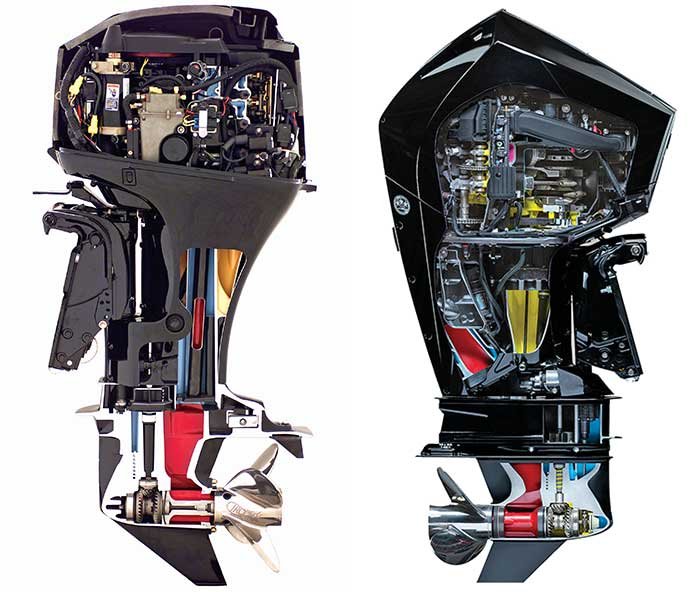
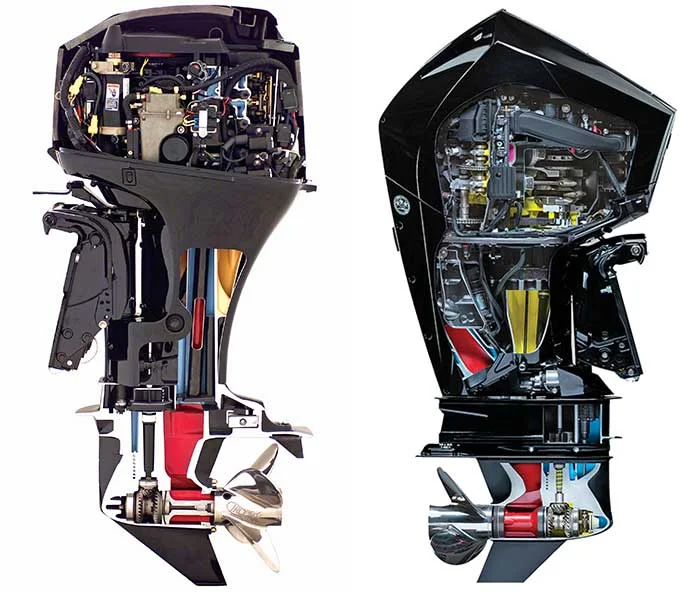
A 2 stroke outboard motor completes a power cycle in two strokes of the piston: compression and combustion happen in one downstroke, and exhaust and intake happen in the return upstroke. Compare this to a 4-stroke engine, which has four separate strokes (intake, compression, combustion, exhaust) and completes a power cycle every other revolution of the crankshaft.
The practical result of this difference:
- 2 stroke: Power pulse every revolution — more power per unit of displacement, lighter weight, simpler mechanically
- 4 stroke: Power pulse every two revolutions — more efficient fuel burn, lower emissions, quieter, no oil mixing required
A well-designed 2 stroke outboard motor at a given horsepower will almost always weigh less than a comparable 4-stroke. That used to be the dominant selling point. Pound for pound of thrust, 2-strokes were hard to beat.
Why 2 Stroke Outboard Motors Became Less Common
This happened gradually through the late 1990s and 2000s, driven primarily by emissions regulations in North America, Europe, and eventually most of the world. Traditional carbureted 2 stroke outboard motors are notoriously dirty — they discharge a significant portion of their fuel-oil mixture unburned through the exhaust port as part of the scavenging process. Those hydrocarbons go directly into the water.
When the US EPA and California’s CARB established progressively stricter marine emissions standards, carbureted 2-strokes couldn’t meet them. Yamaha, Mercury, and others tried direct injection 2-stroke technology (Yamaha’s HPDI, Mercury’s OptiMax) which dramatically reduced emissions by injecting fuel directly into the combustion chamber after the exhaust port closed. These engines were cleaner, but they were expensive and complex.
Ultimately, 4-stroke technology won. It meets emissions standards more easily, it’s more fuel efficient, and it doesn’t require oil mixing. The trade-off is weight and, in some configurations, a slightly less responsive power delivery at very high RPM. But for the vast majority of boating applications, 4-strokes are the better choice.
The 2 Stroke vs 4 Stroke Debate — Where It Still Matters
If you’re running a boat in an area where 4-stroke weight is a real problem — small canoes, very lightweight inflatable kayaks, ultra-light aluminum tenders — the weight advantage of a small 2 stroke outboard motor can still be meaningful. A 2-stroke 9.9 HP might weigh 25–30% less than a 4-stroke equivalent. On a small boat, that weight difference at the stern changes how the boat handles.
For racing applications, the power-to-weight ratio of 2-stroke engines (when tuned properly) still makes them competitive at lower displacement classes. And in some developing markets where the carbureted 2-stroke supply chain and mechanical knowledge is well-established, they’re still the practical choice.
But for most recreational boaters, offshore fishermen, and commercial operators considering 2 stroke outboard motors vs 4-stroke alternatives today, the 4-stroke wins on fuel cost, oil consumption (no mixing), emissions compliance, and long-term serviceability.
Understanding 2 Stroke Outboard Motor Specifications
If you’re evaluating a used 2 stroke outboard motor or trying to understand the specs on one you’re already running, here’s what the key specifications mean:
Displacement
Measured in cc (cubic centimeters) or liters. Because 2-strokes fire every revolution, a 500cc 2-stroke and a 500cc 4-stroke won’t produce the same power — the 2-stroke will typically produce significantly more horsepower from the same displacement.
Fuel Delivery
Most older 2 stroke outboard motors use carburetion. You’ll also see VRO (Variable Ratio Oiling) on some models — a system that mixes oil with fuel automatically rather than requiring premixing. VRO simplifies operation but requires its own maintenance and can fail, leading to oil starvation if the VRO pump stops working.
Oil Mixing Ratio
Traditional 2-strokes require oil mixed into the fuel. Older engines often specified 50:1 or 100:1 ratios (fuel to oil by volume). Running the wrong ratio causes problems — too rich in oil means fouled plugs and excessive smoke; too lean means insufficient lubrication and engine damage.
Power-to-Weight
This is where 2 stroke outboard motors traditionally shine. A 50 HP carbureted 2-stroke might weigh 20–30 lbs less than a comparable 4-stroke. On applications where weight matters, that’s real.
RPM Range
2-strokes typically rev higher than 4-strokes at equivalent displacement, contributing to their power output. Most carbureted 2-stroke outboards run in the 4,500–6,000 RPM range under load.
Maintenance of 2 Stroke Outboard Motors
If you’re still running a 2 stroke outboard motor, here’s what the maintenance picture looks like compared to a 4-stroke:
Advantages
- No oil changes (no crankcase oil to change)
- Simpler valve-free engine design — fewer moving parts
- Easier access for spark plug changes on most models
- Lighter weight makes manual tilting easier on smaller engines
Disadvantages
- Requires oil in every tank of fuel (unless VRO-equipped, which has its own maintenance needs)
- Higher carbon fouling on spark plugs due to oil combustion
- More frequent spark plug replacement (typically every 100 hours, often less under hard use)
- Higher fuel consumption at equivalent horsepower compared to modern 4-strokes
- More sensitive to fuel quality and oil mix ratio
- Emissions compliance issues in many jurisdictions
What to Check When Buying a Used 2 Stroke
If you’re evaluating a used 2 stroke outboard motor:
- Check compression on all cylinders. Low compression means worn rings or cylinders.
- Inspect the lower unit for water intrusion (milky gear oil = failed seal).
- Check the water pump — a blocked or failing impeller causes overheating fast.
- Look at spark plug condition. Fouled, oily plugs indicate rich running or oil system issues.
- Run it at idle and listen. Uneven running usually points to a carb issue or a dead cylinder.
- Check the propeller for impact damage that could indicate previous prop strikes.
Modern Alternative: Why Our 4-Stroke Lineup Outperforms 2 Stroke Outboard Motors in Most Cases
We want to be straight with you: if you’re in the market for a new outboard motor and you’re considering a 2 stroke outboard motor because of price, weight, or power delivery, a modern Yamaha 4-stroke at comparable horsepower is worth serious consideration first.
Here’s the direct comparison:
| Feature | 2 Stroke (Carbureted) | Yamaha 4 Stroke (EFI) |
|---|---|---|
| Fuel Efficiency | Lower | Significantly Higher |
| Emissions | High (hydrocarbons) | Very Low |
| Oil Mixing Required | Yes | No |
| Weight | Lower (advantage) | Heavier |
| Cold Start | Temperamental | Reliable (EFI) |
| Parts Availability | Diminishing | Excellent worldwide |
| Emissions Compliance | Often non-compliant | Fully compliant |
If you’re replacing a 2 stroke outboard motor and the weight difference matters to you, talk to us about the lighter options in our 4-stroke lineup. The Yamaha 8 HP F8SMHB weighs just 58 lbs (26.3 kg) — competitive with many 2-stroke alternatives at the same power level. The Yamaha 8 HP F8LMHB offers the long shaft version of the same lightweight package.
Our Lightweight 4-Stroke Outboard Motor Specifications
For customers transitioning away from 2 stroke outboard motors, here are our lightest 4-stroke options with full specifications:
Yamaha 8 HP F8SMHB — Best Weight Alternative to Small 2-Strokes
- Configuration: In-line 2, 4-stroke
- Displacement: 138cc
- Fuel Delivery: Carburetor
- Starting: Manual
- Shaft Length: Short (15″)
- Weight: 58 lbs (26.3 kg)
- Max RPM: 5,000–6,000
- No oil mixing required
Yamaha 9.9 HP F9.9SMHB — The 2-Stroke Replacement Choice
- Configuration: In-line 2, 4-stroke
- Displacement: 212cc
- Fuel Delivery: Carburetor
- Starting: Manual
- Shaft Length: Short (15″)
- Weight: 79 lbs (35.8 kg)
- Gear Ratio: 2.08:1
- Max RPM: 5,000–6,000
For heavier loads requiring the torque characteristics that used to favor 2-strokes, the Yamaha 9.9 HP T9.9LPHB high-thrust variant delivers comparable low-end pull without the emissions or oil mixing hassle of a 2-stroke. The Yamaha 9.9 HP T9.9XWHB also offers extra-long shaft for applications where shaft length is the critical spec.
Where 2 Stroke Outboard Motors Still Have a Role
To be fair: there are still genuine use cases where a 2 stroke outboard motor makes sense:
- Remote areas with 2-stroke mechanic infrastructure: If you’re in a region where every local mechanic knows 2-stroke carburetors and 4-stroke EFI is unfamiliar territory, the serviceability advantage of the simpler engine matters.
- Racing and competition: Performance 2-stroke engines tuned for specific classes still dominate certain competitive categories.
- Ultra-light weight applications: Very small watercraft where even 10–15 lbs of weight difference is significant.
- Budget-constrained buyers: A used 2-stroke in good condition can be a reasonable starting point when the purchase price of a new 4-stroke is out of reach.
External Resources for 2 Stroke Outboard Motor Owners
- iBoats.com — Parts database and technical resources for older outboard motor models including 2-strokes
- Yamaha Outboards Support — Service documentation for current Yamaha 4-stroke models
- EPA Marine Emissions Standards — Current compliance requirements for marine engines by jurisdiction
Also see our guide on 4 stroke outboard motors for a detailed comparison, and our post on affordable outboard motors which covers value options across our full lineup.
Shopping for a Motor? Here’s Where to Start
If you came here researching 2 stroke outboard motors and you’re now considering a 4-stroke replacement, here are the best starting points in our catalog based on typical 2-stroke use cases:
- Replacing a small 2-stroke (under 10 HP): Yamaha 8 HP F8SMHB or Yamaha 9.9 HP F9.9SMHB
- Replacing a mid-range 2-stroke (25–60 HP): Yamaha 60 HP F60LB
- Replacing a performance 2-stroke (70–90 HP): Yamaha 90 HP F90LB or Yamaha VF90LA V MAX SHO
We ship worldwide with full freight documentation. Contact us if you have questions about compatibility with your hull or want to discuss which 4-stroke best matches the performance profile of the 2 stroke outboard motor you’re replacing.
Posts Widget
- 1

- 2

- 3
- 4


S.H Continental Marine
USA HERALD MAGAZINE INC
Our team is dedicated to providing exceptional customer service.
Email: info@shcontinentalmarine.com
Choose S.H Continental Marine
for your outboard engine needs and enjoy superior quality, exceptional customer service, and unbeatable prices.
