
Best Outboard Motors: How to Actually Choose the Right One
“Best” is a word that gets thrown around a lot in outboard motor marketing, and honestly, it doesn’t mean much without context. The best outboard motors for a bass fisherman running a lightweight aluminum boat look nothing like the best outboard motors for someone piloting a heavy pontoon full of family and gear. Horsepower, weight, fuel delivery, and shaft length all interact with your specific boat and how you use it, so a “best of” list that doesn’t ask what you’re actually doing on the water isn’t a very useful list.
We sell and rig outboards every day at S.H Continental Marine, across the full range from portable 8 HP kickers to big V6 offshore setups, and this is genuinely the most common conversation we have with customers: not “which motor is best,” but “which motor is best for what I’m actually going to do with it.” Let’s break that down properly, by use case, so you can figure out where you land.
Start With What You’re Actually Doing on the Water
Before horsepower, before brand, before anything else, figure out your primary use case. Most boaters fall into a handful of categories, and the “best” motor changes considerably depending on which one you’re in:
- Weekend recreational boating on lakes or protected coastal water, where reliability, quiet operation, and fuel economy matter more than raw speed.
- Serious fishing — bass, inshore, or offshore — where trolling capability, shallow-water performance, and quick acceleration to reach fishing grounds all matter.
- Family cruising and watersports, where you need enough horsepower to pull a tube or skier and enough stability for a boat loaded with passengers.
- Commercial or heavy-duty use, where total cost of ownership, hour ratings, and parts availability outweigh almost everything else.
Once you know which of these describes you, the “best outboard motors” conversation gets a lot more specific and a lot more useful.
Best Overall Four-Stroke: Mid-Range Horsepower Workhorses
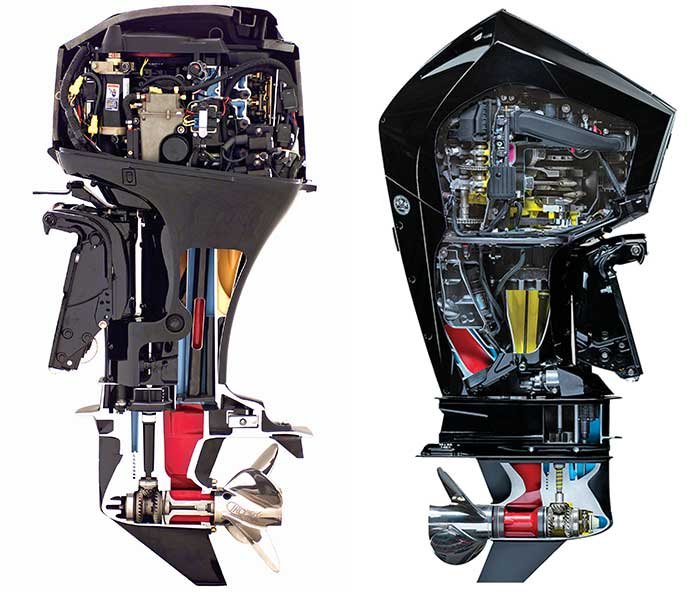
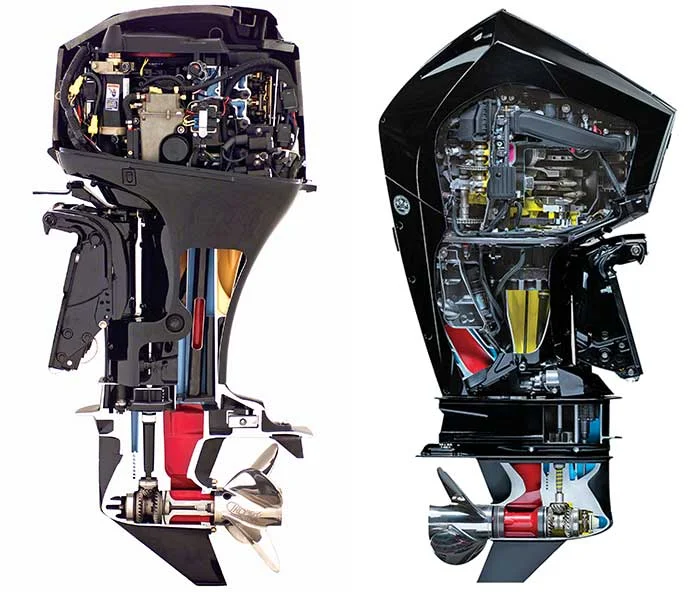
For the largest slice of boat owners — people running center consoles, pontoons, bay boats, and family runabouts in the 20 to 26 foot range — a mid-range four-stroke in the 90 to 150 HP class tends to hit the sweet spot of power, fuel economy, and weight. The Yamaha 90 HP F90XB is a strong example: a 1.8L inline-four with EFI, Yamaha’s Variable Trolling RPM Switch for precise low-speed control, and a corrosion-resistant YDC-30 alloy block that holds up well in both fresh and saltwater. At roughly 353 pounds, it’s light enough to avoid weighing down smaller hulls while still delivering enough thrust for most family boating and moderate fishing use.
If your boat calls for more power, the same engineering philosophy scales up through Yamaha’s larger four-cylinder and V6 offerings — the core reliability and corrosion protection carry through the whole lineup, which is part of why this size class shows up so often in “best outboard motors” comparisons across boating publications. Similarly sized options like the Yamaha 90 HP F90JB and the Yamaha 90 HP F90LB are worth comparing side by side, since the differences between them come down to jet vs. propeller drive and shaft length rather than raw power.
Best for Small Boats and Tenders: Portable Four-Strokes
If you’re outfitting a dinghy, inflatable, small jon boat, or looking for a reliable backup kicker motor, the calculation changes entirely. Weight and portability matter as much as power here. The Yamaha 9.9 HP T9.9XPHB is a genuinely excellent choice in this category — light enough to carry and mount without a hoist, electric start for convenience, a 25-inch shaft for deeper transoms, and enough thrust to comfortably push a loaded dinghy or serve as auxiliary power on a small sailboat.
For even smaller applications, Yamaha’s 8 HP F8SMHB trims weight further while keeping the same four-stroke reliability, and it’s a favorite among owners who need a genuinely portable motor they can lift by hand.
Best for Serious Fishing: High-Thrust and Trolling-Focused Models
Anglers have different priorities than cruisers — quiet low-speed operation, precise throttle control, and enough thrust to hold position against current or wind matter more than top speed. Yamaha’s High Thrust series, including models like the Yamaha 9.9 HP T9.9LPHB, uses a specially designed lower unit and propeller to generate more push at low RPM than a standard outboard of the same horsepower — genuinely useful for pontoons, larger sailboats, and any application where you need to muscle a heavier hull around without redlining the engine.
If your fishing style leans toward bass boats or bay boats where speed to the fishing grounds matters as much as trolling control, the mid-range four-cylinder models mentioned above — with their light weight and strong throttle response — tend to be the better fit than a dedicated high-thrust motor.
Best for Fuel Economy: Modern EFI Four-Strokes
If minimizing fuel burn is your priority, look specifically at electronic fuel injection over carbureted models, and pay attention to the compression ratio and full-throttle RPM range listed in the spec sheet — higher compression with a well-tuned EFI system generally extracts more energy per gallon. Nearly every current-generation four-stroke from Yamaha, Honda, and Mercury in the mid-horsepower range delivers meaningfully better fuel economy than the carbureted and two-stroke motors they replaced a decade or two ago.
What Separates a Genuinely Good Motor From a Marketing Claim
A lot of “best outboard motors” content online is really just a repackaged spec sheet with superlatives added. Here’s what we’d actually tell you to look at instead:
| What to Check | Why It Matters |
|---|---|
| Weight vs. your boat’s transom rating | An overweight motor stresses the transom and hurts handling; an underpowered one struggles to plane |
| Shaft length vs. your transom height | Wrong shaft length causes cavitation and poor performance regardless of how good the engine is |
| Fuel delivery system | EFI generally starts easier and runs cleaner than carbureted setups, especially after storage |
| Alternator output | Higher amperage supports more electronics without straining the charging system |
| Warranty length and dealer network | A long warranty backed by a real service network beats a marginally higher horsepower number |
Get those five things right for your specific boat and use case, and you’ve effectively identified the best outboard motor for you — regardless of what any generic ranking says.
New vs. Pre-Owned: Does It Change What’s “Best”?
A well-maintained pre-owned motor from a reputable brand can absolutely outperform a cheaper new motor from a less established manufacturer, particularly if you’re comparing similar horsepower classes. The tradeoff is warranty coverage and unknown maintenance history — a new motor removes that uncertainty entirely. If budget allows, we generally point first-time buyers toward new for the peace of mind, and steer experienced owners who know what to inspect toward pre-owned, where the value can be considerable.
Saltwater vs. Freshwater: Does the “Best” Motor Change?
The core engine doesn’t change much between fresh and saltwater use, but the details that determine longevity absolutely do. In saltwater, corrosion protection stops being a nice-to-have and becomes the deciding factor — look specifically for a proprietary corrosion-resistant alloy block, a robust anode placement layout, and a manufacturer with a strong reputation for saltwater durability. Yamaha’s YDC-30 alloy and multi-layer paint systems, for example, are specifically engineered around that saltwater use case, which is a big part of why the brand shows up so often in coastal and offshore fleets.
In freshwater, corrosion is a slower process, which opens up a slightly wider range of “best” options since you’re not fighting saltwater intrusion as aggressively. That said, we’d still recommend against skimping on corrosion protection even on a freshwater lake boat — algae, minerals, and general moisture exposure still take a toll over a decade of ownership, just more slowly than salt air does.
Best Outboard Motors by Boat Type
Breaking this down by hull type tends to be more useful than a generic ranking, since the same horsepower can feel completely different depending on what it’s pushing:
- Aluminum fishing boats: Light four-stroke motors in the 40-90 HP range typically offer the best balance of speed to the fishing grounds and fuel economy, since aluminum hulls plane easily and don’t need excessive power.
- Pontoon boats: These benefit from higher-thrust motors in the 90-150 HP range because of the wider, flatter hull design — a High Thrust or standard mid-range four-stroke both work well depending on how many passengers you typically carry.
- Center console and bay boats: This is where the 90-150 HP four-stroke class really shines, offering enough speed for offshore runs without excessive weight on the transom.
- Sailboats needing auxiliary power: A High Thrust portable in the 8-20 HP range, with a long shaft to match a deeper transom, is almost always the right call — raw speed matters far less here than reliable, controllable low-speed thrust.
- Inflatables and dinghies: Weight is everything. The lightest reliable four-stroke that meets your minimum thrust needs, typically in the 8-15 HP range, is the right choice.
Mistakes People Make When Chasing “The Best”
After rigging hundreds of boats, a few patterns show up repeatedly in customers who end up unhappy with their choice:
Buying more horsepower than the boat needs. An oversized motor doesn’t just cost more upfront — it adds weight, burns more fuel at any given speed, and can actually hurt handling on a hull that wasn’t designed for that much power on the back.
Ignoring shaft length. This is the single most common rigging mistake we see. A motor that’s technically “the best” in its class will perform poorly, cavitate, and wear out faster if the shaft length doesn’t match the transom height — it’s not a minor detail, it’s foundational to the whole setup working correctly.
Chasing brand loyalty over fit. Some buyers insist on a specific brand because of past experience or reputation, even when a different manufacturer’s model in that horsepower class is a better match for their boat. All three major brands make excellent motors; the “best” one is the one correctly sized and rigged for your specific hull.
Skipping the test run. Whenever possible, see or hear the motor running before committing, especially on a used purchase. A smooth idle and clean acceleration tell you more in five minutes than any spec sheet.
Where Digital Controls and Extra Features Actually Pay Off
A lot of what pushes a motor into “premium” territory these days is digital — integrated displays, joystick docking controls, keyless ignition, and multi-engine synchronization for boats running two or three motors side by side. These are genuinely nice, but whether they’re worth the added cost depends heavily on how you use the boat.
If you’re regularly docking in tight marina slips or running twin or triple engine setups, joystick control and digital synchronization can be worth every penny — it turns a stressful docking maneuver into something almost anyone aboard can handle. If you’re running a single motor on a boat you launch from a trailer and mostly use on open water, those same features add cost and complexity without much practical benefit. Keyless ignition is nice to have but rarely decisive. Integrated digital gauges are genuinely useful for monitoring engine health over time, and we’d rate that as one of the more worthwhile upgrades if it’s within budget, since catching a developing problem early is exactly the kind of thing that keeps a good motor good for longer.
What Boating Publications Tend to Get Right (and Wrong)
Annual “best outboard motors” roundups from boating magazines are genuinely useful for tracking which manufacturers are innovating in a given model year — new EFI calibrations, weight reductions, updated corrosion protection, and so on. Where they tend to fall short is in treating all boaters as having similar needs, which pushes a lot of these lists toward flagship, high-horsepower models that look impressive in a magazine spread but aren’t the right fit for a majority of actual buyers. The Discover Boating site is one of the more balanced independent resources if you want a second opinion beyond a single dealer.
Our advice: read those roundups for a sense of what’s new and well-engineered in a given year, then filter that information through your own boat’s specifications and your actual use case rather than taking the ranking at face value. A motor that tops a magazine’s list because of blistering top speed isn’t automatically the best choice for someone who mostly trolls for bass or cruises a family pontoon on weekends.
Warranty and Support: The Overlooked Half of “Best”
Two motors with nearly identical specs can be a very different purchase depending on what stands behind them. A five-year factory warranty backed by an established dealer network means that if something does go wrong — and eventually, on any motor, something will need attention — you’re not stuck sourcing obscure parts or waiting weeks for a technician who’s never worked on that engine family before.
This is genuinely part of what “best” should mean in practice. A slightly less powerful motor from a manufacturer with strong warranty coverage and readily available service is often the smarter long-term choice over a marginally faster motor from a brand with thin support in your region. When we walk customers through options, warranty terms and parts availability come up in nearly every conversation, right alongside horsepower and price.
A Straightforward Way to Narrow It Down
If you’re overwhelmed by options, work through it in this order:
- Confirm your boat’s maximum horsepower rating (usually on a capacity plate near the helm) — never exceed it.
- Measure your transom height to determine the correct shaft length.
- Decide your primary use case from the categories above.
- Shortlist two or three models within your horsepower range and use case.
- Compare weight, fuel delivery, warranty, and price across your shortlist.
That process alone eliminates the vast majority of “best outboard motors” confusion, because you’re comparing motors that actually fit your boat rather than scrolling through a generic top-ten list.
Browse the Full Lineup or Just Ask Us
We carry outboard motors for sale across every horsepower class, from portable 8 HP kickers through big V6 offshore power, all with full specs listed so you can compare shaft length, weight, fuel delivery, and warranty side by side. If you’d rather skip the research and just tell us your boat and how you use it, reach out to our team — matching motors to boats is most of what we do all day, and we’d rather get you the right one the first time than sell you the biggest number on the spec sheet.
Frequently Asked Questions
What is the best outboard motor brand overall?
Yamaha, Honda, and Mercury consistently lead in reliability, parts availability, and resale value across most horsepower classes, though the “best” specific model still depends heavily on your boat and use case.
What horsepower outboard do I need for my boat?
Check your boat’s capacity plate for the maximum rated horsepower, then choose a motor within that limit based on your typical load and how much performance headroom you want — running near the max rating isn’t required, but it’s rarely a mistake either.
Are more expensive outboard motors always better?
Not necessarily. Price often reflects added features like digital displays and joystick controls rather than core reliability. A well-matched mid-range motor frequently outperforms an oversized or overpowered premium model for typical recreational use.
Should I buy new or used when looking for the best outboard motor?
New motors offer warranty protection and no unknown history, which is valuable for first-time buyers. Experienced owners who can properly inspect a used motor’s condition can often find excellent value in a well-maintained pre-owned engine.
The best outboard motor is the one that’s correctly sized, properly matched to your boat, and backed by a brand with a real service network — everything else is a matter of preference.
Posts Widget
- 1

- 2

- 3
- 4


S.H Continental Marine
USA HERALD MAGAZINE INC
Our team is dedicated to providing exceptional customer service.
Email: info@shcontinentalmarine.com
Choose S.H Continental Marine
for your outboard engine needs and enjoy superior quality, exceptional customer service, and unbeatable prices.
