
How Honda Outboard Engines Work Explained 2

How Honda Outboard Engines Work Explained
Anybody who spends time around boats eventually hears somebody say the same thing:
“Just get a Honda outboard.”
There’s a reason people say that.
Honda outboard engines built a reputation over the years for being reliable, quiet, fuel efficient, and hard to kill if they’re maintained properly. Whether it’s a fishing boat, work boat, pontoon, or center console, Honda outboards are everywhere.
And usually, people searching for How Honda Outboard Engines Work Explained are trying to figure out one of two things.
Either they’re thinking about buying one.
Or they already own one and want to understand how the engine actually works before replacing parts or buying another motor.
We sell Honda outboard engines and marine motors for customers worldwide, so we talk to boat owners constantly. Some are replacing older engines. Some want better fuel economy. Others are trying to replace an outboard that finally gave up after years in saltwater.
Most people don’t want complicated explanations.
They just want to understand how these engines work, why they last so long, and which Honda outboard engine makes sense for their boat.
That’s what this guide is about.
Why Honda Outboard Engines Became So Popular
Honda already had a reputation for building reliable engines before they entered the marine world.
Once they started building four-stroke outboards, people noticed pretty quickly that these motors were different from a lot of older two-stroke setups.
They ran quieter.
Used less fuel.
Produced less smoke.
And generally felt smoother.
That matters when you spend long days on the water.
A lot of boat owners searching for How Honda Outboard Engines Work Explained are surprised to learn Honda used automotive engine technology in many of their marine engines.
That’s one reason these motors became so trusted worldwide.
Basic Explanation of How Honda Outboard Engines Work
At the most basic level, a Honda outboard engine works by converting fuel into mechanical power that spins the propeller and pushes the boat through the water.
Simple explanation.
But there’s a lot happening inside the motor to make that happen smoothly.
Here’s the basic process.
Air and Fuel Enter the Engine
The engine pulls air in through the intake system.
Fuel mixes with the air before entering the combustion chamber.
Modern Honda outboards use fuel injection on many models, which helps improve fuel economy and throttle response.
Compression Happens
The piston moves upward inside the cylinder and compresses the air-fuel mixture.
This creates pressure inside the combustion chamber.
Spark Ignites the Mixture
The spark plug ignites the compressed fuel-air mixture.
That explosion forces the piston downward.
That movement creates power.
Crankshaft Transfers Power
The piston connects to the crankshaft through connecting rods.
As the pistons move up and down, the crankshaft rotates.
That rotational movement transfers power through the driveshaft.
Propeller Spins
The driveshaft turns the gears inside the lower unit.
That rotation spins the propeller.
Once the propeller spins, the boat moves through the water.
That’s the basic answer behind How Honda Outboard Engines Work Explained.
Why Honda Four-Stroke Engines Feel Different
Anybody who has used both two-stroke and four-stroke outboards usually notices the difference immediately.
Honda four-stroke outboards generally feel:
- Smoother
- Quieter
- Cleaner running
- More fuel efficient
A lot of boat owners switching from older two-stroke motors are surprised how quiet Honda outboards are at idle.
That’s one reason they became so popular for fishing boats and recreational boats.
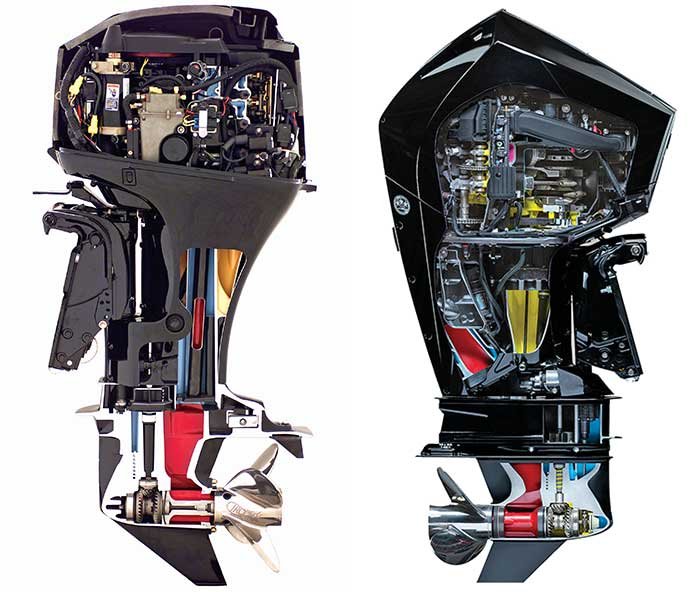
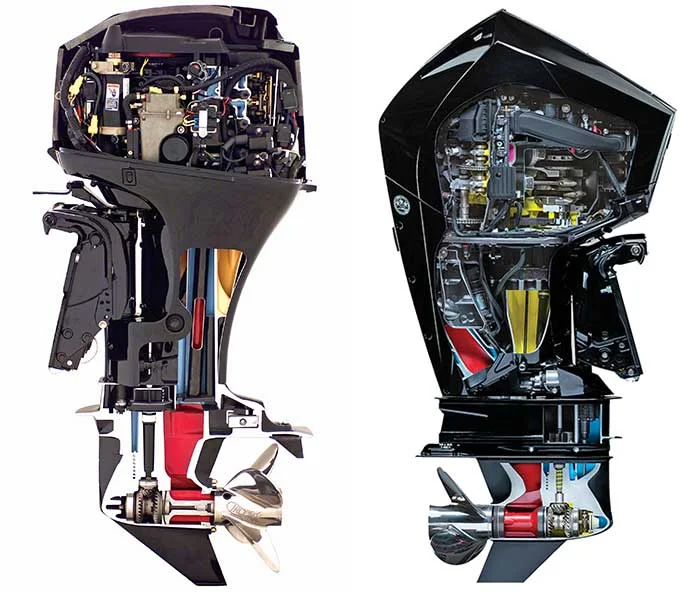
Honda Outboard Engine Components
To really understand How Honda Outboard Engines Work Explained, it helps to know the major parts of the engine.
Powerhead
This is basically the main engine itself.
The powerhead contains:
- Pistons
- Cylinder head
- Crankshaft
- Valves
- Fuel system
- Ignition system
Think of it as the heart of the outboard motor.
Midsection
The midsection connects the engine to the lower unit.
It also houses the driveshaft that transfers power downward.
Lower Unit
The lower unit contains the gears and propeller shaft.
This section stays underwater while operating.
Propeller
The propeller converts engine power into forward movement.
Different propeller sizes affect acceleration, speed, and fuel efficiency.
Honda BF Series Outboard Engines
Honda BF outboards are among the most recognized marine engines worldwide.
We regularly sell different Honda BF engines depending on availability.
Popular models include:
Honda BF90 Specifications
The BF90 is a popular size for fishing boats and medium-sized recreational boats.
Specifications
- Engine Type: Four-stroke
- Horsepower: 90 HP
- Cooling System: Water-cooled
- Fuel System: Electronic fuel injection
- Shaft Options: Multiple shaft lengths available
- Best Use: Fishing boats and pontoons
A lot of customers searching for How Honda Outboard Engines Work Explained ask about the BF90 because it’s considered one of the most dependable mid-range outboards.
Honda BF150 Specifications
The BF150 is one of Honda’s most respected outboards.
People like it because it balances power, reliability, and fuel efficiency well.
Specifications
- Engine Type: Four-stroke
- Horsepower: 150 HP
- Fuel System: Programmed fuel injection
- Cooling System: Water-cooled
- Starting System: Electric
- Best Use: Offshore boats and larger recreational boats
Why Fuel Injection Matters
Older carbureted outboards worked fine, but fuel injection changed things.
Fuel-injected Honda outboards usually offer:
- Easier starting
- Better fuel economy
- Smoother throttle response
- Better cold-weather performance
- Cleaner combustion
That’s one reason modern Honda outboards became so popular.
Why Honda Outboards Last So Long
People constantly ask why Honda outboards have such a strong reputation.
Honestly, it comes down to a few things.
Good Engineering
Honda has always been known for building durable engines.
Lower Engine Stress
Many Honda outboards are designed to run smoothly without feeling overstressed.
Proper Maintenance
This matters more than anything.
A properly maintained Honda outboard can last for years.
Common Honda Outboard Problems
No engine is perfect.
Even Honda outboards eventually develop problems, especially in saltwater environments.
Some common issues include:
- Corrosion
- Fuel system problems
- Water pump wear
- Electrical issues
- Lower unit damage
- Overheating problems
A lot of customers searching for How Honda Outboard Engines Work Explained are already dealing with one of these issues.
Signs Your Honda Outboard May Need Replacement
Sometimes repairs stop making financial sense.
That’s when people start looking for replacement motors.
Hard Starting
If the engine becomes difficult to start repeatedly, fuel or ignition problems may be developing.
Loss of Power
Weak acceleration or poor performance under load can signal engine wear.
Excessive Smoke
Smoke can point to oil or fuel system problems.
Overheating
Repeated overheating can damage internal engine components.
Metal in Gear Oil
Metal shavings inside lower unit oil can indicate gear damage.
We Sell Honda Outboard Engines
We sell Honda outboard engines and marine motors for customers worldwide.
That includes:
- Used Honda outboards
- Low-hour Honda marine engines
- Honda BF series motors
- Four-stroke outboards
- Complete outboard assemblies
- Replacement lower units
- Marine engine parts
A lot of buyers contact us because they want a replacement engine without paying new outboard prices.
That’s understandable.
Marine engines are expensive.
A good used Honda outboard can save a lot of money.
Why Used Honda Outboards Stay in Demand
Honda outboards hold value well.
There’s a reason for that.
People trust them.
A well-maintained Honda marine engine can run for years if serviced properly.
That’s why used Honda outboards remain in high demand worldwide.
Saltwater vs Freshwater Use
Where the engine was used matters.
Freshwater engines usually experience less corrosion.
Saltwater engines can still be good, but maintenance history becomes extremely important.
That’s something buyers should always ask about.
Why Boat Owners Prefer Four-Stroke Outboards
Four-stroke outboards became dominant because they offer several advantages.
Better Fuel Economy
Four-stroke engines generally burn less fuel.
Less Smoke
They run cleaner than older two-stroke motors.
Quieter Operation
This matters a lot on fishing boats and family boats.
Longer Engine Life
Properly maintained four-strokes often last a very long time.
Honda Outboard Maintenance Matters
Even the best outboard engine needs maintenance.
That includes:
- Oil changes
- Water pump service
- Fuel filter replacement
- Spark plug replacement
- Gear oil service
- Corrosion prevention
Neglect destroys marine engines faster than almost anything else.
Why People Buy Outboards Online Now
Years ago most people bought marine engines locally.
Now buyers search online because inventory is larger.
That means:
- More engine options
- Better pricing
- Easier comparison
- Access to lower-hour engines
- Shipping worldwide
That’s why searches for How Honda Outboard Engines Work Explained continue growing online.
Low Hour Honda Outboards
Hours matter on marine engines just like mileage matters on vehicles.
Lower-hour outboards usually have:
- Less wear
- Better compression
- Longer remaining life
- Better resale value
That’s why low-hour Honda outboards sell quickly.
We Ship Worldwide
We ship Honda outboard engines worldwide.
Engines are secured carefully before transport to help prevent damage during shipping.
We also help buyers with freight arrangements and shipping details.
Frequently Asked Questions
How do Honda outboard engines work?
Honda outboards use internal combustion to create power that spins the propeller and moves the boat through the water.
Are Honda outboards reliable?
Yes. Honda outboards are known for durability and fuel efficiency when maintained properly.
Do you sell used Honda outboard engines?
Yes. We sell used Honda marine engines and outboard motors.
What is the most popular Honda outboard?
The BF90 and BF150 are two of the most requested models.
Do Honda outboards use fuel injection?
Many modern Honda outboards use electronic fuel injection.
Are four-stroke outboards better?
Most boat owners prefer four-stroke engines because they’re quieter, cleaner, and more fuel efficient.
Do you ship worldwide?
Yes. We ship Honda outboard engines worldwide.
What’s better for saltwater use?
Proper maintenance matters more than anything, but freshwater engines usually experience less corrosion.
Are low-hour outboards worth it?
Usually yes. Lower hours generally mean less engine wear.
Final Thoughts
A lot of people searching for How Honda Outboard Engines Work Explained are really trying to answer a bigger question:
“Is a Honda outboard worth buying?”
For many boat owners, the answer is yes.
Honda outboards built a reputation for reliability over years of real-world use. Whether it’s a fishing boat, work boat, or recreational setup, these engines are known for smooth performance, fuel efficiency, and long engine life when maintained properly.
We sell Honda outboard engines and marine motors for customers worldwide. Whether you need a replacement outboard, a lower-hour Honda BF engine, or a complete marine setup, we can help you find the right engine without paying brand-new outboard prices.
Yamaha 300HP Outboard Review: Built for Speed and Strength – Yamaha 300HP outboard for sale
Electric vs Gas Outboard Motors: Pros, Cons & Which is Right for You
Posts Widget
- 1

- 2
- 3
- 4


S.H Continental Marine
USA HERALD MAGAZINE INC
Our team is dedicated to providing exceptional customer service.
Email: info@shcontinentalmarine.com
Choose S.H Continental Marine
for your outboard engine needs and enjoy superior quality, exceptional customer service, and unbeatable prices.
