
Marine Engines for Cargo Boats: The Ultimate 2026 Guide

Freight doesn’t care about your engine’s paperwork, it just needs to get from point A to point B on schedule, fully loaded, day after day. Marine engines for cargo boats live under a different set of demands than almost anything else we sell: constant load, low-speed torque instead of top-end speed, and zero tolerance for the kind of unplanned downtime that leaves a shipment sitting on a dock. We supply marine engines for cargo boats to operators running everything from small inter-island supply runs to river freight transport, and this guide covers what actually matters when the engine’s job is to move weight reliably, not win any races. Whether you’re running a single supply tender or coordinating a small fleet across a regular freight circuit, the same core questions apply: how much weight are you actually moving, how often, and what happens operationally the day an engine fails mid-route.
What Makes Cargo Applications Different
A recreational boat runs light most of the time and loaded occasionally. A cargo boat runs loaded, or close to it, almost every trip. That single difference changes the engineering priorities completely. Marine engines for cargo boats need strong low-end torque to get a heavy hull up and moving efficiently, gearing that favors pushing power over top speed, and enough cooling and structural margin to handle sustained loaded running without the component fatigue that shows up fast on engines never designed for it.
Torque and Gearcase: Why They Matter More Than Top Speed
- Low-end torque. Getting a fully loaded hull onto plane, or moving efficiently at displacement speed when planing isn’t realistic, depends far more on torque than peak horsepower numbers.
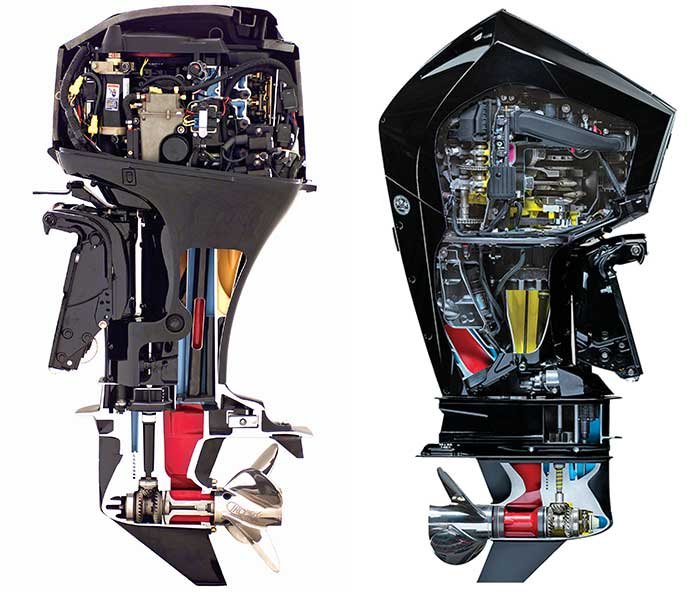
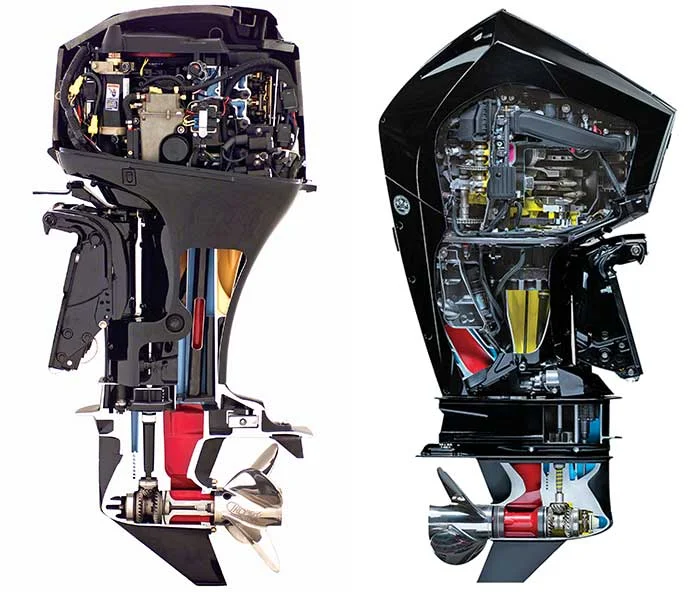
- Command Thrust and heavy-duty gearcases. A lower gear ratio paired with a larger-diameter propeller shaft delivers more pushing power at lower RPM, which is exactly what a loaded cargo hull needs most of the time.
- Propeller selection matters as much as the engine. A prop pitched for a light, fast recreational boat is often the wrong choice entirely for a boat that spends its life loaded down with freight.
- Reinforced cooling for sustained load. Pushing a heavy hull means the engine works harder for longer on every single trip, so cooling capacity that’s adequate for occasional loaded running isn’t necessarily adequate for constant loaded running.
Specifications Typical of Marine Engines for Cargo Boats
| Spec | Typical Range |
|---|---|
| Horsepower range | 40 HP to 350 HP depending on hull size and typical load |
| Gearcase | Low-ratio commercial or Command Thrust gearcase for pushing power |
| Configuration | Single, twin, or triple depending on redundancy needs and load |
| Fuel system | Electronic fuel injection standard on current commercial-spec models |
| Duty rating | Continuous commercial duty rather than intermittent recreational use |
| Starting | Electric start standard on nearly all commercial-spec models |
Sizing an Engine to Your Load, Not Your Empty Hull
The single most common mistake we see with marine engines for cargo boats is sizing based on the boat’s empty weight rather than its typical loaded weight. A hull that handles beautifully light and empty can be seriously underpowered once it’s carrying a full load of freight, and underpowering a loaded cargo boat isn’t just a performance problem, it burns more fuel per trip, strains the engine harder than a properly sized unit would, and shortens service life. Always size against your realistic maximum load, not the boat’s capacity plate minimum or how it runs empty at the dock.
Single Engine vs. Twin Setups for Freight Reliability
For cargo operations running scheduled routes, whether that’s a daily supply run between islands or a regular freight circuit on inland waterways, engine reliability isn’t optional. A single engine failure on a loaded cargo boat can mean a missed delivery, spoiled perishable freight, or a stranded vessel far from port. Many cargo operators choose twin marine engines for cargo boats specifically so a single failure doesn’t strand a loaded boat, running back at reduced speed on the remaining engine rather than not making it back at all. The extra cost of a second engine is, for scheduled freight operations, usually cheaper than the cost of one missed or ruined shipment.
What We Currently Stock
Recent stock suited to cargo and freight applications has included heavy-duty options like the Suzuki 300 HP DF300APL2 and commercial-gearcase units like the Mercury 40ELHPT Command Thrust SeaPro, both popular for pushing loaded hulls efficiently. Browse our Suzuki and Mercury category pages for current inventory, or tell us your hull size and typical cargo weight and we’ll recommend a configuration built for the load rather than just the highest horsepower number available.
Cargo Boats in Island and River Economies
A huge share of the demand we see for marine engines for cargo boats comes from island nations and river delta regions where water transport isn’t a leisure activity, it’s the primary way goods move between communities. Inter-island supply boats, river cargo lighters, and small coastal freighters depend on reliable outboard power in places where a missed run isn’t an inconvenience, it can mean a community goes without supplies for days. We ship marine engines for cargo boats to operators across island and coastal economies worldwide, and we understand that reliability and parts availability matter as much as raw specifications in these applications.
Weight Distribution and Transom Rating
Cargo boats need particular attention paid to transom rating and weight distribution that recreational buyers rarely think about. Confirm your hull’s maximum horsepower and transom weight rating before ordering an engine, and if you’re running twin or triple engines, make sure the transom is rated for the combined weight, not just a single unit. Overloading a transom, whether with too much horsepower or too many engines for the hull’s rating, is a structural risk that shows up as stress cracking and eventual failure long before the engines themselves would ever be the problem.
Maintenance for Continuous Cargo Duty
Cargo boats running daily routes accumulate hours faster than almost any other application we supply for. Maintenance needs to run on an hour-based schedule rather than a seasonal one: oil and filter changes every 100 hours, more frequent water pump impeller checks given the sustained loaded running, and gear oil service on a tighter interval if the boat operates in silty river water or debris-heavy coastal areas. Falling behind on hour-based maintenance is one of the fastest ways to turn a reliable cargo engine into an unreliable one, often well before the hours would suggest a problem is coming.
Fuel Efficiency for Daily Freight Routes
For a boat running the same route daily, fuel cost adds up fast, and marine engines for cargo boats with electronic fuel injection meaningfully outperform older carbureted engines on fuel burn per trip. Over a season of daily runs, even a modest efficiency improvement per trip compounds into real savings, which matters directly to the margins on a freight operation running tight schedules and thin per-trip profit.
Corrosion Protection in Continuous Service
Cargo boats often stay in the water far more than recreational craft that get trailered between uses, which raises the corrosion protection stakes considerably. Check anodes monthly on continuously moored cargo vessels rather than seasonally, flush with fresh water where practical after saltwater routes, and inspect electrical connectors regularly, since a boat running daily has less natural downtime for small corrosion issues to be caught before they become expensive.
Spare Parts Strategy for Remote Operations
A lot of cargo operations we work with run in locations where the nearest authorized service center is a genuine logistical challenge to reach quickly. For marine engines for cargo boats operating in remote or island locations, keeping a basic spares kit on hand, water pump impellers, spark plugs, fuel filters, and critical fasteners, makes a real difference in how quickly a small issue gets resolved versus how long a boat sits idle waiting on parts to arrive. We can help put together a starter spares kit alongside your engine order specifically for operators in harder-to-reach locations.
Buying New vs. Used for Cargo Operations
New engines make the most sense for operators running scheduled freight routes where predictable uptime directly protects revenue. Well-maintained used engines can still work for lower-frequency cargo routes, provided you get full service history, an hour count, and a compression test before buying. We’re upfront about hours and condition on every used engine we sell for cargo applications, since operators need accurate information to plan realistic maintenance budgets rather than dealing with surprises after the engine’s already in service.
Financing and Multi-Unit Cargo Fleet Orders
Operators running multiple cargo boats, or planning to add vessels to an existing freight route, should talk to us directly about volume orders. We arrange consolidated shipping to reduce per-unit freight costs and coordinate delivery timing so an entire fleet isn’t taken out of service for engine replacement all at once. Tell us your boat count, typical load, and route schedule, and we’ll put together a phased order plan that keeps your freight operation running while engines are replaced or added.
Worldwide Shipping for Cargo Applications
We ship marine engines for cargo boats internationally by sea and air freight, handling crating, insurance, and export documentation on our end. We’ve supplied cargo and freight operators across Africa, the Caribbean, Southeast Asia, the Middle East, Latin America, and Europe, managing customs classifications so engines arrive ready to install instead of stuck at port while paperwork gets sorted out. For operators in harder-to-reach locations, we plan shipping routes and timing around your actual logistics rather than a one-size-fits-all schedule.
Documentation for Regulatory and Insurance Purposes
Commercial cargo operations frequently need documentation that recreational buyers never think about: proof of an engine’s authentic origin for insurance purposes, compliance paperwork for local maritime or port authorities, and sometimes registration documentation depending on the vessel type and the waterways it operates on. We provide serial number verification and origin documentation with every sale, since we know cargo operators often need to produce this paperwork before a vessel can even be licensed to operate commercially.
Choosing Between Outboard and Larger Inboard Power
Not every cargo application needs a large inboard diesel. For small-to-mid sized cargo lighters, supply tenders, and coastal freight boats, marine engines for cargo boats built around outboard power are often more practical: easier and cheaper to service, simpler to replace entirely if something fails badly rather than requiring an in-hull repair, and they free up deck space that would otherwise go to an engine room, which matters directly on smaller cargo hulls where every bit of deck space can carry freight instead. Larger cargo vessels running very long distances or extremely heavy tonnage still make more sense with inboard diesel power, but for the mid-size freight applications most of our customers run, outboard configurations are frequently the more practical and cost-effective choice.
Handling River Silt and Debris
Cargo routes on rivers and inland waterways bring a specific challenge recreational buyers rarely deal with: silt, floating debris, and shallower water than most engines are designed around. Marine engines for cargo boats operating on these routes benefit from more frequent cooling system checks, since silt-laden water strains water pumps and cooling passages faster than clean coastal or open water. A shallow-water drive option is also worth considering for routes with variable depth, since it lets the operator run closer to the bottom without constantly risking prop or gearcase damage on a loaded, harder-to-maneuver hull.
Weather and Seasonal Route Planning
Many cargo routes, particularly in tropical and monsoon-affected regions, deal with real seasonal variation in water conditions. Operators running marine engines for cargo boats through rough-water seasons should factor engine reliability margins into scheduling, since a loaded boat handles rough conditions very differently from an empty one, and a route that’s comfortable in calm season can become genuinely demanding once seasonal weather sets in. Planning maintenance timing around slower seasons, rather than deferring it into your busiest and roughest months, keeps engines in better condition when reliability matters most.
Standardizing Engines Across a Cargo Fleet
Operators running more than one cargo vessel often find real value in standardizing on a single brand and horsepower class across the fleet. It simplifies spare parts inventory, means crew and any on-site mechanics only need to learn one system, and makes swapping a spare engine between vessels possible in an emergency if configurations match. The tradeoff is slightly less flexibility to optimize each specific hull individually, but for most freight operators running scheduled routes, the operational simplicity of standardized marine engines for cargo boats across the fleet outweighs that tradeoff.
Crew Familiarity With Loaded-Hull Handling
A loaded cargo boat handles differently from an empty one in ways that matter for both safety and engine longevity, slower to accelerate, longer to stop, and more sensitive to trim adjustments. Crew who understand how to trim the engine correctly for a loaded run, rather than running with recreational-boat habits, both protect the engine from unnecessary strain and get better fuel economy out of every trip. A short orientation when new marine engines for cargo boats are delivered, covering trim, throttle management under load, and basic warning signs, pays for itself quickly in reduced wear and more predictable fuel consumption.
Common Mistakes Cargo Operators Make
The most frequent one is buying based on empty-hull performance rather than loaded performance, which leaves the boat underpowered exactly when it matters most. A second common mistake is skipping redundancy on routes where a stranded boat has real consequences for perishable or time-sensitive freight. A third is underestimating how much faster hours accumulate on a daily cargo route compared to recreational use, which leads to missed maintenance intervals and premature engine wear. All three are avoidable with proper sizing and a maintenance schedule that matches actual usage rather than a generic seasonal one.
Insurance Considerations for Cargo Vessels
Marine insurers covering cargo and freight vessels frequently require documentation of engine origin, service history, and sometimes proof that the installation meets manufacturer specifications for the rated load. Operators who can’t produce this paperwork when it’s requested sometimes face higher premiums or complications at claim time, particularly after an incident involving a loaded vessel. Keeping organized records from the point of purchase, including verification documentation and service logs, makes the insurance side of running a cargo operation considerably less stressful when a claim or policy renewal comes around.
Planning for Fleet Growth
Freight demand tends to grow in steps rather than smoothly, a new contract or route can mean adding a vessel with fairly short notice. Operators who standardize on marine engines for cargo boats from a supplier who understands their route and load profile can move faster when that growth happens, since we already know the specifications that work for your operation rather than starting the sizing conversation from scratch each time. Keeping an ongoing relationship with your engine supplier, rather than treating each purchase as a one-off transaction, generally pays off when you need to scale quickly.
Setting a Realistic Budget for Cargo Power
Commercial-duty marine engines for cargo boats typically cost more than a recreational-spec equivalent of similar horsepower, reflecting the reinforced components and gearcase engineering built for sustained loaded running. That premium is almost always smaller than the cost of a missed delivery, spoiled freight, or an early rebuild on an engine that was never rated for the duty it ended up doing. Budget for the right spec from the outset, and factor freight, commissioning, and any spares kit into your total cost rather than treating them as afterthoughts once the engine has already shipped.
Common Questions About Marine Engines for Cargo Boats
What horsepower do I need for a cargo boat?
It depends on hull size and typical loaded weight, not empty weight. Send us your hull dimensions and typical cargo load and we’ll recommend an appropriately sized configuration.
Should a cargo boat run more than one engine?
For scheduled freight routes where a stranded boat has real consequences, twin engines are common specifically for redundancy, so a single failure doesn’t strand a loaded vessel.
What gearcase is best for pushing heavy loads?
Command Thrust or a similar low-ratio commercial gearcase, which trades some top speed for significantly better low-speed pushing power on loaded hulls.
How often should engines be serviced on a daily cargo route?
On an hour-based schedule, typically every 100 hours for oil and filters, since daily freight routes accumulate hours far faster than recreational use.
Do you ship marine engines for cargo boats internationally?
Yes, we export worldwide by sea and air freight, including to island and remote coastal locations, with consolidated shipping available for multi-unit orders.
Is outboard power reliable enough for regular freight routes?
Yes, provided the engine is correctly sized for the load and maintained on an hour-based schedule. Twin-engine configurations add further reliability for scheduled routes.
What’s the biggest sizing mistake operators make?
Sizing against the boat’s empty weight instead of its typical loaded weight, which leaves the vessel underpowered exactly when it’s carrying freight.
Can you help with spares for remote cargo routes?
Yes, we can put together a starter spares kit alongside your engine order for operators running in harder-to-reach or island locations.
Ready to Source Marine Engines for Cargo Boats
Whether you’re running a single supply boat or coordinating a small freight fleet, we can help you specify the right horsepower, gearcase, and configuration for your actual load and route, then get it shipped to your location. Tell us your hull size, typical cargo weight, and route schedule, and we’ll recommend marine engines for cargo boats built for the job rather than just the biggest number on the spec sheet. You can also browse our other outboard motor buying guides, including our guide to outboard motors for commercial boats and our guide to verifying genuine outboard motors, if you’re still comparing options.
For international guidance on small commercial vessel safety and cargo operations, the International Maritime Organization publishes standards referenced by operators and regulators worldwide.
Posts Widget
- 1

- 2

- 3

- 4


S.H Continental Marine
USA HERALD MAGAZINE INC
Our team is dedicated to providing exceptional customer service.
Email: info@shcontinentalmarine.com
Choose S.H Continental Marine
for your outboard engine needs and enjoy superior quality, exceptional customer service, and unbeatable prices.
