
Outboard Motor Lower Unit Oil: The Essential Guide to Gear Case Maintenance (2026)

If you’ve ever pulled the drain plug on an outboard’s gear case and watched milky, coffee-with-too-much-creamer fluid dribble out instead of clean gold-brown oil, you already know why this matters. Outboard motor lower unit oil is the single most overlooked fluid on the back of your boat, and it’s also the one most likely to sink a gearcase quietly, over months, while everything still runs fine on the surface.
Engine oil gets all the attention because you can see it on the dipstick every time you pop the cowling. The gear oil down in the lower unit is out of sight, out of mind, and that’s exactly the problem. We service every used outboard that comes through our shop before it ships anywhere in the world, and outboard motor lower unit oil is one of the first things we check — not the last.
This isn’t a complicated topic, but it’s one a lot of owners genuinely don’t understand, mostly because nobody ever walks them through it. So let’s go through what this oil actually does, how it’s different from the oil in your crankcase, how often you need to be checking it, what the warning signs look like when something’s gone wrong, and exactly how to drain and refill it yourself if you’re comfortable getting your hands a little dirty.
What the Lower Unit Actually Does
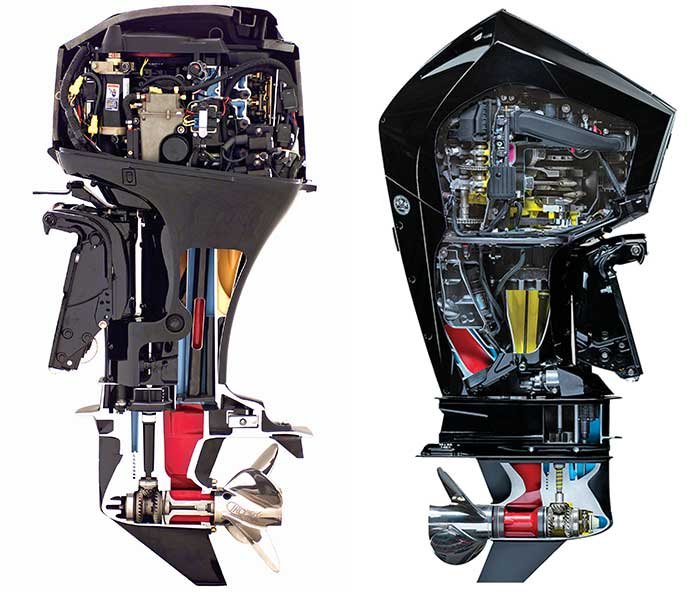
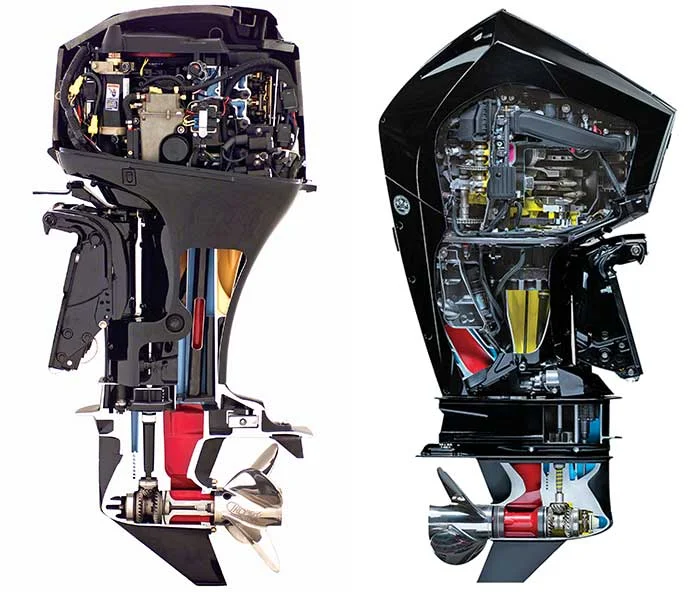
The lower unit — also called the gear case — is the housing at the bottom of the outboard, below the water where the propeller lives. Inside it, a set of gears takes rotational power coming straight down the driveshaft from the powerhead and redirects it ninety degrees, out horizontally to the propeller shaft. That’s the whole job: turn the power ninety degrees and spin the prop.
It sounds simple because mechanically it is, but those gears are meshing under real load every time you’re on plane, they’re spinning at high RPM, and they’re doing it submerged in water with only a handful of seals standing between the gear case and the lake or the ocean around it.
Outboard motor lower unit oil is what keeps those gears from grinding themselves apart. It’s a heavy, viscous gear lube — not the thinner oil circulating up in the powerhead — and it has to do three jobs at once: lubricate the gear teeth and bearings under shock loading, carry heat away from a housing that has no separate cooling system of its own, and resist getting broken down by whatever moisture manages to sneak past the seals. That last point is the one most owners don’t think about until it’s already a problem.
Most gear cases run a set of bevel or hypoid pinion gears at the top of the driveshaft meshing against the forward and reverse gears on the prop shaft, with a sliding dog clutch shifting between the two depending on which way the shifter’s pointed. Every one of those contact points is under sliding load, not just rolling load, which is a big part of why gear oil needs a different additive package than engine oil in the first place.
There’s also not much total volume of oil down there — usually under a quart on a small-to-mid-size outboard — so there’s very little margin for that oil to be contaminated or low before some part of the gear train starts running close to dry.
Why Outboard Motor Lower Unit Oil Is Different From Engine Oil
We get asked fairly often whether you can just top off the gear case with whatever four-stroke or two-stroke engine oil is sitting on the shelf. Don’t. They’re built for completely different environments. Crankcase oil is formulated to handle combustion byproducts, high heat cycling, and thin enough viscosity to circulate through an oil pump and past piston rings.
Gear oil in the lower unit is a much thicker, higher-viscosity lubricant designed specifically for the sliding and rolling contact of hypoid or spiral-bevel gears under heavy load, and it carries extreme-pressure (EP) additives that engine oil simply doesn’t need. If you’ve read our guide to marine engine oil, you already know how particular the powerhead is about what runs through it — the gear case is every bit as particular, just about a different fluid entirely.
The other big difference is exposure. Your crankcase oil never touches water under normal operation. The lower unit gear oil sits in a housing that’s underwater every time the boat is running, separated from the lake or ocean by nothing more than a couple of small rubber seals on the driveshaft and prop shaft. Those seals are a wear item.
They will eventually let water in, and when that happens, only the gear oil down there is going to show you the evidence before it turns into an expensive gear case rebuild. It’s a closed system with almost no room for error, and that’s precisely why outboard motor lower unit oil needs its own maintenance schedule instead of getting lumped in with an engine oil change.
How Often to Check and Change Outboard Motor Lower Unit Oil
The general rule of thumb across the outboard world is every 100 hours of run time or once a season, whichever comes first — and for most weekend boaters, that means once a season is what actually triggers the change, since you’re not putting 100 hours on a recreational engine in a typical year.
Saltwater use, heavy trolling with the motor at low RPM for extended periods, or an engine that sees commercial-style hours should lean toward the more frequent end of that range. Every manufacturer publishes their own exact interval and it does vary a bit by model and shaft length, so check your owner’s manual for the number specific to your engine — but 100 hours or annually is the baseline you can work from if that manual isn’t in front of you.
Checking is separate from changing, and it costs you nothing but a few minutes. Pull the lower drain screw partway, or use a pump to draw a small sample, and look at the color and consistency before you commit to a full drain. This is worth doing at the start of the season even if you’re not due for a full oil change yet, the same way you’d check trim and tilt fluid or run through the rest of your outboard motor maintenance checklist before the first trip out.
It’s also worth checking anytime you’ve had a hard hit — a prop strike on a rock or a log, fishing line wrapped tight around the prop shaft, or even a rough trailer landing can nick a seal instantly, and that damage won’t wait politely for your next scheduled interval.
Warning Signs Your Outboard Motor Lower Unit Oil Is Telling You Something
Once you get in the habit of pulling a sample, you’ll start to notice patterns fast. Clean outboard motor lower unit oil should look like honey or light amber, maybe slightly darker if it’s been in there a while. Anything else is a message. The table below covers the ones we see most often at the shop.
| What You See | Likely Cause | What To Do |
| Milky, white, or tan and frothy | Water intrusion through a worn or damaged seal | Replace the seal(s) before it runs again — don’t just top it off and hope |
| Metal flakes or glitter in the drained oil | Gear or bearing wear inside the case | Have the gear case inspected; catching it early can save the whole unit |
| Oil level low or empty at the vent screw | Leaking seal or loose/missing drain and vent screws | Find and fix the leak, replace both screw washers, refill fully |
| Oil smells burnt or is very dark and thin | Overheating or extended interval without a change | Change it now and shorten your interval going forward |
| Fine gray or black sludge | Normal seal and gasket wear breaking down over time | Usually fine at a routine change; keep an eye on frequency |
Milky oil is the one that should get your attention immediately. It means water has found its way past a seal, and gear oil that’s been emulsified with water loses most of its lubricating ability right when the gears need it most.
Keep running the motor on compromised gear oil and you’re not looking at a cheap seal replacement anymore — you’re looking at pitted, rusted gears and bearings, and at that point you’re rebuilding or replacing the whole case. A propeller strike, fishing line wrapped tight around the prop shaft, or just age and heat cycling are the usual causes of a bad seal in the first place, and every one of them is a lot cheaper to fix before the water gets in than after.
A quick way to pull a sample without a full drain: thread a small hand pump or squeeze bulb into the drain hole and draw a couple of ounces up into a clear cup. You get the same diagnostic information — color, water contamination, particulate — without committing to a full service, and it takes about two minutes. If what comes out looks clean and full, you can top it back off and move on with your day.
How to Drain and Refill the Lower Unit Yourself
This is a job most owners can handle in the driveway with basic hand tools, a gear oil pump, and about thirty minutes. You’ll need a drain pan, a screwdriver or the correct hex/square driver for your engine’s drain and vent screws, a gear oil pump (the tube-style pump that threads into the drain hole works best), fresh marine gear oil, and new sealing washers for both screws. Here’s the actual procedure for changing your outboard motor lower unit oil, start to finish.
- Trim the motor to a vertical, running position and make sure it’s stable and supported — you don’t want it tilted while you’re draining, or oil pools in the wrong spot.
- Place a drain pan underneath the gear case. Locate the two screws on the lower unit: the drain screw near the bottom and the vent screw higher up, closer to where the case meets the exhaust housing.
- Remove the vent screw first, then the drain screw. Old oil will start flowing out the bottom immediately — let it fully drain, which can take a few minutes for thicker or colder gear oil.
- Inspect what drained into the pan for color, water contamination, and metal particles before you dispose of it. This is your diagnostic moment, so don’t skip straight to refilling.
- Thread a gear oil pump tube into the bottom (drain) hole and start pumping fresh gear oil in from the bottom. Filling from the bottom pushes air out the top vent hole naturally, instead of trapping air pockets the way filling from the top would.
- Keep pumping until clean oil starts coming out steadily from the vent hole at the top with no more air bubbles. That’s your sign the case is full.
- Insert and snug the vent screw first, while oil is still flowing, then remove the pump and quickly install the drain screw. Doing it in this order keeps you from losing oil or drawing in air between the two steps.
- Always install new sealing washers on both the drain and vent screws — don’t reuse the old ones. They’re cheap, and a compressed, worn washer is exactly how water intrusion starts in the first place.
- Wipe down the housing, torque both screws to spec (don’t overtighten and strip the housing), and log the date and hour meter reading somewhere you’ll actually see it next season.
That last step matters more than people think. A written log, even a sticky note taped inside the console, is what keeps you from guessing whether it’s been one season or three since the outboard motor lower unit oil was last changed. And dispose of the old gear oil properly — most auto parts stores and marinas will take used oil for recycling, and gear oil should never go down a drain or into the ground.
What Type of Gear Oil to Use
Most outboards call for SAE 80W-90 or straight 90W gear lube as their outboard motor lower unit oil, and it needs to be a marine-rated formulation specifically — automotive gear oil isn’t built to resist the moisture exposure a lower unit deals with, and it lacks the additive package marine gear oil uses to stay stable when water inevitably works its way in over time.
Marine gear lube is engineered to shed small amounts of water rather than emulsify with it the way a road-going GL-5 gear oil often will. Stick with a reputable marine brand, match the viscosity your manufacturer specifies, and don’t mix different brands or additive packages in the same fill. If you’re not sure which weight your particular motor takes, that’s exactly the kind of detail your owner’s manual will spell out, and it’s worth the two minutes to confirm rather than guess.
Some newer four-stroke outboards spec a slightly different blend than older two-strokes did, and a few high-performance engines call for a specific factory formulation rather than a generic 80W-90, so don’t assume the gear oil that worked in your last boat’s motor is automatically right for a new one. When we prep a used engine for sale — something like the Tohatsu 60 HP MFS60D we currently have in stock — we’re filling the gear case with the exact spec that manufacturer calls for, not just whatever’s on the shelf.
The Real Cost of Ignoring It
Here’s the part that actually costs people money. A worn prop-shaft seal caught early is a ten or twenty dollar part and maybe an hour of labor. Ignore the milky oil, keep running the motor through a season or two because it “still runs fine,” and you’re not replacing a seal anymore — you’re replacing pitted gears, corroded bearings, and possibly the whole gear case housing if it’s rusted from the inside.
On a small motor that might run you several hundred dollars. On a mid-size or high-horsepower engine, a full lower unit rebuild or replacement can run well into four figures, sometimes rivaling a good chunk of what the motor is worth. We’ve seen owners bring in engines where a fifteen-dollar seal, ignored for two seasons, turned into a gear case that wasn’t worth repairing at all — and every one of those stories starts the same way, with someone who meant to check the outboard motor lower unit oil “next time out” and never quite got to it.
This is exactly why checking your outboard motor lower unit oil belongs on the same short list as checking your trim and tilt fluid and running through your general maintenance routine at the start and end of every season. None of these checks take long. None of them are expensive. All of them are far cheaper than the failure they prevent.
The National Marine Manufacturers Association’s consumer education site, Discover Boating, covers general seasonal maintenance basics along the same lines if you want a broader checklist beyond just the gear case.
Buying a Used Outboard? Check the Lower Unit First
If you’re shopping for a used engine, the outboard motor lower unit oil is one of the fastest ways to size up how well a motor was actually cared for. Pull a small sample before you buy. Milky oil, metal flakes, or an owner who has no idea when it was last changed are all red flags worth factoring into your offer, right alongside the points we cover in our guide to what to check before buying a used outboard motor. A seller who can tell you exactly when the gear oil was last serviced, and can show you clean amber oil on request, is usually a seller who took care of the rest of the motor too.
It’s also why we don’t skip this step on anything we sell. Every used engine that leaves our shop, whether it’s a small kicker motor like the Used Suzuki 4hp Long Shaft, a mid-range workhorse like the Yamaha 60 HP F60LB, or a high-performance engine like the Used Mercury 225hp Optimax XL Shaft, gets a full lower-unit service — fresh outboard motor lower unit oil, new drain and vent washers, and a seal inspection — before it ships anywhere in the world.
That’s not a marketing line, it’s just what “fully serviced” actually has to mean if the words are going to matter, and it’s the same standard we’d want applied to a motor we were buying ourselves.
Outboard motor lower unit oil doesn’t ask for much. Check it at the start of the season, change it every 100 hours or annually, replace both washers every single time you crack the case open, and pay attention when the color or consistency looks off.
Do that and you’ll get years of trouble-free service out of a gear case that would otherwise fail quietly and expensively. Skip it, and the lower unit is often the first major component to go on an otherwise healthy motor — not because the part is weak, but because nobody was looking at it. Whether you’re maintaining the engine you’ve already got or shopping for the next one, wherever you’re located, the outboard motor lower unit oil is worth five minutes of your attention every single time you’re near the motor.
Posts Widget
- 1

- 2

- 3

- 4


S.H Continental Marine
USA HERALD MAGAZINE INC
Our team is dedicated to providing exceptional customer service.
Email: info@shcontinentalmarine.com
Choose S.H Continental Marine
for your outboard engine needs and enjoy superior quality, exceptional customer service, and unbeatable prices.
