
Outboard Motors for Commercial Boats: The Ultimate 2026 Guide
A recreational buyer picks an outboard based on top speed and how it looks on the back of the boat. Fleet buyers ask different questions: how many hours a week will this run, what happens if it fails mid-shift, and what does a rebuild cost in three years. Outboard motors for commercial boats get judged on duty cycle, not curb appeal, and that changes almost everything about which engine actually makes sense. We supply outboard motors for commercial boats to charter operators, ferry services, dive shops, and fishing fleets worldwide, and this guide covers what actually matters when you’re buying for continuous, revenue-generating use rather than weekend runs.
How Commercial Duty Changes What You’re Buying
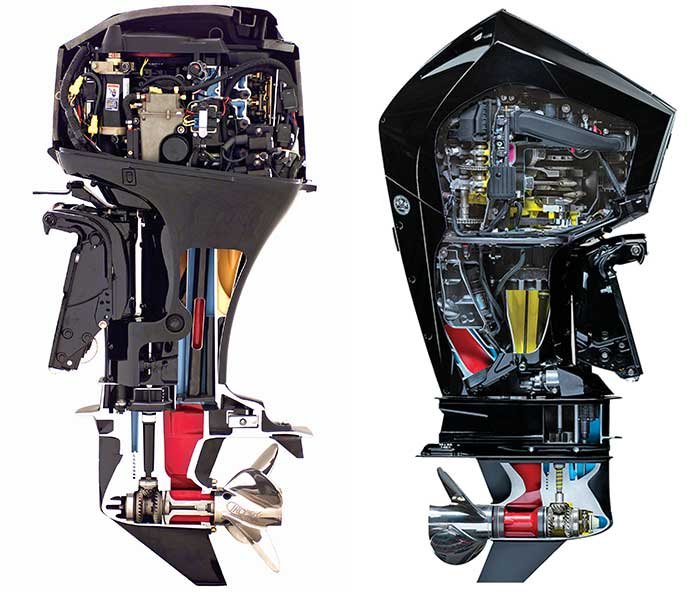
An outboard that’s perfectly adequate for twenty hours a season starts showing weaknesses fast at two hundred hours a month. Outboard motors for commercial boats need to handle sustained mid-to-high RPM running, frequent full-throttle starts with heavy loads, and far less downtime between uses for components to cool and recover. Manufacturers build specific commercial variants, often called SeaPro, Command Thrust, or simply “commercial rated,” with reinforced internals, different gear ratios, and sometimes lower maximum RPM ratings in exchange for a longer service life under constant load.
Key Features That Separate Commercial-Duty Engines
- Command Thrust or heavy-duty gearcases. A lower gear ratio and larger-diameter propeller shaft push heavier hulls more efficiently at low speed, which matters for boats that spend most of their working hours loaded rather than running light and fast.
- Reinforced cooling systems. Continuous-duty engines often get upgraded water pumps and larger cooling passages to handle sustained running better than a recreational-spec equivalent.
- Simplified electronics on some models. Certain commercial variants intentionally skip performance-tuning electronics in favor of simpler, more field-serviceable systems, since downtime costs money in a way it doesn’t for a weekend boat.
- Extended service intervals engineered for hours, not seasons. Commercial maintenance schedules are built around operating hours rather than calendar time, since a fleet engine can rack up a year’s worth of recreational hours in a couple of months.
Specifications Typical of Outboard Motors for Commercial Boats
| Spec | Typical Range |
|---|---|
| Horsepower range | 25 HP to 350 HP depending on hull and application |
| Gearcase | Standard or Command Thrust / low-ratio commercial gearcase |
| Duty rating | Continuous commercial duty, higher hour tolerance than recreational spec |
| Cooling | Reinforced water pump and cooling passages on commercial variants |
| Starting | Electric start standard on nearly all commercial-spec models |
| Recommended service interval | Hour-based, typically every 100 to 300 hours depending on component |
Matching Horsepower to Commercial Application
- Water taxis and passenger tenders: Typically 40 to 115 HP, balancing fuel economy against the need to stay on schedule regardless of passenger load.
- Dive and charter boats: 90 to 250 HP is common, often paired with twin engines for redundancy when clients are aboard offshore.
- Small-scale commercial fishing: 25 to 150 HP depending on hull size, with an emphasis on low-end torque for pulling gear and running loaded.
- Ferry tenders and workboats: 115 to 350 HP, frequently with Command Thrust gearcases for pushing consistently heavy loads at moderate speed.
Whatever the application, outboard motors for commercial boats should be sized with a margin above the boat’s typical loaded weight, not just its empty weight. A margin that feels like overkill light and empty pays off the day you’re running at capacity in rough conditions.
Single Engine vs. Twin and Triple Setups
Redundancy is a bigger factor in commercial decisions than in recreational ones. A single engine failure on a weekend fishing trip is an inconvenience; the same failure on a scheduled ferry run or a dive boat with paying clients offshore is a liability problem. Many operators running outboard motors for commercial boats choose twin or triple configurations specifically so a single engine failure doesn’t strand the boat, even if it means running at reduced speed back to port on the remaining engines. The added purchase and maintenance cost of a second engine is, for a lot of commercial operators, simply the cost of doing business responsibly.
Leading Brands for Commercial Applications
Every major manufacturer offers some version of a commercial-duty line. Mercury’s SeaPro and Command Thrust models are purpose-built for continuous fleet use. Suzuki and Yamaha both offer heavy-duty gearcase options across much of their mid-to-large horsepower range, popular with charter and dive operators worldwide. Honda’s reputation for smooth, low-vibration running makes it a common choice for operators whose crews spend full shifts next to the engine. We stock outboard motors for commercial boats across all of these brands; browse our Mercury, Honda, Suzuki, and Yamaha category pages for current stock, or read our dedicated guides to genuine Honda marine engines and genuine Mercury marine engines if brand authenticity is part of your decision.
What We Currently Stock
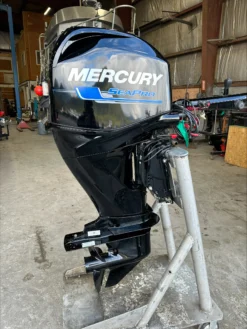
Recent commercial-duty stock has included the Mercury 40ELHPT Command Thrust SeaPro, along with heavy-duty options like the Suzuki 300 HP DF300APL2 for larger workboats and tenders. Availability shifts with fleet demand, so tell us your typical load, hull size, and duty cycle and we’ll recommend the right horsepower and gearcase configuration rather than just the biggest engine on the shelf.
Warranty Terms for Commercial Use
This is a detail recreational buyers rarely think about and commercial buyers can’t afford to skip: manufacturer warranties on outboard motors for commercial boats are usually shorter than the recreational warranty on the exact same engine, precisely because commercial use accumulates hours so much faster. A three-year recreational warranty might translate to one year or a fixed hour cap under commercial terms. Always confirm commercial warranty terms before you buy, and factor the shorter coverage window into your total cost of ownership rather than assuming recreational warranty language applies.
Maintenance Scheduling for Fleet Operations
Fleet maintenance runs on hours logged, not the calendar. A commercial engine doing forty hours a week can hit its 100-hour service interval in under three weeks, which means fleet operators need a maintenance rhythm built around actual usage tracking rather than the once-or-twice-a-season schedule recreational owners follow. Oil and filter changes every 100 hours, water pump impeller checks more frequently than the recreational interval given the sustained running, and gear oil service on a tighter schedule if the boat regularly operates in silty or debris-heavy water. Falling behind on hour-based service is one of the most common reasons commercial engines fail early, well before recreational-spec wear would predict.
Corrosion Protection for Continuous Duty
Commercial boats often spend more total time in the water than recreational boats that get trailered and stored between trips, which means corrosion protection matters even more. Check anodes monthly rather than seasonally on continuously moored commercial hulls, flush with fresh water after every saltwater shift where practical, and inspect electrical connectors regularly since commercial engines get less downtime for issues to be noticed early.
Fuel Efficiency and Operating Cost
For a recreational owner, a few extra liters an hour barely registers. For a fleet running several boats daily, fuel efficiency across your outboard motors for commercial boats compounds into a real line item on the balance sheet. Electronic fuel injection, standard on nearly every current commercial-spec engine, meaningfully outperforms older carbureted models on fuel burn, and even small efficiency gains per engine add up fast across a multi-boat fleet running daily routes.
Buying New vs. Used for Commercial Fleets
New engines make sense when warranty coverage and predictable maintenance costs matter most, particularly for operators running scheduled passenger services where downtime has real financial consequences. Well-maintained used engines can still make sense for lower-stakes applications, provided you get full service history, an hour count, and a compression test before buying. We’re upfront about hours and condition on every used commercial engine we sell, since fleet buyers need accurate information to plan maintenance budgets, not optimistic sales copy.
Financing and Bulk Fleet Orders
Outfitting or refreshing a fleet is a different conversation than buying one engine. We work with charter operators, ferry services, and commercial fishing fleets on volume orders, arranging consolidated shipping to bring per-unit freight costs down and coordinating delivery timing so you’re not taking boats out of service all at once. If you’re planning a fleet refresh, tell us your boat count, typical horsepower needs, and timeline, and we’ll put together a phased plan rather than a single overwhelming order.
Worldwide Shipping for Commercial Orders
We ship outboard motors for commercial boats internationally by sea and air freight, handling crating, insurance, and export documentation on our end. We’ve supplied commercial operators across Africa, the Caribbean, Southeast Asia, the Middle East, Latin America, and Europe, managing customs classifications so engines arrive ready to install rather than delayed at port. For multi-unit fleet orders, consolidated freight typically brings the per-engine shipping cost down noticeably compared to ordering one at a time.
Regulatory and Insurance Documentation
Commercial operators frequently need documentation beyond what a recreational buyer would ever ask for: proof of an engine’s authentic origin for insurance purposes, compliance paperwork for local maritime authorities, and sometimes classification society approval depending on the vessel type and jurisdiction. We provide serial number verification and origin documentation with every commercial sale, since we know operators often need to produce this paperwork for regulators or insurers before an engine ever gets mounted.
Standardizing on One Brand Across a Fleet
Operators running more than a handful of boats often land on a single brand for outboard motors for commercial boats across the whole fleet, and there’s a practical reason beyond loyalty. Standardizing means one parts inventory instead of three, mechanics who only need to be trained on one system rather than juggling different diagnostic tools and service procedures across brands, and simpler warranty and service-provider relationships. The tradeoff is less flexibility to chase the single best engine for each specific hull, but for most fleet operators the simplicity pays for itself in reduced downtime and lower parts carrying costs.
Spare Parts and Field Serviceability
A recreational owner can wait a week for a part to ship. A commercial operator with a boat sitting idle is losing revenue every day it’s down. Before committing to a specific engine for outboard motors for commercial boats, check realistic parts lead times to your location, not just the manufacturer’s stated global network. Keeping a basic spares kit on hand, water pump impellers, spark plugs, fuel filters, and the specific fuses or fasteners your engines commonly need, cuts downtime dramatically compared to ordering parts reactively after something fails.
Crew Training and Basic Troubleshooting
Commercial crews benefit from at least basic familiarity with the engines they’re running daily, beyond just operating the throttle. Knowing how to read a warning tone or alarm code, check oil level correctly, and recognize early signs of overheating or a failing water pump lets crew catch small problems before they become a stranded boat mid-shift. A short training session with your supplier or dealer when new outboard motors for commercial boats are delivered is worth the hour it takes, particularly for operators who don’t have an in-house mechanic on call.
Noise, Vibration, and Crew Fatigue on Long Shifts
Commercial crews spend entire shifts, not just an afternoon, within a few feet of the engine, which makes noise and vibration a real operational factor rather than a comfort preference. Engines with better vibration damping and lower cabin or console noise measurably reduce crew fatigue over an eight or ten hour day, which matters for both safety and simple quality of life for the people running the boat. It’s worth factoring into the decision alongside horsepower and gearcase specs when comparing outboard motors for commercial boats from different manufacturers.
Emissions and Regulatory Considerations
Depending on your operating region, commercial vessels may face different emissions standards or reporting requirements than recreational boats, particularly in ports and inland waterways with stricter local regulations. Modern electronically fuel-injected engines generally meet current international marine emissions standards more comfortably than older carbureted designs, which is worth factoring in if you operate in or near jurisdictions tightening environmental rules for commercial marine traffic. Check local requirements before finalizing a purchase, since compliance rules vary considerably by country and by waterway.
Why Outboards Instead of Inboard Diesels for Many Fleets
Not every commercial vessel needs a big inboard diesel, and for a large share of the operators we work with, outboard motors for commercial boats make more practical sense. Outboards are easier and cheaper to service, simpler to swap out entirely if something goes seriously wrong rather than requiring an in-hull repair, and take up no interior hull space, which matters on smaller workboats, tenders, and dive boats where every foot of deck space counts. Twin or triple outboard setups also give commercial operators redundancy that a single inboard simply can’t match without a second engine room. Inboard diesels still make sense for larger vessels running very long ranges or extremely heavy loads, but for the mid-size commercial fleet applications most of our customers run, outboard power is often the more practical and cost-effective choice.
Common Mistakes Fleet Buyers Make
The most common one is buying recreational-spec engines because they’re cheaper up front, then discovering the hard way that the components weren’t built for the duty cycle. A close second is skipping the redundancy conversation and running single engines on boats that really need a backup. The third is underestimating shipping and lead time for multi-unit orders and getting caught short-staffed on power when a scheduled service needs to launch. None of these are complicated to avoid, they just require treating the purchase as an operational decision rather than a one-off transaction.
Operating in Different Climates and Regions
Outboard motors for commercial boats face very different conditions depending on where they operate. Year-round tropical operators dealing with constant saltwater exposure and high humidity need more frequent anode and corrosion checks than a seasonal operator in a temperate climate who lays up for part of the year. River and inland waterway operators often deal with more debris and silt, which puts extra strain on water pumps and cooling systems compared to open ocean use. When we help fleet buyers specify engines, we factor in the operating region alongside horsepower and load, since the right engine for a year-round tropical charter operation isn’t necessarily the same spec that makes sense for a seasonal temperate ferry route.
Insurance and Vessel Documentation
Marine insurers covering commercial vessels frequently require documentation of the engine’s origin, service history, and sometimes a survey confirming the installation meets manufacturer specifications. Operators who can’t produce this paperwork sometimes face higher premiums or, in some cases, denied claims after an incident. Keeping organized records from the point of purchase, including our verification documentation and any service history, makes the insurance side of running a commercial fleet considerably less stressful when a claim or renewal comes up.
Setting a Realistic Budget
Commercial-duty outboard motors for commercial boats typically cost somewhat more than a recreational-spec equivalent of the same horsepower, reflecting the reinforced components and different gearcase engineering. That premium is almost always smaller than the cost of unplanned downtime or an early rebuild on an engine that wasn’t rated for the duty cycle it ended up running. Budget for the correct spec from the start rather than trying to save money upfront and absorbing the cost later in lost revenue days. Factor freight, commissioning, and crew training into the total cost as well, not just the sticker price of the engine itself, since those line items are real and predictable when you plan for them upfront rather than treating them as surprises after the order ships.
Common Questions About Outboard Motors for Commercial Boats
What makes an outboard “commercial rated” instead of just recreational?
Reinforced internals, often a different gearcase ratio for pushing loads, upgraded cooling, and a service schedule and warranty structure built around sustained hours rather than seasonal recreational use.
Do commercial outboards cost more than recreational versions?
Usually somewhat more for the same horsepower, reflecting the reinforced components, but the premium is generally smaller than the cost of downtime from an underspecced engine.
Should a commercial boat run twin engines?
For passenger-carrying or offshore commercial use, twin or multi-engine setups are common specifically for redundancy, so a single failure doesn’t strand the boat or passengers.
How often should a commercial engine be serviced?
On an hour-based schedule rather than a calendar one, typically every 100 hours for oil and filters, with more frequent impeller and gear oil checks under heavy use.
Do you ship outboard motors for commercial boats internationally?
Yes, we export worldwide by sea and air freight with consolidated shipping available for multi-unit fleet orders.
Is the warranty the same as a recreational engine?
No, commercial warranty terms are typically shorter or hour-capped compared to recreational coverage on the same model. Always confirm terms before ordering.
Can I mix brands across a commercial fleet?
You can, but most operators find standardizing on one or two brands reduces parts inventory complexity and simplifies crew training and mechanic familiarity across the fleet.
What documentation should I keep for insurance purposes?
Serial number verification, proof of authentic origin, and service history. Insurers covering commercial vessels frequently request this at claim time or renewal.
Ready to Source Outboard Motors for Commercial Boats
Whether you’re outfitting a single workboat or refreshing a multi-vessel fleet, we can help you specify the right horsepower, gearcase, and brand for your duty cycle and get it shipped to your location. Tell us your typical load, hull size, and hours per week, and we’ll recommend outboard motors for commercial boats that are actually built for the job rather than just the biggest engine available. You can also browse our other outboard motor buying guides, including our guide to commercial outboard motors for fleet and charter operators and our guide to verifying genuine outboard motors, if you’re still comparing options.
For general commercial vessel safety standards and equipment guidance referenced by operators worldwide, the International Maritime Organization publishes current regulatory frameworks relevant to commercial small craft.
Posts Widget
- 1

- 2

- 3

- 4


S.H Continental Marine
USA HERALD MAGAZINE INC
Our team is dedicated to providing exceptional customer service.
Email: info@shcontinentalmarine.com
Choose S.H Continental Marine
for your outboard engine needs and enjoy superior quality, exceptional customer service, and unbeatable prices.
