Marine Engine Troubleshooting: The Essential Guide to Working Through a Problem (2026)

Marine Engine Troubleshooting: The Essential Guide to Working Through a Problem
An engine that won’t start, stumbles at idle, or dies at the worst possible moment rarely fails for a mysterious reason. Almost every problem traces back to one of a handful of systems: fuel, ignition, cooling, electrical, or a mechanical fault, and the fastest way to a fix is ruling those out in order rather than replacing parts at random and hoping. Good marine engine troubleshooting is a process, not a guess, and it’s a process that works the same whether you’re on the water with a dead engine or diagnosing a nagging issue at the dock.
We sell complete outboard motors across most major brands, and we diagnose engines all day as part of getting used inventory ready for sale. The patterns repeat often enough that most problems fall into a short list of usual suspects, and knowing that list before you start pulling things apart saves hours of chasing the wrong lead.
Start with the question: did it run before, or has it never run right
This single question changes the entire diagnostic path. An engine that ran fine last trip and won’t start today almost always has a specific, recent cause: stale fuel, a dead battery, a tripped kill switch, or water in the fuel. An engine that’s never run quite right since you got it, or since a repair, points toward something that was set up incorrectly, a timing issue, a bad part from that repair, or a persistent fuel quality problem. Don’t skip this question. It immediately eliminates half the possibilities before you’ve touched a single wrench.
The engine won’t start at all
Work through this in order rather than jumping around. Check the kill switch lanyard first, since a disconnected or improperly seated lanyard clip is one of the most common reasons an otherwise healthy engine won’t crank at all, and it’s the fastest thing to rule out. Next, battery voltage: a battery reading under 12.4 volts at rest often doesn’t have enough cranking power even if the engine turns over weakly. Then fuel: is fresh fuel actually reaching the engine, and does the primer bulb hold pressure without collapsing? Finally, spark: pull a plug and check for a strong, consistent spark when cranking. Most no-start situations resolve somewhere in these four checks before you need to go any deeper into the engine.
| Symptom | Most Likely Cause | Quick Check |
|---|---|---|
| Won’t crank at all | Dead battery, kill switch, bad ground | Check lanyard, test battery voltage |
| Cranks but won’t fire | No spark, no fuel, or flooded | Pull a plug, check for spark and fuel smell |
| Starts then dies immediately | Fuel delivery or choke/primer issue | Check primer bulb, fuel line kinks |
| Hard starting when cold only | Choke or cold-start enrichment issue | Verify choke engages fully |
Rough idle or stalling at low RPM
An engine that runs fine at speed but stumbles or stalls at idle usually has a fuel delivery problem rather than an ignition one, since idle circuits are the most sensitive part of a carbureted or fuel-injected system to even small amounts of contamination or a vacuum leak. Old fuel that’s picked up moisture or started to break down is the single most common cause on engines that sat over winter without stabilizer treatment. A fouled idle jet on a carbureted engine, or a dirty idle air control valve on an EFI model, produces almost identical symptoms, which is why fuel system cleanliness is always worth checking before assuming a sensor has failed.
Overheating: the warning most owners catch too late
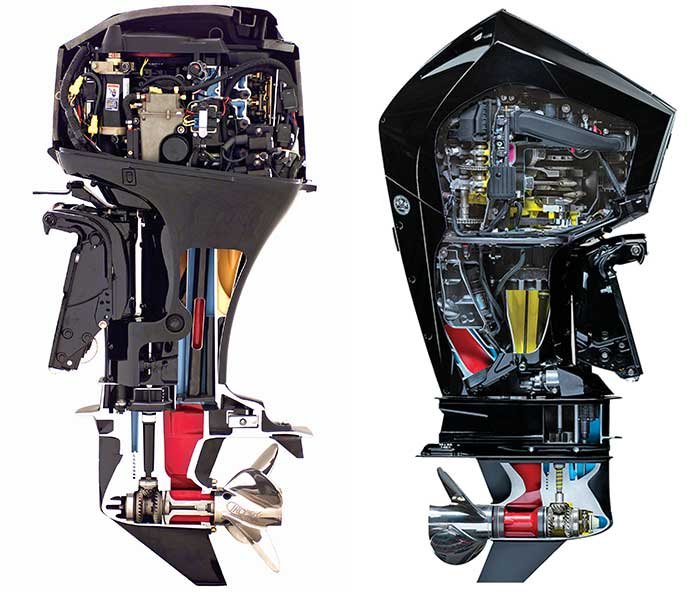
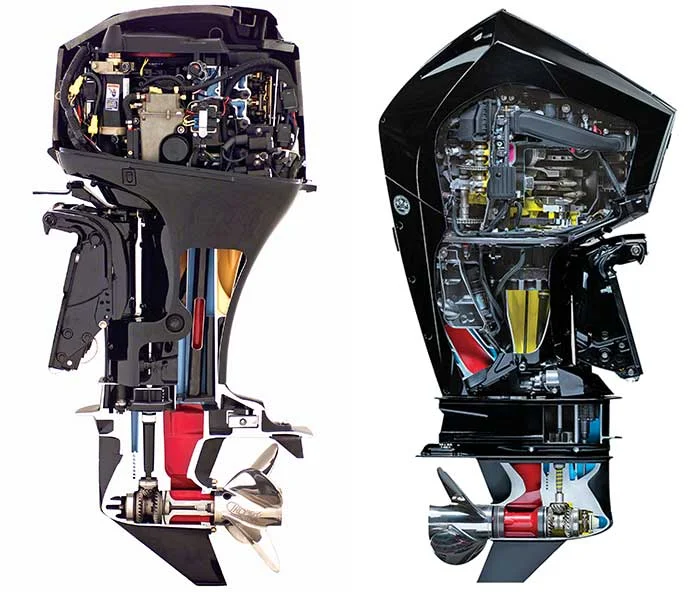
An overheating outboard usually gives you the tell-tale sign before real damage happens: no water stream, or a weak one, from the tell-tale hole (the small stream of water that should be visibly discharging while the engine runs). If that stream stops or weakens, shut the engine down and investigate before running it further. The most common cause by far is a clogged or failed water intake, often from debris, growth in the lower unit, or running in shallow, silty water. The second most common is a worn impeller, the rubber pump component that physically moves cooling water through the engine and degrades over time even without a blockage. Thermostat failure is less common but does happen, and it can cause overheating even with normal water flow at the tell-tale.
| Overheating Symptom | Likely Cause |
|---|---|
| No tell-tale stream at all | Blocked intake or dead impeller |
| Weak or intermittent stream | Partial blockage or worn impeller |
| Normal stream but engine still overheats | Failed thermostat or internal blockage |
| Overheats only at high RPM | Impeller not keeping pace with demand |
Loss of power or the engine won’t reach full RPM
This loss-of-power category is one of the more frustrating parts of marine engine troubleshooting because it can stem from so many different systems. A fouled or partially clogged fuel filter restricts flow enough to starve the engine under load, even while idle and low-speed running feel fine. A propeller that’s been damaged, even with a strike small enough that it isn’t visually obvious, can noticeably rob performance. A slipping hub inside the propeller (a wear item on many props that allows the blades to spin slightly independent of the shaft under load) produces a similar symptom and is easy to miss without pulling the prop to check. And on engines with a failing ignition coil, power loss under load, rather than a total misfire, is often the first sign something’s starting to go before it fails completely.
Vibration and unusual noise
In marine engine troubleshooting terms, new vibration that wasn’t there before almost always traces back to the propeller: a bent blade, fishing line wrapped around the shaft, or debris caught between the blades. Before assuming an internal engine problem, pull the prop and inspect it closely, since a barely visible ding can throw off balance enough to feel like a much bigger issue. If the prop checks out clean, engine mount condition is next; worn or cracked motor mounts let the engine move more than it should, translating normal running vibration into something you can feel through the whole boat. Unusual knocking or ticking noises that weren’t there before warrant stopping and investigating rather than continuing to run, since those sounds often mean something mechanical has already started wearing.
Electrical gremlins: the hardest category to pin down
Electrical faults are among the hardest marine engine troubleshooting cases: intermittent problems, gauges that flicker, an engine that occasionally dies for no clear reason, a charging system that isn’t keeping the battery topped off, are genuinely harder to diagnose than fuel or mechanical issues because the fault often isn’t present when you’re actually looking for it. Start with the basics that cause a disproportionate number of electrical gremlins: corroded battery terminals, a loose ground strap, or a connector that’s technically making contact but with enough resistance to cause problems under vibration. A multimeter and a systematic check of connections, working from the battery outward, resolves more electrical issues than any amount of parts-swapping.
When it’s a fuel problem versus when it just looks like one
Stale fuel, water-contaminated fuel, and a genuinely failed fuel pump can all present nearly identical symptoms: hard starting, stumbling, stalling under load. The distinguishing test is usually straightforward: drain a small sample from the primer bulb or a low point in the fuel line into a clear container and look for separation, cloudiness, or a distinct water layer at the bottom. If the fuel looks clean and smells normal, the problem is more likely mechanical, in the pump, filter, or injectors, rather than the fuel itself. Skipping this simple check is one of the most common ways owners end up replacing a perfectly good fuel pump when the actual problem was a tank full of six-month-old gasoline.
Reading spark plug color: an old trick that still works
Pulling a spark plug and reading its color tells you more about combustion than almost any other single check, and it costs nothing but a plug socket. A plug with a light tan or grayish-tan color indicates a healthy mixture and normal combustion. Black, sooty deposits point to a mixture running too rich, often from a stuck choke, a dirty air filter restricting airflow, or a carburetor jet issue. A plug that looks unusually white or has a blistered, glazed appearance suggests the mixture is running too lean or ignition timing is off, both of which risk engine damage if left unaddressed. Oil fouling on a four-stroke’s plug points toward worn rings or valve seals, which is a more serious finding than a simple fuel mixture issue. This single five-minute check is one of the most efficient tools in marine engine troubleshooting and it’s astonishing how often owners skip it in favor of guessing.
Winterization mistakes that show up as spring no-starts
A large share of the no-start calls we see in early season trace directly back to a winterization step that was skipped or done incorrectly the previous fall. Fuel left untreated with stabilizer breaks down over months of storage, leaving varnish deposits in the carburetor or injectors that block fine passages exactly where a rich, reliable fuel flow is most critical. A fogging oil step skipped on a two-stroke, or a fuel system not properly run dry or stabilized, leads to a cylinder that’s harder to get firing cleanly on the first pull of the season. If an engine ran perfectly in the fall and won’t start in spring, winterization is the first place to look before assuming something has actually failed mechanically over the off-season.
A seasonal troubleshooting checklist worth running even when nothing’s wrong
Before the first trip of the season: check fuel for signs of separation or contamination, confirm the tell-tale stream flows properly at start-up, check battery voltage under load rather than just at rest, and pull a plug to check its color and condition. This proactive pass catches small issues while they’re still small, rather than discovering them mid-trip when a fix is far less convenient. A lot of what feels like an emergency breakdown was actually a slow-developing issue that a five-minute pre-season check would have caught weeks earlier.
Keeping a fault log for recurring or fleet issues
For anyone running more than one engine, whether that’s a personal boat and a tender or a small charter fleet, keeping a simple fault log across engines reveals patterns a single incident never would. If the same symptom shows up on multiple engines from the same batch of fuel, that points strongly toward a fuel supply issue rather than a coincidence of multiple engines failing independently. If one specific engine keeps returning with the same complaint after repairs, that’s a sign the underlying cause hasn’t actually been fixed, just temporarily masked. Structured marine engine troubleshooting at a fleet level is really just this same logical process applied across more than one engine at a time, with the added benefit of pattern recognition that a single boat owner doesn’t get to see.
A marine engine troubleshooting toolkit worth keeping aboard
A basic multimeter and a spark tester belong in any marine engine troubleshooting kit, and a spark tester is far more reliable than just pulling a plug and looking for a visual spark, a clear fuel sample container, spare plugs matched to your engine, and the printed or downloaded service manual for your specific model. Half of effective marine engine troubleshooting is having the right tool at hand when a symptom shows up rather than trying to diagnose blind and guessing at what might be wrong.
When troubleshooting says it’s time for a new engine
Sometimes the diagnostic process points toward a conclusion nobody wants: the repair cost approaches or exceeds what the engine is worth, or the failure is the third or fourth major one in as many seasons on an engine that’s simply reaching the end of its practical service life. That’s a legitimate outcome of troubleshooting, not a failure of the process. A sample of what’s currently available if a repower makes more sense than another repair:
| Motor | HP | Approx. Price (USD) |
|---|---|---|
| Yamaha F4LMHA | 4 HP | $1,430 |
| Yamaha F8LMHB | 8 HP | $1,225 |
| Yamaha F40JEHA | 40 HP | $4,075 |
| Yamaha F75LB | 75 HP | $5,650 |
| Yamaha F90JB | 90 HP | $6,300 |
Documenting the fault before you start
Before touching anything, write down exactly what happened: RPM at the time, whether it was under load or idle, any warning sounds or smells, and whether it’s repeatable or a one-time event. This sounds like overkill for a boat problem, but vague memory (“it just kind of died”) is far less useful than specific detail (“it died at roughly 3,500 RPM under load, no warning, restarted fine after five minutes”) when you’re trying to narrow down a cause. This single habit speeds up marine engine troubleshooting more than almost any other single step, whether you’re working it out yourself or describing the problem to a mechanic.
Common mistakes that slow down a diagnosis
Replacing parts before confirming which system is actually at fault, which wastes money and can mask the real problem for a while before it resurfaces. Ignoring intermittent symptoms because they resolved on their own, when intermittent almost always means “not yet failed completely” rather than “not actually a problem.” Skipping the simple checks (fuel quality, battery voltage, kill switch) because they feel too basic to be the cause, when they’re statistically the most common cause by a wide margin. And troubleshooting under time pressure at the dock with everyone waiting, which leads to shortcuts that a calmer diagnostic session at home would have caught.
Worldwide support for engines we sell
Every engine we sell ships with documentation of its condition and service history, and we’re available to walk through marine engine troubleshooting for anything you bought from us, regardless of where in the world it ended up. If a problem does turn out to need a part, we can typically source and ship it to most destinations, and if the underlying issue points toward a repower instead of another repair, we’ll say so plainly rather than stringing along a fix that isn’t going to hold.
Frequently asked questions
My engine cranks fine but won’t fire. Where do I start?
Check for spark first with a proper spark tester, then check fuel delivery. Between those two checks, you’ll usually find the cause without needing to go further.
Is it safe to keep running an engine that’s slightly overheating?
No. Shut it down and investigate immediately. Continuing to run an overheating engine, even briefly, risks damage that turns a simple impeller replacement into a much larger repair.
How do I know if it’s the propeller or the engine causing vibration?
Pull the prop and inspect it closely for bends, nicks, or a slipping hub before assuming an internal engine issue. Propeller damage is the more common cause by a wide margin.
What’s the single most useful tool for marine engine troubleshooting?
A basic multimeter, paired with a real spark tester rather than just visually checking for spark. Together they resolve the majority of no-start and rough-running complaints.
When should I stop troubleshooting and just call a mechanic?
When the diagnostic points to something requiring specialized tools you don’t have, or when repeated attempts haven’t narrowed the cause after working through the basics systematically.
What does a black, sooty spark plug tell me?
It usually points to a mixture running too rich, often from a stuck choke or a dirty air filter. It’s worth checking both before assuming a bigger fuel system problem.
Can bad winterization really cause a no-start months later?
Yes, and it’s one of the most common causes of spring no-starts. Untreated fuel breaks down over months of storage and leaves deposits that block fine fuel passages.
The bottom line
Effective marine engine troubleshooting comes down to working through fuel, ignition, cooling, and electrical systems in a logical order instead of guessing, documenting what actually happened, and knowing when a repair no longer makes financial sense. Every engine in our current inventory ships tested and documented, so browse what’s in stock if a repower is on the table, or reach out with your specific symptoms if you’re trying to diagnose an engine you already own. For related reading, see our guide to outboard motor spare parts for sourcing the part a diagnosis points to, and our marine engine parts online guide for finding it without guesswork. For official emissions and engine standards referenced by manufacturers, see the EPA’s marine spark-ignition engine regulations.
Posts Widget
-
1

-
2

-
3

-
4


S.H Continental Marine
USA HERALD MAGAZINE INC
Our team is dedicated to providing exceptional customer service.
Email: info@shcontinentalmarine.com
Choose S.H Continental Marine
for your outboard engine needs and enjoy superior quality, exceptional customer service, and unbeatable prices.