
Mercury 5 HP Outboard: 7 Best Petrol, Propane & Sail Power Models (2026)

A Mercury 5 hp outboard is a 123 cc single-cylinder four-stroke that weighs around 55 to 60 lb, holds about a litre of fuel in a built-in tank and runs at 4,500 to 5,500 rpm. It comes in three types: standard petrol, Sail Power (a longer shaft, a high-thrust prop and a small charging alternator for sailboats), and propane, which runs on the same 20 lb gas bottle you’d use for a barbecue. It’s made for inflatables, dinghies, small tenders, canoes and sailboats.
We sell seven new versions of the Mercury 5 hp outboard, priced from $1,695 to $1,929, and ship them worldwide with free delivery. This guide covers the specs, the differences between petrol, propane and Sail Power, how the Mercury compares with other 5s and with Mercury’s own 4 and 6, and which version suits your boat. Jump to the price list or browse the Mercury 5 HP category.
Table of Contents
Table of Contents

Why Buy a Mercury 5 HP Outboard?
Five horsepower is about as much as most people want to carry in one hand. It’s enough to push a loaded tender or a small sailboat at a sensible speed, and the engine still lifts on and off a transom without a crane. A Mercury 5 hp outboard adds a few things that make it worth a look:
- A propane option. Mercury says the propane 5 runs about six hours at full throttle on a single 20 lb tank and produces 25% lower exhaust emissions than comparable petrol outboards (Mercury Marine: FourStroke Propane 5hp).
- A Sail Power option with a high-thrust prop and a 4-amp, 50-watt alternator to top up a sailboat’s battery.
- A front-mounted gear lever. Germany’s YACHT magazine called this a real convenience when the engine is used as an auxiliary on a sailboat (YACHT: 5 hp outboard test, Mercury F5MLH).
- Six trim positions and a full forward, neutral and reverse gearbox.
- Three shaft lengths in our range: 15, 20 and 25 inches.
Mercury 5 HP Outboard Specifications
| Specification | Mercury 5 FourStroke |
|---|---|
| Engine | 123 cc (7.5 cu in) single-cylinder four-stroke |
| Bore x stroke | 59 x 45 mm |
| Dry weight | About 55–60 lb (25 kg tested by YACHT; Sail Power 59 lb; propane from 59.5 lb) |
| Gear ratio | 2.15:1 |
| Full-throttle rpm | 4,500–5,500 |
| Fuel tank | 1.1–1.2 L built-in (petrol models); external tank possible |
| Starting | Manual (recoil) |
| Shift | Forward, neutral, reverse |
| Trim | 6-position manual; 70° tilt range |
| Charging | 12 V, 4 A, 50 W on Sail Power models |
| Sail Power prop | 8 3/8 x 6 in high-thrust |
| Factory warranty | 3 years (Defender, US) |
Sources: Defender: Mercury 5 HP Sail Power (2026) specifications, YACHT’s test of the F5MLH and Mercury’s propane page. Weights differ slightly between models and sellers.
How to Read Mercury 5 HP Outboard Model Codes
- M = manual (rope) start. All our Mercury 5s are manual start.
- No shaft letter = 15-inch shaft. L = 20-inch. XL = 25-inch.
- H = tiller handle.
- A = with alternator, used on the Sail Power models.
- LPG = runs on propane.
So the “5MLHA-LPG” is a manual-start, 20-inch, tiller Sail Power engine that runs on propane. The “5MH” is the basic 15-inch petrol model.
Every Mercury 5 HP Outboard We Sell
All seven are new, manual-start tiller engines. Prices are as listed in our store when this guide was written, so check each product page for the latest price and stock.
| Model | Fuel | Shaft | Sail Power | Price |
|---|---|---|---|---|
| 5MH-LPG | Propane | 15 in | No | $1,695 |
| 5MLH-LPG | Propane | 20 in | No | $1,725 |
| 5MH | Petrol | 15 in | No | $1,735 |
| 5MLHA Sail Power | Petrol | 20 in | Yes | $1,755 |
| 5MLHA-LPG Sail Power | Propane | 20 in | Yes | $1,790 |
| 5MXLHA-LPG Sail Power | Propane | 25 in | Yes | $1,820 |
| 5MXLH | Petrol | 25 in | No | $1,929 |
The prices sit within about $235 of each other, so choose on what suits your boat rather than on cost. Interestingly, the propane models in our store currently cost no more than the petrol ones, and the cheapest Mercury 5 hp outboard we sell is the 15-inch propane 5MH-LPG.
Petrol, Propane or Sail Power?
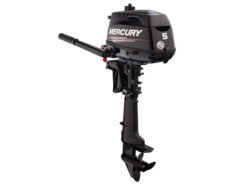
Standard petrol (5MH, 5MXLH)
The familiar choice. A Mercury 5 hp outboard on petrol has a small built-in tank of about 1.1 to 1.2 litres, so you can run without a separate fuel tank on short trips. You can connect an external tank for longer runs, though Defender notes the external tank and line aren’t included. Choose the 15-inch 5MH for inflatables and dinghies, or the 25-inch 5MXLH for tall transoms.
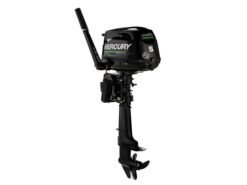
Propane (the LPG models)
These run on a standard 20 lb propane bottle, the kind used for a gas barbecue, or on smaller camping canisters. Mercury lists several advantages: no petrol to carry or spill, no fuel priming before starting thanks to the pressurised system, auto shut-off valves in the engine and hose connector, and lower emissions. Mercury says a 20 lb tank gives roughly six hours at full throttle. Propane also doesn’t go stale the way petrol does, which helps if the engine sits for weeks between uses.
Things to know: propane bottles are bulkier than a small petrol tank, and you’ll need somewhere safe to secure one in the boat. There’s a manual choke for cold starts. Our propane outboard motor guide covers propane engines in much more detail.
Sail Power (the A models)
Sail Power is built for sailboats. According to Mercury, it has a longer shaft, a high-thrust prop and a 12-volt, 4-amp alternator. The high-thrust prop pushes a heavy displacement hull better at low speed than the standard prop, and the alternator keeps a small battery topped up for navigation lights or a VHF. YACHT notes that only the Sail Power version has a generator. Choose the petrol 5MLHA, or the propane 5MLHA-LPG (20-inch) or 5MXLHA-LPG (25-inch).
Which Mercury 5 HP Outboard Fits Your Boat?
Inflatable dinghies and yacht tenders
Short transom, light boat, one to three people. The 15-inch 5MH or 5MH-LPG. Check the dinghy’s maximum horsepower and engine weight. See our outboard motors for dinghies and inflatable boat motors guides.
Sailboats up to around 25 feet
Measure from the bracket or transom to the waterline, and allow for the stern lifting in waves. Most small keelboats need 20 or 25 inches. A Sail Power Mercury 5 hp outboard with the high-thrust prop is the right tool. Our guide to outboards for sailboats explains sizing.
Canoes and square-stern boats
Many square-stern canoes are rated for only a few horsepower. Check first, and consider the 4 HP if the rating is low. Our outboard motors for canoes guide helps.
Small aluminium boats and jon boats
On a 10 to 12-foot aluminium boat, a 5 HP gives a steady displacement speed for fishing. It won’t plane a loaded boat. If you want to plane, look at a 9.9 or more. See our jon boat outboard guide.
Lakes with fuel or emission rules
Some lakes and reservoirs restrict petrol engines or horsepower. A propane Mercury 5 hp outboard may be allowed where petrol isn’t, but rules vary, so always check with the local authority first.
Mercury 5 HP Outboard vs Yamaha, Suzuki, Tohatsu and Honda
Here’s how 5 and 6 HP portables compare on our prices:
| Model | Our price |
|---|---|
| Mercury 5MH (15 in, petrol) | $1,735 |
| Mercury 5MH-LPG (15 in, propane) | $1,695 |
| Tohatsu MFS5DS | $1,600 |
| Tohatsu MFS5DL | $1,630 |
| Tohatsu MFS5DLPGS propane | $1,750 |
| Tohatsu MFS5 Sail Pro propane | $1,950 |
| Honda BF5DHSHNA | $1,573 |
| Honda BF5DHLHNA | $1,687 |
| Yamaha F6SMHA (6 HP) | $1,750 |
| Suzuki DF6AS5 (6 HP) | $1,790 |
One thing worth knowing: YACHT noted that the Mercury F5MLH is almost identical in construction to the Tohatsu MFS5DD. That’s not unusual in small outboards, where brands often share designs. So if you’re choosing between those two, the deciding factors are price, the dealer network near you and the propane or Sail Power option you want.
On our prices, the Honda and Tohatsu 5s are a little cheaper than the petrol Mercury 5 hp outboard. The Mercury propane models are cheaper than Tohatsu’s propane versions. Mercury’s strength is its large dealer network in many countries, which makes parts and servicing easier to find. For more, read our Honda 5 HP buying guide, 5 HP outboard motor guide, small Suzuki outboards and Yamaha portable outboards.

Mercury 4 vs 5 vs 6: Which Size?
Mercury’s 4, 5 and 6 HP portables all use the same 123 cc single-cylinder engine, according to our product specs. So the weight is close, and the difference is mostly power and price.
| Engine | 15 in shaft | 20 in shaft |
|---|---|---|
| Mercury 4 | 4MH $1,535 | 4MLH $1,555 |
| Mercury 5 | 5MH $1,735 | 5MLHA $1,755 |
| Mercury 6 | 6MH $1,930 | 6MLH $1,950 |
- Choose the 4 for small inflatables, canoes and boats rated for 4 HP. It’s about $200 cheaper.
- Choose a Mercury 5 hp outboard if you want propane or Sail Power, which only the 5 offers in our Mercury range.
- Choose the 6 for a bit more push on a heavier tender, if the boat is rated for it.
- Go smaller with the 3.5MH ($1,160) or 2.5MH ($995) for very light boats.
- Go bigger with the Mercury 8MH ($2,560) or our Mercury 9.9 guide if you want to plane a small boat.
Always check the boat’s capacity plate first. It lists the maximum horsepower, people and weight (Discover Boating on capacity plates). Our guide on selecting the correct horsepower explains how to read it.
What to Expect on the Water
In YACHT’s test, the 5 HP Mercury reached 26 km/h when well trimmed and produced a bollard pull of 0.57 kN. YACHT described the engine as very economical with good performance, though it didn’t publish fuel figures.
Treat that speed as a light-boat figure. On a displacement sailboat, a Mercury 5 hp outboard won’t go faster than the hull’s natural speed limit, however much power you add. That’s why the Sail Power version focuses on thrust rather than top speed. On an inflatable with two people and gear, you’ll cruise comfortably, but don’t expect to plane.
Mercury says the propane version runs about six hours at full throttle on a 20 lb tank. At lower throttle settings you’d expect longer, but Mercury doesn’t publish part-throttle figures, so plan around the full-throttle number.
Who Buys a Mercury 5 HP Outboard?
Cruising sailors
For a yacht’s tender, a Mercury 5 hp outboard is light enough to pass down to the dinghy and strong enough to carry two people and shopping into a headwind. Sailors on small keelboats choose the Sail Power versions as auxiliary power for getting in and out of harbour.
Lake and river anglers
On a small aluminium boat or square-stern canoe, a 5 HP gives a steady trolling and cruising speed. Anglers who fish only occasionally often prefer propane, because there’s no stale petrol to cause starting trouble after weeks in the shed.
Campers and caravanners
People who carry a small inflatable on a car roof or in a camper like the propane Mercury 5 hp outboard because it runs from the same gas bottle as the camp stove. That’s one fuel instead of two.
Clubs, schools and rescue boats
Sailing clubs use small outboards on support dinghies and committee boats. Simple manual starting and a forward-mounted gear lever make a Mercury 5 hp outboard easy for different people to use.
How to Read a Mercury 5 Spec Sheet
Different sellers list slightly different numbers for the same engine. Here’s why:
- Weight. YACHT weighed 25 kg (about 55 lb) for the F5MLH. Defender lists 59 lb for the Sail Power, and Mercury says the propane model starts at 59.5 lb. Shaft length, the alternator and the propane system all add a little.
- Tank size. You’ll see 1.1 and 1.2 litres for the built-in tank. That’s rounding, not a different tank.
- Propeller. Defender lists an 8 3/8 x 6 in prop on the Sail Power. YACHT tested with a 7.8 x 8 in prop. Different props suit different boats.
- Charging. Only Sail Power models have the 4-amp alternator.
- Full-throttle rpm. 4,500 to 5,500 rpm is the range to prop for, not a speed promise.
If anything on a Mercury 5 hp outboard listing isn’t clear, ask us before you order.
Choosing the Right Shaft Length
This matters more on a small engine than you might think. On a sailboat, the stern rises and falls in waves, and a short shaft lifts the prop out of the water. That makes the engine race and lose drive just when you need it.
- 15 inches suits most inflatables, small dinghies and low-transom boats.
- 20 inches suits most small aluminium boats and many sailboats with a stern bracket.
- 25 inches suits sailboats with high transoms or brackets, and boats in choppy water.
Measure from the top of the transom or bracket down to the bottom of the hull. On a sailboat, measure with the bracket in its lowered position. Our guides to long shaft vs short shaft and cavitation plate height explain how.
Three Real Set-Ups for a Mercury 5 HP Outboard
These are typical matches, not performance promises. Check your boat’s rating and transom first.
A 3-metre inflatable tender for a cruising yacht
Lifted on and off the yacht’s rail every day, used to ferry two people and shopping ashore. The 15-inch 5MH is the simple choice. The built-in tank means no separate fuel can in the tender for short runs.
A 23-foot sailboat on a bracket
Needs steady thrust into a headwind, a way to charge the battery and a shaft long enough to stay in the water in chop. The propane 5MXLHA-LPG Sail Power on a 25-inch shaft fits, and propane means no petrol stored aboard. If you’d rather stick with petrol, the 20-inch 5MLHA suits lower brackets.
A small lake fishing boat used a few times a month
A 12-foot boat, slow trolling and long gaps between trips. Stale petrol is a common cause of starting trouble on small engines. The propane 5MLH-LPG avoids that, and you can run it from the same propane bottle you use for a camp stove or barbecue.

Fitting and Carrying a Mercury 5 HP Outboard
A Mercury 5 hp outboard clamps onto the transom. Most people fit it themselves.
- Check the transom or bracket is solid and rated for the weight.
- Centre the engine and set the height so the anti-ventilation plate is roughly level with the bottom of the hull.
- Tighten the clamp screws and recheck them after a short run. Use a safety lanyard or chain so you don’t lose the engine overboard.
- Fill the oil if the engine arrives dry, as the manual instructs.
- Add fuel or connect the propane bottle.
- Start in neutral with the kill-switch lanyard attached, and check for a cooling-water stream.
Carrying it: at about 55 to 60 lb, most adults can carry it a short distance. YACHT’s one criticism was that there’s only one carry handle, which makes the engine a little awkward to handle. Close the fuel vent before you lift it, and lay it down only on the side the owner’s manual shows, or oil can run into places it shouldn’t. Our how to install an outboard motor guide has more.
Running a Propane Mercury 5 Safely
Propane is safe when it’s handled properly. Mercury builds in auto shut-off valves in the engine and in the fuel hose connector. A few practical habits on top of that:
- Secure the bottle upright so it can’t roll around the boat.
- Keep it ventilated. Propane is heavier than air and can collect low down in enclosed spaces.
- Disconnect the bottle when you’re finished, and check the connector for damage.
- Follow local rules on carrying gas bottles in boats, which vary by country.
- Don’t modify the fuel system or use unapproved fittings.
For a fuller picture of propane outboards, read our propane outboard motor guide.
Mercury 5 HP Outboard Features Explained
Single-cylinder four-stroke
The Mercury 5 hp outboard uses one cylinder, which keeps the engine light, narrow and simple. Mercury describes a balanced powerhead and a vibration-damping cowl, plus a slim shape that fits narrow transoms. There’s no oil to mix with the fuel, as there would be with an old two-stroke.
Built-in fuel tank
Petrol versions carry about 1.1 to 1.2 litres in a tank under the cowl. For a tender run ashore and back, that’s often all you need, and it means one less thing to carry. For longer trips, connect an external tank.
Front-mounted gear lever
The forward, neutral and reverse lever sits at the front of the engine, above the carry handle, rather than on the side. YACHT singled this out as easy to use, especially when you’re reaching back from a sailboat’s cockpit.
Six trim positions and a 70-degree tilt
You can set the engine angle to suit the boat and load, and tilt it up out of the water when sailing or beaching. Defender lists a 70-degree tilt range.
Pressurised propane system
On the LPG models, the fuel is under pressure in the bottle, so there’s no priming bulb to squeeze before starting. A manual choke helps with cold starts, and auto shut-off valves sit in the engine and in the hose connector, according to Mercury.
Sail Power charging
The Sail Power models add a 12-volt, 4-amp, 50-watt alternator. That’s modest, but enough to keep a small battery topped up for navigation lights, a VHF or a phone charger while you motor.
Using a Mercury 5 HP Outboard on a Sailboat
A small sailboat is where the Sail Power Mercury 5 hp outboard earns its keep. A few things make the difference between an engine that works and one that frustrates you.
Shaft length. When the boat pitches, the transom lifts. A short shaft lets the prop come out of the water and race. Most bracket-mounted engines on small keelboats need 20 or 25 inches.
Thrust, not speed. A displacement sailboat has a natural top speed set by its waterline length. Extra horsepower won’t push it past that. What you want is steady thrust into wind and waves, which is what the Sail Power high-thrust prop is for.
Steering. Many sailors lock the outboard straight and steer with the rudder. Others use the tiller for tight marina turns. The front gear lever helps here because you can reach it from the cockpit.
Charging. If your boat has a small battery for lights or a radio, the Sail Power alternator keeps it topped up while you motor in and out of harbour.
Fuel aboard. Some sailors prefer propane because they already carry it for the galley stove and would rather not store petrol in a locker. Check local rules on gas storage aboard.
Our outboards for sailboats guide covers more on sizing and mounting.
Propane vs Petrol: Which Is Easier to Live With?
Both versions of the Mercury 5 hp outboard make the same power, so the choice comes down to how you use the engine.
Propane makes sense if you:
- use the engine occasionally, since propane doesn’t go stale like petrol
- already carry propane for a barbecue, camp stove or galley
- dislike the smell and mess of petrol in a small boat or car boot
- want lower emissions; Mercury quotes 25% lower exhaust emissions than comparable petrol outboards
Petrol makes sense if you:
- want the built-in tank for short runs with nothing else to carry
- travel where propane bottles are hard to refill or exchange
- want the simplest, most familiar set-up
Running costs depend on local fuel prices, which vary a lot between countries, so we can’t give one answer. Compare what a 20 lb propane refill and the equivalent petrol cost where you live.
Storing a Mercury 5 Between Trips
- Flush it with fresh water after saltwater use.
- Petrol models: run the carburettor dry or drain it as the manual explains if the engine will sit for more than a few weeks.
- Propane models: disconnect the bottle and store it outside, upright and away from heat.
- Store the engine upright on a stand, or lay it on the side the manual specifies.
- Keep it dry and covered.
Break-In and Maintenance
A Mercury 5 hp outboard is simple, but it still needs regular care. Follow the owner’s manual. The main jobs on a Mercury 5 hp outboard:
- Break-in: vary the throttle and avoid long full-throttle runs early on. See our break-in guide.
- Engine oil changes at the intervals Mercury sets.
- Gearcase oil, checked for water. See our lower unit oil guide.
- Spark plug checks and replacement.
- Water pump impeller, especially if you run in sand.
- Fuel: on petrol models, drain the carburettor or run it dry before storage, as the manual describes. Old petrol is the most common reason small outboards won’t start.
Our maintenance checklist, winterizing guide and troubleshooting guide cover the rest.
Saltwater or Freshwater Use
A Mercury 5 hp outboard works in both. In salt water, flush it in a barrel or bucket of fresh water after each trip, rinse the outside and check the anode. Store it upright on a stand, out of the weather. Our saltwater outboard guide has more tips.
What Else to Budget For
- An external fuel tank and line, if you want longer range on petrol models.
- A propane bottle and regulator-compatible hose for LPG models, if not supplied.
- An engine stand for storage.
- A safety lanyard and a lock. Small portables are easy to steal.
- A spare prop and shear hardware.
- A sailboat bracket, if your boat doesn’t have one.
See our hidden costs guide.
New or Used Mercury 5?
Used 5 HP engines are cheap and plentiful, but many have had old fuel left in them and need carburettor work. Ask how it was stored, check that it pumps cooling water, and look at the gear oil. Older two-stroke 5s need oil mixed into the fuel. Our 2-stroke vs 4-stroke guide explains the difference. You can also see our used outboard engines and used Mercury guide. A new Mercury 5 hp outboard comes with a factory warranty and no unknown history.
When a Mercury 5 HP Outboard Isn’t the Right Choice
- You want to plane a small boat. Look at a 9.9 or 15. See our Mercury 15 guide.
- You want the lightest possible engine. The 2.5 or 3.5 HP weigh much less. See our portable outboard motors and lightweight outboard motors guides.
- You want electric start. Our Mercury 5s are all manual start. The Mercury 8EH offers electric start.
- You want silent, zero-emission running. See our electric outboard motors guide.
Common Mistakes When Buying a Mercury 5 HP Outboard
- A short shaft on a sailboat. The prop comes out of the water in waves.
- Ignoring the boat’s rating. Some small inflatables and canoes are rated under 5 HP.
- Buying standard when you need Sail Power. On a sailboat, the high-thrust prop and charging matter.
- Leaving petrol in the engine for months.
- Forgetting a safety lanyard on the engine itself. Small outboards do fall overboard.
Mercury 5 HP Outboard Pros and Cons
What’s good:
- Light, simple single-cylinder four-stroke.
- Propane and Sail Power options.
- Front-mounted gear lever, praised by YACHT.
- Three shaft lengths.
- Built-in fuel tank on petrol models.
- Mercury dealer network in many countries.
What to weigh up:
- Petrol models cost slightly more than Honda and Tohatsu 5s on our prices.
- Only one carry handle.
- No charging on non-Sail Power models.
- Manual start only.
Safety and the Rules That Apply
Even with a small engine like a Mercury 5 hp outboard, boats have limits. The capacity plate or builder’s label shows the maximum horsepower, people and weight (Discover Boating). Many small inflatables and canoes are rated for very little power, so check before you buy.
Attach the kill-switch lanyard to yourself whenever the engine runs. On a tender, falling out with the engine still in gear is a real risk. Wear a lifejacket, especially when climbing between a yacht and its tender. Rules on registration, licences, horsepower limits and propane carriage vary by country and by individual lake, so check local requirements.
Questions to Ask Before Buying Any 5 HP Outboard
- Who will service it near me?
- What warranty applies in my country? See our warranty guide.
- Does it ship with oil, or dry?
- For propane models: what hose and fittings come with it, and can I get bottles locally?
- What import costs apply?
When Your Engine Arrives
- Check the box before you sign, and note any damage on the delivery paperwork.
- Check the model code: shaft length, fuel type and Sail Power.
- Look the engine over for damage.
- Keep the packaging until everything checks out.
- Record the serial number for warranty and servicing.
- Add oil if the manual says the engine ships dry, then read the break-in section.

A Simple Buying Walkthrough
- Read the boat’s rating. If it allows 5 HP, a Mercury 5 hp outboard is an option.
- Measure the transom or bracket. 15, 20 or 25 inches.
- Choose the fuel. Petrol for simplicity and range; propane if you dislike carrying petrol, use the engine occasionally, or boat where cleaner fuel helps.
- Sailboat? Choose Sail Power for the thrust prop and charging.
- Add up extras: tank or bottle, stand, lock, lanyard.
- Order or ask us. Pick from the Mercury 5 HP category, or send us your boat details.
Before You Order: A Quick Checklist
- Maximum horsepower and engine weight for your boat
- Transom or bracket height
- Petrol or propane
- Standard or Sail Power
- Do you need battery charging?
- How far will you carry the engine?
Send us your answers and we’ll help you choose the right Mercury 5 hp outboard.
Buying a Mercury 5 HP Outboard From Us
Every Mercury 5 hp outboard on this page is new and for sale in our store. Our shipping policy says orders normally ship within 1 to 6 business days with free delivery. You’ll get a tracking email when your engine leaves, and you can follow it on our order tracking page. Import duties and taxes depend on your country, so check with your customs office before ordering. Some countries have extra rules for shipping or importing propane equipment, so check those too if you’re buying an LPG model.
Helpful reading:
- Outboard motors worldwide shipping
- Cost of shipping an outboard motor internationally
- Outboard motors with warranty
- How to spot genuine Mercury engines
- Our guide to buying Mercury outboards
Still deciding? Contact us with your boat’s type, length, transom height and rating. You can also browse the Mercury 5 HP range, all Mercury outboard motors or the full shop. Returns are covered by our refund and returns policy.
Mercury 5 HP Outboard FAQ
How much does a Mercury 5 hp outboard cost?
In our store, new prices run from $1,695 for the propane 5MH-LPG to $1,929 for the 25-inch petrol 5MXLH.
How much does a Mercury 5 hp outboard weigh?
About 55 to 60 lb. YACHT measured 25 kg for the F5MLH, Defender lists 59 lb for the Sail Power, and Mercury says the propane model starts at 59.5 lb.
Does the Mercury 5 have a built-in fuel tank?
Petrol models have a built-in tank of about 1.1 to 1.2 litres, and you can add an external tank.
How long does a propane Mercury 5 run on one tank?
Mercury says about six hours at full throttle on a 20 lb propane tank.
What is Sail Power?
A version for sailboats with a longer shaft, a high-thrust prop and a 4-amp alternator for charging, according to Mercury.
Does a Mercury 5 hp outboard have reverse?
Yes. It has forward, neutral and reverse, with the gear lever at the front.
Can it charge a battery?
Only the Sail Power models, which have a 12-volt, 4-amp alternator.
How fast will a Mercury 5 go?
YACHT recorded 26 km/h in its test on a light boat. Speed depends heavily on the boat and load.
Is the propane version as powerful as the petrol one?
Mercury describes it as a true 5 hp.
Who makes the Mercury 5?
YACHT noted it is almost identical in construction to Tohatsu’s MFS5DD. It’s sold and supported as a Mercury.
Can I use it in salt water?
Yes. Flush it with fresh water after each trip.
Do you ship a Mercury 5 hp outboard worldwide?
Yes. We ship worldwide with free delivery, and orders normally ship within 1 to 6 business days.
Is a Mercury 5 hp outboard good for a sailboat?
Yes, for small sailboats. Choose a Sail Power version with a 20 or 25-inch shaft for the high-thrust prop and battery charging.
Is the Mercury 5 hp outboard good for an inflatable?
Yes, if the inflatable is rated for 5 HP. Most need the 15-inch shaft, so the 5MH or 5MH-LPG.
Can I run the propane model on small camping canisters?
Mercury mentions smaller camp canisters for portability, but the six-hour full-throttle figure is for a 20 lb tank. Expect much shorter run times from small canisters.
Sources and References
Posts Widget
- 1

- 2

- 3

- 4


S.H Continental Marine
USA HERALD MAGAZINE INC
Our team is dedicated to providing exceptional customer service.
Email: info@shcontinentalmarine.com
Choose S.H Continental Marine
for your outboard engine needs and enjoy superior quality, exceptional customer service, and unbeatable prices.
